
Verwandte Artikel zu To Craft Democracies: An Essay on Democratic Transitions
Inhaltsangabe
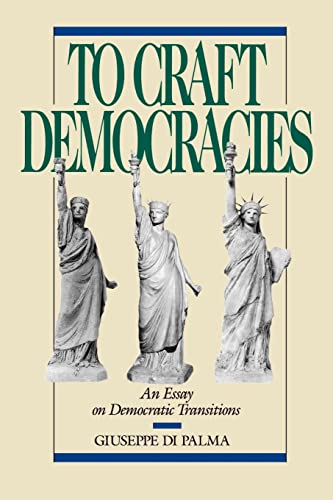
No detailed description available for "To Craft Democracies".
Die Inhaltsangabe kann sich auf eine andere Ausgabe dieses Titels beziehen.
Über die Autorin bzw. den Autor
Giuseppe Di Palma is Professor of Political Science at the University of California, Berkeley, and the author of Surviving Without Governing: The Italian Parties in Parliament (California, 1977) and coeditor of The Central American Impasse (1986).
Von der hinteren Coverseite
"Giuseppe Di Palma's book could not be more timely, given the snowballing events that are gaining momentum in Eastern and Western Europe. . . . It represents a truly fresh look at the red-hot issue of transitions to democracy."—Joseph LaPalombara, Yale University
Aus dem Klappentext
"Giuseppe Di Palma's book could not be more timely, given the snowballing events that are gaining momentum in Eastern and Western Europe. . . . It represents a truly fresh look at the red-hot issue of transitions to democracy." Joseph LaPalombara, Yale University
Auszug. © Genehmigter Nachdruck. Alle Rechte vorbehalten.
To Craft Democracies
An Essay on Democratic TransitionsBy Giuseppe Di PalmaUniversity of California Press
Copyright © 1991 Giuseppe Di PalmaAll right reserved.
ISBN: 9780520072145
Chapter I
Rethinking Some Hard Facts
Far be it from me to advocate a new social science orthodoxy. Yet there is a rekindled public and scholarly interest in the prospects for democracy in countries where democracy does not now exist. That attention and the renewed theoretical optimism among a number of scholars deserve a fair hearing. This essay has been written in defense of that optimism.
On some grounds the optimism may not seem warranted, and the skeptics may have a field day. If optimism were based on democracy's recent record of victories, we should take note that the record is at least mixed. Since the middle of the 1970s a number of surprisingly promising transitions to democracy have occurred. All these transitions were from right-wing authoritarian regimes—as conventionally understood. All were in southern Europe (Greece, Portugal, Spain) or South America (Argentina, Brazil). Reacting to those events, several students of the two areas have eagerly turned their attention to "democratic transitions."1
Yet other transitions—in South America, the Mediterranean,and elsewhere—have been less than promising or inspiring. In South America (Peru, Ecuador, Paraguay, Uruguay, Bolivia), the Mediterranean (Turkey), Central America (El Salvador, Guatemala, Santo Domingo), and Asia (the Philippines, South Korea) the final outcomes of recent democratizing efforts are either uninspiring or difficult to call. Also, expectations that democratization would create regional demonstration effects, carrying along other authoritarian regimes, have so far remained unfulfilled. In South America the Chilean dictatorship has put up a long if apparently losing rearguard action against democratic intrusions. In Central America democracy, reaction, and revolution mix freely and explosively. Prospects look just as unpromising among Marxist or Socialist regimes—despite considerable internal variation (from East European people's democracies to self-styled Marxist regimes in Central America and Africa). Recent momentous developments in Communist Europe promise radical changes, but are we willing to bet on democracy in the short run? Poland and Hungary offer reasons for hope, but regional demonstration effects are still unclear. For all its economic liberalization, China, a continent by itself, seems to be taking steps toward what students of Latin American development call "bureaucratic authoritarianism." And as to Africa as a whole, the prospects we can extrapolate from the postcolonial record seem just as bleak.
Finally, trends toward democratization must be balanced against their counterparts. In Latin America, for example, stable regime types have been rare. Rather, there has been a seesaw between regimes. In general, the 1970s and 1980s have not yet produced that dramatic leap in democratization that followed both world wars. In general, even by the most generous definition of democracy, the proportion of democraciesamong independent nations is no greater today than it was after World War I.2
In sum, the hard facts of trends and numbers do not speak in favor of democracy. And there is another apparent hard fact, closely connected with trends and numbers. The greater the pool of independent nations and the more we move away from the core of long-established Western-style democracies, the more the nations facing democratization fall short of qualities classically associated with Western democracy. Such qualities have been investigated extensively by many influential scholars, mainly in the 1950s and 1960s, and fall into three categories: (1) economic prosperity and equality; (2) a modern and diversified social structure in which nondependent middle classes occupy center stage; and (3) a national culture that, by tolerating diversity and preferring accommodation, is already implicitly democratic. Nations facing democratization without these three characteristics face yet another impediment: democratic transitions are now tending to take place in a climate of mobilization and impatience, if not of outright violence. The benefits of gradualism and accommodation, which have marked the Western experience, would thus be lost.
These are the hard facts weighing on the future of democracy. Indeed, they have led Samuel Huntington to question recent theoretical optimism. He concludes that "with a few exceptions, the limits of democratic development in the world may well have been reached."3 Is the tail of theoretical optimism trying pointlessly to wag the dog of hard facts? Is the optimism largely a fad—another example of the social scientist who obliges tenuous events?
The hard facts (albeit not all of them) miss some points; in fact, they miss the point. Theoretical optimism is not stimulated by the hard facts at all, which, taken by themselves,counsel caution. (There may be further reason for caution: owing to emerging incompatibilities between postindustrial progress and democracy as a system of government, the future of the system itself may be questioned in its geographical core.)4 Rather, theoretical optimism, modest in itself, builds from a different and banal observation. Hard facts do not mean necessity. In political matters, particularly in matters of regime change, causal relations are only probable and outcomes uncertain. We can make broad probabilistic predictions about categories (such as, "Countries possessing quality X are more likely to develop democracy than …"), but we cannot make firm predictions about individual cases. In any single case, unless relevant circumstances cumulate in the extreme, the end result is not inescapable. This is true even if we were to discount the roles of choice and discretion in political events. But this role should not be discounted, especially when it comes to the macropolitical change embodied in regime crises and transitions. Not for nothing does the word crisis derive from the Greek krisis , meaning sorting out, choosing, deciding. From this to my next assertion the step is small.
It is a dismal science of politics (or the science of a dismal politics) that passively entrusts political change to exogenous and distant social transformations.5 Applied to the future of democracy, such a science translates instinctively the structurally improbable (the hard facts) into the politically impossible. A recent carefully drawn propositional inventory of the conditions favoring the development or maintenance of democracy in the Third World lists forty-nine demanding conditions—mostly, in fact, preconditions.6 A similarly lengthy list could have easily been drawn, after World War I, by a panel of European social scientists, Marxist or non-Marxist, to demonstrate the impossibility of a Communist revolution in backward places like czarist Russia. ButLenin, by choosing to act, denied not only the prophecy but also his own social scientific Marxist heritage. And the Russian Revolution demanded new explanations.
Should we not, as students and advocates of democracy, reexamine our tried-and-true theoretical staple, to pare it down, to enrich and diversify it, somewhat? "It ill serves the cause of democracy in the third world," writes Myron Weiner, drawing from the Russian case,
for countries to be told that their growth rates are too low, their political culture inappropriate for democracy to...
„Über diesen Titel“ kann sich auf eine andere Ausgabe dieses Titels beziehen.
Suchergebnisse für To Craft Democracies: An Essay on Democratic Transitions

Beispielbild für diese ISBN
To Craft Democracies: An Essay on Democratic Transitions
Verlag:
University of California Press, 1990
ISBN 10: 0520072146
ISBN 13: 9780520072145
Gebraucht
Paperback
Anbieter: ThriftBooks-Atlanta, AUSTELL, GA, USA
Verkäuferbewertung 5 von 5 Sternen

Paperback. Zustand: Good. No Jacket. Pages can have notes/highlighting. Spine may show signs of wear. ~ ThriftBooks: Read More, Spend Less. Artikel-Nr. G0520072146I3N00
Gebraucht kaufen
EUR 7,41
Versand gratis
Versand innerhalb von USA
Versand innerhalb von USA
Anzahl: 1 verfügbar
Beispielbild für diese ISBN
To Craft Democracies
Anbieter: PBShop.store US, Wood Dale, IL, USA
Verkäuferbewertung 5 von 5 Sternen
PAP. Zustand: New. New Book. Shipped from UK. Established seller since 2000. Artikel-Nr. L2-9780520072145
Neu kaufen
EUR 36,43
Versand gratis
Versand innerhalb von USA
Versand innerhalb von USA
Anzahl: Mehr als 20 verfügbar
Beispielbild für diese ISBN
To Craft Democracies
Anbieter: PBShop.store UK, Fairford, GLOS, Vereinigtes Königreich
Verkäuferbewertung 5 von 5 Sternen
PAP. Zustand: New. New Book. Shipped from UK. Established seller since 2000. Artikel-Nr. L2-9780520072145
Neu kaufen
EUR 32,71
EUR 5,85 Versand
Versand von Vereinigtes Königreich nach USA
Versand von Vereinigtes Königreich nach USA
Anzahl: Mehr als 20 verfügbar
Beispielbild für diese ISBN
To Craft Democracies: An Essay on Democratic Transitions
Verlag:
University of California Press, 1990
ISBN 10: 0520072146
ISBN 13: 9780520072145
Neu
Softcover
Anbieter: Ria Christie Collections, Uxbridge, Vereinigtes Königreich
Verkäuferbewertung 5 von 5 Sternen
Zustand: New. In English. Artikel-Nr. ria9780520072145_new
Neu kaufen
EUR 32,58
EUR 13,17 Versand
Versand von Vereinigtes Königreich nach USA
Versand von Vereinigtes Königreich nach USA
Anzahl: Mehr als 20 verfügbar
Beispielbild für diese ISBN
To Craft Democracies An Essays on Democratic Transitions (Paper)
Verlag:
Univ of California Pr on Demand, 1990
ISBN 10: 0520072146
ISBN 13: 9780520072145
Neu
Paperback
Anbieter: Revaluation Books, Exeter, Vereinigtes Königreich
Verkäuferbewertung 5 von 5 Sternen
Paperback. Zustand: Brand New. reprint edition. 248 pages. 9.00x6.00x0.75 inches. In Stock. Artikel-Nr. x-0520072146
Neu kaufen
EUR 49,47
EUR 11,66 Versand
Versand von Vereinigtes Königreich nach USA
Versand von Vereinigtes Königreich nach USA
Anzahl: 2 verfügbar
Foto des Verkäufers
To Craft Democracies. An Essay on Democratic Transitions
ISBN 10: 0520072146
ISBN 13: 9780520072145
Gebraucht
Original-kartoniert
Anbieter: Der Buchfreund, Wien, Österreich
Verkäuferbewertung 4 von 5 Sternen

Original-kartoniert. Zustand: Sehr gut. gr8 Original-kartoniert en 248 pp. Artikel-Nr. 236311245
Gebraucht kaufen
EUR 10,00
EUR 72,50 Versand
Versand von Österreich nach USA
Versand von Österreich nach USA
Anzahl: 1 verfügbar
Foto des Verkäufers
Dipalma: To Craft Democracies - An Essays on Democratic Tran
Verlag:
University of California Press, 1992
ISBN 10: 0520072146
ISBN 13: 9780520072145
Neu
Softcover
Anbieter: moluna, Greven, Deutschland
Verkäuferbewertung 5 von 5 Sternen
Zustand: New. Is democracy a hot-house plant? By focusing on the objective conditions that make democracy probable, sociological and historical theories of democracy often lose sight of what is possible. This title explores those conciliatory political undertakings that . Artikel-Nr. 594720191
Neu kaufen
EUR 39,29
EUR 48,99 Versand
Versand von Deutschland nach USA
Versand von Deutschland nach USA
Anzahl: Mehr als 20 verfügbar
Foto des Verkäufers
To Craft Democracies : An Essay on Democratic Transitions
Anbieter: AHA-BUCH GmbH, Einbeck, Deutschland
Verkäuferbewertung 5 von 5 Sternen
Taschenbuch. Zustand: Neu. Neuware - To Craft Democracies is an original and imaginative work that, in the light of recent transitions, challenges our assumptions about fledgling democracies and breaks new theoretical ground. Artikel-Nr. 9780520072145
Neu kaufen
EUR 72,36
EUR 30,50 Versand
Versand von Deutschland nach USA
Versand von Deutschland nach USA
Anzahl: 2 verfügbar
Beispielbild für diese ISBN
To Craft Democracies - An Essays on Democratic Transitions (Paper)
Verlag:
University of California Press, 1992
ISBN 10: 0520072146
ISBN 13: 9780520072145
Gebraucht
Softcover
Anbieter: Buchpark, Trebbin, Deutschland
Verkäuferbewertung 5 von 5 Sternen
Zustand: Gut. Zustand: Gut | Sprache: Englisch | Produktart: Bücher | Keine Beschreibung verfügbar. Artikel-Nr. 1400460/3
Gebraucht kaufen
EUR 20,18
EUR 105,00 Versand
Versand von Deutschland nach USA
Versand von Deutschland nach USA
Anzahl: 1 verfügbar