
Verwandte Artikel zu Injury Biomechanics and Control: Optimal Protection...
Inhaltsangabe
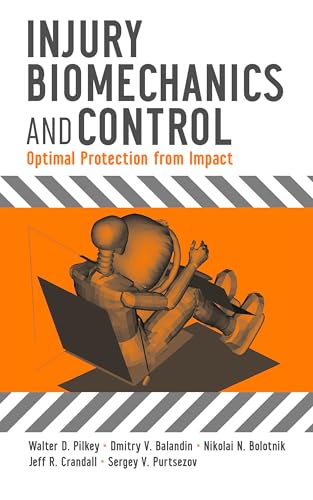
With this book as their guide, readers will discover how to design better protective equipment and devices such as helmets, seat belts, and wheelchairs in order to minimize the risk or the extent of injury to people subjected to impact loads. It is based on the theory of optimal shock isolation, first developed in the 1950s to protect missile systems from intensive shock loads.
Using examples from automotive, aviation, and military areas, the authors demonstrate how optimal shock isolation theory enables designers to improve the performance of protective equipment by incorporating control and optimization methods developed for shock isolation systems.
The first part of Injury Biomechanics and Control lays down the engineering foundation, setting forth core principles and techniques, including:
-
Fundamentals of impact and shock isolation systems
-
Basic optimal shock isolation for single-degree-of-freedom systems
-
Optimal shock isolation for multi-degree-of-freedom systems
The second part applies the principles set forth in the first part to solve real-world problems, using simple mathematical models that simulate the mechanical response of human bodies to impact loads in order to optimize shock isolation systems. This book enables scientists, engineers, and students in mechanical, biomechanical, and biomedical engineering to fully realize the potential of shock isolation methods for the development of protective equipment and devices.
Die Inhaltsangabe kann sich auf eine andere Ausgabe dieses Titels beziehen.
Über die Autorin bzw. den Autor
The late Walter D. Pilkey, PhD, was the Morse Professor of Mechanical and Aerospace Engineering, with courtesy positions in Plastic Surgery and Neurosurgery at the University of Virginia. He received his BA, MS, and PhD from Washington State University, Purdue University, and Penn State University, respectively.
Dmitry V. Balandin, Dsc (Physics And Mathematics), is the Chair of Numerical and Functional Analysis at Nizhny Novgorod State University, Nizhny Novgorod, Russia. His areas of expertise include shock isolation, automatic control, and theoretical mechanics. He received his MS, PhD, and DSc, from Nizhny Novgorod State University, Institute for Problems in Mechanics of the USSR Academy of Sciences, and Moscow State University, respectively.
Nikolai N. Bolotnik, Dsc (Physics And Mathematics), is the head of the Laboratory of Robotics and Mechatronics at the Institute for Problems in Mechanics of the Russian Academy of Sciences, Moscow, Russia. His areas of expertise include optimal control, shock isolation, and robotics. He received his MS, PhD, and DSc degrees from Moscow Institute of Physics and Technology, Institute for Problems in Mechanics of the USSR Academy of Sciences, and Moscow State University, respectively.
Jeff R. Crandall, PhD, received his BA degree from Dartmouth College and his PhD from the University of Virginia, where he is currently a professor in the Department of Mechanical and Aerospace Engineering and Director of the Center for Applied Biomechanics. His research involves characterizing human response and injury during dynamic loading.
Sergey V. Purtsezov, PhD, received his MS and PhD degrees from the Nizhny Novgorod State University, Russia, and is presently a research scientist at the Center for Applied Biomechanics of the University of Virginia. His research interests include shock isolation, measurement, and modeling in biomechanics.
Von der hinteren Coverseite
With this book as their guide, readers will discover how to design better protective equipment and devices such as helmets, seat belts, and wheelchairs in order to minimize the risk or the extent of injury to people subjected to impact loads. It is based on the theory of optimal shock isolation, first developed in the 1950s to protect missile systems from intensive shock loads.
Using examples from automotive, aviation, and military areas, the authors demonstrate how optimal shock isolation theory enables designers to improve the performance of protective equipment by incorporating control and optimization methods developed for shock isolation systems.
The first part of Injury Biomechanics and Control lays down the engineering foundation, setting forth core principles and techniques, including:
-
Fundamentals of impact and shock isolation systems
-
Basic optimal shock isolation for single-degree-of-freedom systems
-
Optimal shock isolation for multi-degree-of-freedom systems
The second part applies the principles set forth in the first part to solve real-world problems, using simple mathematical models that simulate the mechanical response of human bodies to impact loads in order to optimize shock isolation systems. This book enables scientists, engineers, and students in mechanical, biomechanical, and biomedical engineering to fully realize the potential of shock isolation methods for the development of protective equipment and devices.
Aus dem Klappentext
With this book as their guide, readers will discover how to design better protective equipment and devices such as helmets, seat belts, and wheelchairs in order to minimize the risk or the extent of injury to people subjected to impact loads. It is based on the theory of optimal shock isolation, first developed in the 1950s to protect missile systems from intensive shock loads.
Using examples from automotive, aviation, and military areas, the authors demonstrate how optimal shock isolation theory enables designers to improve the performance of protective equipment by incorporating control and optimization methods developed for shock isolation systems.
The first part of Injury Biomechanics and Control lays down the engineering foundation, setting forth core principles and techniques, including:
-
Fundamentals of impact and shock isolation systems
-
Basic optimal shock isolation for single-degree-of-freedom systems
-
Optimal shock isolation for multi-degree-of-freedom systems
The second part applies the principles set forth in the first part to solve real-world problems, using simple mathematical models that simulate the mechanical response of human bodies to impact loads in order to optimize shock isolation systems. This book enables scientists, engineers, and students in mechanical, biomechanical, and biomedical engineering to fully realize the potential of shock isolation methods for the development of protective equipment and devices.
„Über diesen Titel“ kann sich auf eine andere Ausgabe dieses Titels beziehen.
Suchergebnisse für Injury Biomechanics and Control: Optimal Protection...

Beispielbild für diese ISBN
Injury Biomechanics and Control: Optimal Protection from Impact
Anbieter: Phatpocket Limited, Waltham Abbey, HERTS, Vereinigtes Königreich
Verkäuferbewertung 5 von 5 Sternen

Zustand: Good. Your purchase helps support Sri Lankan Children's Charity 'The Rainbow Centre'. Ex-library, so some stamps and wear, but in good overall condition. Our donations to The Rainbow Centre have helped provide an education and a safe haven to hundreds of children who live in appalling conditions. Artikel-Nr. Z1-R-040-02423
Gebraucht kaufen
EUR 95,65
EUR 12,70 Versand
Versand von Vereinigtes Königreich nach USA
Versand von Vereinigtes Königreich nach USA
Anzahl: 1 verfügbar
Beispielbild für diese ISBN
INJURY BIOMECHANICS AND CONTROL: OPTIMAL PROTECTION FROM IMPACT
Anbieter: Majestic Books, Hounslow, Vereinigtes Königreich
Verkäuferbewertung 4 von 5 Sternen

Zustand: New. pp. xvii + 286 Illus. Artikel-Nr. 8304482
Neu kaufen
EUR 109,21
EUR 7,76 Versand
Versand von Vereinigtes Königreich nach USA
Versand von Vereinigtes Königreich nach USA
Anzahl: 4 verfügbar
Beispielbild für diese ISBN
Injury Biomechanics And Control: Optimal Protection From Impact
Anbieter: Romtrade Corp., STERLING HEIGHTS, MI, USA
Verkäuferbewertung 5 von 5 Sternen
Zustand: New. This is a Brand-new US Edition. This Item may be shipped from US or any other country as we have multiple locations worldwide. Artikel-Nr. ABBB-52450
Beispielbild für diese ISBN
Injury Biomechanics and Control
Anbieter: PBShop.store UK, Fairford, GLOS, Vereinigtes Königreich
Verkäuferbewertung 5 von 5 Sternen
HRD. Zustand: New. New Book. Shipped from UK. Established seller since 2000. Artikel-Nr. FW-9780470100158
Neu kaufen
EUR 121,75
EUR 5,99 Versand
Versand von Vereinigtes Königreich nach USA
Versand von Vereinigtes Königreich nach USA
Anzahl: 1 verfügbar
Beispielbild für diese ISBN
Injury Biomechanics and Control: Optimal Protection from Impact
Anbieter: Ria Christie Collections, Uxbridge, Vereinigtes Königreich
Verkäuferbewertung 5 von 5 Sternen
Zustand: New. In English. Artikel-Nr. ria9780470100158_new
Neu kaufen
EUR 147,09
EUR 13,48 Versand
Versand von Vereinigtes Königreich nach USA
Versand von Vereinigtes Königreich nach USA
Anzahl: Mehr als 20 verfügbar
Foto des Verkäufers
Injury Biomechanics and Control: Optimal Protection from Impact
Anbieter: moluna, Greven, Deutschland
Verkäuferbewertung 5 von 5 Sternen
Zustand: New. Coverage of the fundamentals, control, and protection of injuries, incorporating content from biomechanics, mechanics, and control. Applications across a number of markets and industries including sports medicine, military action, and aircraft and automobil. Artikel-Nr. 594693422
Neu kaufen
EUR 137,83
EUR 48,99 Versand
Versand von Deutschland nach USA
Versand von Deutschland nach USA
Anzahl: Mehr als 20 verfügbar
Beispielbild für diese ISBN
Injury Biomechanics and Control
Anbieter: Kennys Bookstore, Olney, MD, USA
Verkäuferbewertung 5 von 5 Sternen
Zustand: New. Coverage of the fundamentals, control, and protection of injuries, incorporating content from biomechanics, mechanics, and control. Applications across a number of markets and industries including sports medicine, military action, and aircraft and automobile design. Num Pages: 304 pages, Illustrations. BIC Classification: MFGV; TBC. Category: (P) Professional & Vocational. Dimension: 241 x 157 x 24. Weight in Grams: 602. . 2009. 1st Edition. Hardcover. . . . . Books ship from the US and Ireland. Artikel-Nr. V9780470100158
Neu kaufen
EUR 197,67
EUR 9,37 Versand
Versand innerhalb von USA
Versand innerhalb von USA
Anzahl: Mehr als 20 verfügbar
Foto des Verkäufers
Injury Biomechanics and Control
Anbieter: AHA-BUCH GmbH, Einbeck, Deutschland
Verkäuferbewertung 5 von 5 Sternen
Buch. Zustand: Neu. Neuware - With this book as their guide, readers will discover how to design better protective equipment and devices such as helmets, seat belts, and wheelchairs in order to minimize the risk or the extent of injury to people subjected to impact loads. It is based on the theory of optimal shock isolation, first developed in the 1950s to protect missile systems from intensive shock loads. Using examples from automotive, aviation, and military areas, the authors demonstrate how optimal shock isolation theory enables designers to improve the performance of protective equipment by incorporating control and optimization methods developed for shock isolation systems. The first part of Injury Biomechanics and Control lays down the engineering foundation, setting forth core principles and techniques, including: - Fundamentals of impact and shock isolation systems - Basic optimal shock isolation for single-degree-of-freedom systems - Optimal shock isolation for multi-degree-of-freedom systems The second part applies the principles set forth in the first part to solve real-world problems, using simple mathematical models that simulate the mechanical response of human bodies to impact loads in order to optimize shock isolation systems. This book enables scientists, engineers, and students in mechanical, biomechanical, and biomedical engineering to fully realize the potential of shock isolation methods for the development of protective equipment and devices. Artikel-Nr. 9780470100158
Neu kaufen
EUR 184,84
EUR 35,00 Versand
Versand von Deutschland nach USA
Versand von Deutschland nach USA
Anzahl: 1 verfügbar