
Verwandte Artikel zu Don't Eat This Book: Fast Food and the Supersizing...
Inhaltsangabe
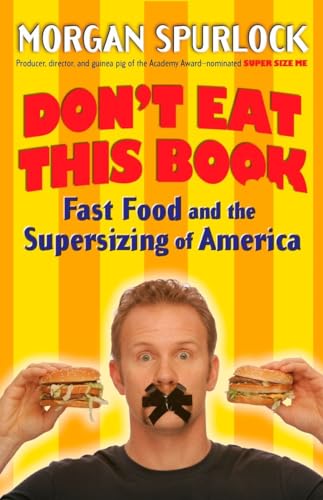
Don’t eat this groundbreaking, hilarious book—but if you care about your country’s health, your children’s, and your own, you better read it.
For thirty days, Morgan Spurlock ate nothing but McDonald’s as part of an investigation into the effects of fast food on American health. The resulting documentary earned him an Academy Award nomination and broke box-office records worldwide.
But there’s more to the story, and in Don’t Eat This Book, Spurlock examines everything from school lunch programs and the marketing of fast food to the decline of physical education. He looks at why fast food is so tasty, cheap, and ultimately seductive—and interviews experts from surgeons general and kids to marketing gurus and lawmakers, who share their research and opinions on what we can do to offset a health crisis of supersized proportions.
Die Inhaltsangabe kann sich auf eine andere Ausgabe dieses Titels beziehen.
Über die Autorin bzw. den Autor
Morgan Spurlock was a writer, director, and producer, and in 2004 he was awarded the Best Director prize at the Sundance Film Festival.
Auszug. © Genehmigter Nachdruck. Alle Rechte vorbehalten.
One
Do You Want Lies with That?
Don't do it. Please. I know this book looks delicious, with its lightweight pages sliced thin as prosciutto and swiss, stacked in a way that would make Dagwood salivate. The scent of freshly baked words wafting up with every turn of the page. Mmmm, page. But don't do it. Not yet. Don't eat this book.
We turn just about everything you can imagine into food. You can eat coins, toys, cigars, cigarettes, rings, necklaces, lips, cars, babies, teeth, cameras, film, even underwear (which come in a variety of scents, sizes, styles and flavors). Why not a book?
In fact, we put so many things in our mouths, we constantly have to be reminded what not to eat. Look at that little package of silicon gel that's inside your new pair of sneakers. It says do not eat for a reason. Somewhere, sometime, some genius bought a pair of sneakers and said, "Ooooh, look. They give you free mints with the shoes!"—soon followed, no doubt, by the lawsuit charging the manufacturer with negligence, something along the lines of, "Well, it didn't say not to eat those things."
And thus was born the "warning label." To avoid getting sued, corporate America now labels everything. Thank the genius who first decided to take a bath and blow-dry her hair at the same time. The Rhodes scholar who first reached down into a running garbage disposal. That one-armed guy down the street who felt around under his power mower while it was running.
Yes, thanks to them, blow-dryers now come with the label do not submerge in water while plugged in. Power mowers warn keep hands and feet away from moving blades. And curling irons bear tags that read for external use only.
And that's why I warn you—please!—do not eat this book. This book is for external use only. Except maybe as food for thought.
We live in a ridiculously litigious society. Opportunists know that a wet floor or a hot cup of coffee can put them on easy street. Like most of you, I find many of these lawsuits pointless and frivolous. No wonder the big corporations and the politicians they own have been pushing so hard for tort reform.
Fifty years ago it was a different story. Fifty years ago, adult human beings were presumed to have enough sense not to stick their fingers in whirring blades of steel. And if they did, that was their own fault.
Take smoking. For most of us, the idea that "smoking kills" is a given. My mom and dad know smoking is bad, but they don't stop. My grandfather smoked all the way up until his death at a grand old age, and my folks are just following in his footsteps—despite the terrifying warning on every pack.
They're not alone, of course. It's estimated that over a billion people in the world are smokers. Worldwide, roughly 5 million people died from smoking in 2000. Smoking kills 440,000 Americans every year. All despite that surgeon general's warning on every single pack.
What is going on here? It's too easy to write off all billion-plus smokers as idiots with a death wish. My parents aren't idiots. I don't think they want to die. (When I was younger, there were times when I wanted to kill them, but that's different.) We all know that tobacco is extremely addictive. And that the tobacco companies used to add chemicals to make cigarettes even more addictive, until they got nailed for it. And that for several generations—again, until they got busted for it—the big tobacco companies aimed their marketing and advertising at kids and young people. Big Tobacco spent billions of dollars to get people hooked as early as they could, and to keep them as "brand-loyal" slaves for the rest of their unnaturally shortened lives. Cigarettes were cool, cigarettes were hip, cigarettes were sexy. Smoking made you look like a cowboy or a movie starlet.
And it worked. When my parents were young, everybody smoked. Doctors smoked. Athletes smoked. Pregnant women smoked. Their kids came out of the womb looking around the delivery room for an ashtray to ash their Lucky Strikes. Everyone smoked.
The change began in 1964, when the first surgeon general's warning about smoking and cancer scared the bejesus out of everybody. In 1971, cigarette ads were banned from TV, and much later they disappeared from billboards. Little by little, smoking was restricted in airplanes and airports, in public and private workplaces, in restaurants and bars. Tobacco sponsorship of sporting events decreased. Tighter controls were placed on selling cigarettes to minors. Everyone didn't quit overnight, but overall rates of smoking began to decrease—from 42 percent of adults in 1965 to 23 percent in 2000, and from 36 percent of high school kids in 1997 to 29 percent in 2001. The number of adults who have never smoked more than doubled from 1965 to 2000.
Big tobacco companies knew it was a war they couldn't win, but they didn't give up without a fight. They threw billions and billions of more dollars into making smoking look cool, hip, sexy—and safe. They targeted new markets, like women, who increased their rate of smoking 400 percent after the surgeon general's report. Yeah, you've come a long way, baby—all the way from the kitchen to the cancer ward. They expanded their markets in the Third World and undeveloped nations, getting hundreds of millions of people hooked; it's estimated that more than four out of five current smokers are in developing countries. As if people without a regular source of drinking water didn't have enough to worry about already. Big Tobacco denied the health risks of smoking, lied about what they were putting into cigarettes and lobbied like hell against every government agency or legislative act aimed at curbing their deadly impact.
Which brings me back to those "frivolous" lawsuits. Back when people were first suing the tobacco companies for giving them cancer, a lot of folks scoffed. (And coughed. But they still scoffed.) Smokers knew the dangers of smoking, everyone said. If they decided to keep smoking for thirty, forty years and then got lung cancer, they couldn't blame the tobacco companies.
Then a funny thing happened. As the lawsuits progressed, it became more and more apparent that smokers did not know all the dangers of smoking. They couldn't know, because Big Tobacco was hiding the truth from them—lying to them about the health risks, and lying about the additives they were putting in cigarettes to make them more addictive. Marketing cigarettes to children, to get them hooked early and keep them puffing away almost literally from the cradle to the early grave, among other nefarious dealings.
In the mid-1990s, shouldering the crushing burden of soaring Medicare costs due to smoking-related illnesses, individual states began to imitate those "ambulance-chasers," bringing their own class-action lawsuits against Big Tobacco. In 1998, without ever explicitly admitting to any wrongdoing, the big tobacco companies agreed to a massive $246 billion settlement, to be paid to forty-fix states and five territories over twenty-five years. (The other four states had already settled in individual cases.)
Two hundred and forty-six billion dollars is a whole lot of frivolous, man.
What these lawsuits drove home was the relationship between personal responsibility and corporate responsibility. Suddenly it was apparent that sticking a cigarette in your mouth was not quite the same thing as sticking those sneaker mints in your mouth. No one spent billions and billions of dollars in marketing, advertising and promotions telling that guy those sneaker mints would make him cool, hip and sexy. Big Tobacco did exactly that to smokers.
Still, a lot of people were skeptical about those lawsuits. Are the big bad corporations with all their big bad money and big bad mind-altering...
„Über diesen Titel“ kann sich auf eine andere Ausgabe dieses Titels beziehen.
Suchergebnisse für Don't Eat This Book: Fast Food and the Supersizing...

Beispielbild für diese ISBN
Don't Eat This Book: Fast Food and the Supersizing of America
Verlag:
Penguin Publishing Group, 2006
ISBN 10: 0425210235
ISBN 13: 9780425210239
Gebraucht
Softcover
Anbieter: World of Books (was SecondSale), Montgomery, IL, USA
Verkäuferbewertung 5 von 5 Sternen

Zustand: Good. Item in good condition. Textbooks may not include supplemental items i.e. CDs, access codes etc. Artikel-Nr. 00090626338
Gebraucht kaufen
EUR 3,72
Versand gratis
Versand innerhalb von USA
Versand innerhalb von USA
Anzahl: 2 verfügbar
Beispielbild für diese ISBN
Don't Eat This Book: Fast Food and the Supersizing of America
Verlag:
Penguin Publishing Group (edition Reprint), 2006
ISBN 10: 0425210235
ISBN 13: 9780425210239
Gebraucht
Paperback
Anbieter: BooksRun, Philadelphia, PA, USA
Verkäuferbewertung 5 von 5 Sternen
Paperback. Zustand: Very Good. Reprint. It's a well-cared-for item that has seen limited use. The item may show minor signs of wear. All the text is legible, with all pages included. It may have slight markings and/or highlighting. Artikel-Nr. 0425210235-11-18
Gebraucht kaufen
EUR 5,44
Versand gratis
Versand innerhalb von USA
Versand innerhalb von USA
Anzahl: 1 verfügbar
Beispielbild für diese ISBN
Don't Eat This Book : Fast Food and the Supersizing of America
Verlag:
Penguin Publishing Group, 2006
ISBN 10: 0425210235
ISBN 13: 9780425210239
Gebraucht
Softcover
Anbieter: Better World Books, Mishawaka, IN, USA
Verkäuferbewertung 5 von 5 Sternen
Zustand: Very Good. Reprint. Pages intact with possible writing/highlighting. Binding strong with minor wear. Dust jackets/supplements may not be included. Stock photo provided. Product includes identifying sticker. Better World Books: Buy Books. Do Good. Artikel-Nr. 15549128-75
Gebraucht kaufen
EUR 6,18
Versand gratis
Versand innerhalb von USA
Versand innerhalb von USA
Anzahl: 1 verfügbar
Beispielbild für diese ISBN
Don't Eat This Book : Fast Food and the Supersizing of America
Verlag:
Penguin Publishing Group, 2006
ISBN 10: 0425210235
ISBN 13: 9780425210239
Gebraucht
Softcover
Anbieter: Better World Books, Mishawaka, IN, USA
Verkäuferbewertung 5 von 5 Sternen
Zustand: Good. Reprint. Pages intact with minimal writing/highlighting. The binding may be loose and creased. Dust jackets/supplements are not included. Stock photo provided. Product includes identifying sticker. Better World Books: Buy Books. Do Good. Artikel-Nr. 6375607-75
Gebraucht kaufen
EUR 6,18
Versand gratis
Versand innerhalb von USA
Versand innerhalb von USA
Anzahl: 1 verfügbar
Beispielbild für diese ISBN
Don't Eat This Book: Fast Food and the Supersizing of America
Anbieter: ThriftBooks-Atlanta, AUSTELL, GA, USA
Verkäuferbewertung 5 von 5 Sternen
Paperback. Zustand: Good. No Jacket. Pages can have notes/highlighting. Spine may show signs of wear. ~ ThriftBooks: Read More, Spend Less. Artikel-Nr. G0425210235I3N00
Gebraucht kaufen
EUR 6,83
Versand gratis
Versand innerhalb von USA
Versand innerhalb von USA
Anzahl: 1 verfügbar
Foto des Verkäufers
Don't Eat This Book: Fast Food and the Supersizing of America
Anbieter: WeBuyBooks, Rossendale, LANCS, Vereinigtes Königreich
Verkäuferbewertung 5 von 5 Sternen
paperback. Zustand: Good. Most items will be dispatched the same or the next working day. A copy that has been read but remains in clean condition. All of the pages are intact and the cover is intact and the spine may show signs of wear. The book may have minor markings which are not specifically mentioned. Artikel-Nr. rev3107413660
Gebraucht kaufen
EUR 10,60
EUR 7,03 Versand
Versand von Vereinigtes Königreich nach USA
Versand von Vereinigtes Königreich nach USA
Anzahl: 1 verfügbar
Beispielbild für diese ISBN
Don't Eat This Book: Fast Food and the Supersizing of America
Anbieter: Robinson Street Books, IOBA, Binghamton, NY, USA
Verkäuferbewertung 4 von 5 Sternen

Paperback. Zustand: Very Good. Prompt Shipment, shipped in Boxes, Tracking PROVIDEDlittle creased else clean very good copy. Artikel-Nr. ware397rm1304
Gebraucht kaufen
EUR 12,40
EUR 8,47 Versand
Versand innerhalb von USA
Versand innerhalb von USA
Anzahl: 1 verfügbar
Foto des Verkäufers
Don't Eat This Book
Anbieter: Hamelyn, Madrid, M, Spanien
Verkäuferbewertung 5 von 5 Sternen
Zustand: Good. : En este libro, Morgan Spurlock, conocido por su documental 'Super Size Me', examina el impacto de la comida rápida en la salud estadounidense. A través de entrevistas con expertos y su propia experiencia comiendo solo McDonald's durante 30 días, Spurlock explora temas como los programas de almuerzo escolar, el marketing de la comida rápida y la disminución de la educación física. Analiza por qué la comida rápida es tan atractiva y qué se puede hacer para combatir la creciente obesidad y problemas de salud relacionados. EAN: 9780425210239 Tipo: Libros Categoría: Salud y Bienestar Título: Don't Eat This Book Autor: Morgan Spurlock Editorial: Berkley Idioma: en Páginas: 320 Formato: tapa blanda. Artikel-Nr. Happ-2026-06-03-674b9210
Gebraucht kaufen
EUR 12,10
EUR 11,99 Versand
Versand von Spanien nach USA
Versand von Spanien nach USA
Anzahl: 1 verfügbar
Beispielbild für diese ISBN
Don't Eat This Book: Fast Food And the Supersizing of America
Anbieter: Book Haven, Wellington, WLG, Neuseeland
Verkäuferbewertung 5 von 5 Sternen
Paperback. Zustand: Very Good. The nauseating truth from the producer, director, and guinea pig of the Academy Award-nominated documentary Super Size Me. Just when you figured it was safe to scarf fries again comes the factpacked and funny new alarm bell from the man whose month-long McDonald's diet became the subject of an Oscar-nominated, box-office-bonanza documentary. Here Morgan Spurlock examines everything from school lunch programs and the marketing of fast food to the decline of physical education. He looks at why fast food is so tasty, cheap, and ultimately seductive-and interviews everyone from surgeons general and kids to marketing gurus and lawmakers, who share their research and opinions on what we can do to offset a health crisis of supersized proportions. 320 pages. Artikel-Nr. 1078176
Gebraucht kaufen
EUR 4,43
EUR 22,29 Versand
Versand von Neuseeland nach USA
Versand von Neuseeland nach USA
Anzahl: 1 verfügbar
Beispielbild für diese ISBN
Don't Eat This Book: Fast Food and the Supersizing of America
Anbieter: Revaluation Books, Exeter, Vereinigtes Königreich
Verkäuferbewertung 5 von 5 Sternen
Paperback. Zustand: Brand New. reprint edition. 320 pages. 9.00x6.25x1.00 inches. In Stock. Artikel-Nr. x-0425210235
Neu kaufen
EUR 18,69
EUR 11,87 Versand
Versand von Vereinigtes Königreich nach USA
Versand von Vereinigtes Königreich nach USA
Anzahl: 2 verfügbar