
Verwandte Artikel zu Live Right 4 Your Type: 4 Blood Types, 4 Program --...
Live Right 4 Your Type: 4 Blood Types, 4 Program -- The Individualized Prescription for Maximizing Health, Metabolism, and Vitality in Every Stage of Your Life (Eat Right 4 Your Type) - Hardcover
Buch 3 von 21: Eat Right 4 Your Type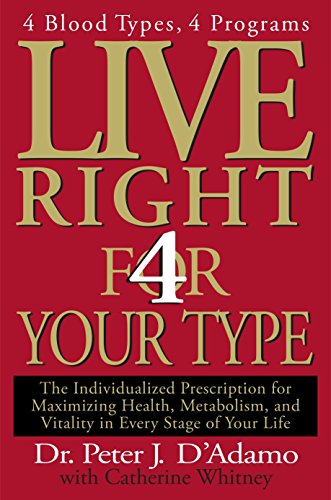
Inhaltsangabe
From the doctor who brought us the blood-type health craze that has swept the nation, here is new research that shows you how to live according to your blood type so that you can achieve total physical and emotional well-being.
Over a million readers have used the individualized blood-type diet solution developed by Dr. Peter J. D'Adamo to achieve their ideal weight. In the five years since the New York Times bestseller Eat Right 4 (for) Your Type was published, new research has indicated that there's a blood-type profile for almost every aspect of our lives, and thanks to that new research, your blood type reveals how you can live a better life. Live Right 4 (for) Your Type is Dr. D'Adamo's ground breaking book that will give you individualized prescriptions according to blood type.
According to your blood type, should you:
• Eat three regular meals a day, or small, frequent ones?
• Have a regimented or flexible routine?
• Go to sleep at the same time every night or have a flexible bedtime?
• Do without rest periods or take them religiously?
• Achieve emotional balance through exercise, meditation, or herbs?
Each blood-type prescription is divided into five life areas. Recommendations, guidelines, and informational charts are provided for the following:
• Lifestyle
• Stress and Emotional Balance
• Maximizing Health
• Overcoming Disease
• Strategies for Aging
Live Right 4 (for) Your Type also has information compiled from new research that greatly expands on the information in Eat Right 4 (for) Your Type, featuring:
• New metabolism-boosting supplement lists to increase the body's efficiency and ability to achieve ideal weight.
• Refined food and supplement lists to increase cardiac efficiency, lower cholesterol, and strengthen your ability to fight colds, flu, and more serious diseases.
• Instructions on how to use vegetables and herbs to improve Natural Killer Cell activity.
• New information on blood type subgroups that influence not only weight, but also physical and mental health.
Die Inhaltsangabe kann sich auf eine andere Ausgabe dieses Titels beziehen.
Über die Autorin bzw. den Autor
Dr. Peter J. D’Adamo is an internationally-acclaimed naturopathic physician, researcher, and lecturer, as well as the author of the New York Times best-selling Eat Right 4 Your Type book series. His extensive research and clinical testing of the connections between blood type, health, and disease has garnered world-wide recognition and led to groundbreaking work on many illnesses. The world-famous immunulogist, Dr. Gerhard Uhlenbruck of the University of Cologne, Germany, has called Dr. D’Adamo “one of the most creative scientists in the Western world.”
Catherine Whitney is the coauthor of numerous bestselling books on health and wellness.
Auszug. © Genehmigter Nachdruck. Alle Rechte vorbehalten.
The Unmistakable You
The Blood Type Gene
What makes me me, and you you? This is the question that is at the heart of the genetic puzzle. It is also central to our exploration of blood types. What is the animating principle that determines the unique set of characteristics you possess, and the different set that belongs to me?The key is genetic heritage. Your genetic heritage is the unbroken story line of your life. Even though you are living in the twenty-first century, you share a common bond with your ancestors. The genetic 'information' that resulted in their particular characteristics has been passed on to you.A helpful analogy is the way a computer manages information. Think of the very process of writing this book. As I sit at my computer, only my creative powers and my typing skills limit me. I am free to move words, sentences, or even whole paragraphs around. This information lies in the dynamic portion of my computer, called the RAM (random access memory). Should a sudden power outage occur, or I neglect to save the material to the hard drive, it would all be lost. However, if I am satisfied with this writing, it will be permanently saved to the hard drive, available for use at a later time.Your genetic heritage is your biologic hard drive. Embedded within it are the recordings of past 'writings' that were saved for later use-along with, in some cases, a few 'disk errors.' These recordings are stored in your DNA (deoxyribonucleic acid). One of the 'saved' pieces of information is your blood type.What determines your blood type? In genetic lingo, the blood type variations are known as alleles. Every person contains alleles-alternate forms of genes. The alleles determine whether you have blue eyes or brown, are tall or short, have black hair or red, and other distinctions. There are three blood type alleles-A, B, and O. That means there are three variations, or alternatives, for your blood type. However, the influence of your blood type is far greater than that of the gene that gives you eye color. Much of that influence has to do with its location and the way it interacts with other genes.
On the Street Where Blood Type Lives
The gene for ABO blood type is located on the q leg of chromosome number 9, around band 34. So the address for your blood type gene is 9q34. It is here that the three basic alleles of the ABO blood system are found, leaving you a Type O, A, B, or AB.1 The mechanics of blood type's influence have to do with the way genes influence other, seemingly unrelated, genes located immediately adjacent or nearby. This mechanism explains why your blood type can have an impact on such a diverse number of bodily systems-from digestive enzymes to neurochemicals.We already know of some intimate relationships between the blood type gene and other genes that impact on our health and well-being. For example, in 1984, researchers reporting in the journal Genetic Epidemiology presented evidence of a family pedigree in which a major gene for breast cancer susceptibility is located near band q34 on chromosome 9.2 There is a clear genetic connection between blood type and breast cancer.Many nutrition experts are baffled when they first hear about the link between blood type and digestion. That's because they are only considering the physical significance of blood type as a surface antigen. Actually, it is not your blood type antigen that is influencing the level of acid in your stomach, but rather the gene for your blood type influencing other seemingly unrelated genes located immediately adjacent (or very close ) to the ABO blood type gene that can exert an effect on your stomach acid levels. This phenomenon, called gene linkage, isn't well understood yet, but it is well known: Many genes influence the actions of other, seemingly unrelated genes.Here's another intriguing link that suggests a relationship between blood type and the brain. The gene for the enzyme dopamine beta hydroxylase (DBH), which converts dopamine to noradrenaline, is located right at 9q34. It's literally sitting on top of the gene for blood type.3 As we will see later, this has vast implications for the association between blood type and stress, mental health, and even personality characteristics.
Your Subtypography
Although there are four blood types-O, A, B, and AB-it would be a ridiculous simplification to suggest that there are only four types of people in the world. The reality is far more intricate and complex. Now, let's take it to another level. Subtyping your blood type, especially your secretor status, provides an even greater specificity of identification. Your blood type doesn't just sit inert in your body. It is expressed in countless ways-and the ways in which it is expressed make a difference. A simple analogy would be a water faucet. Depending on the water pressure, the faucet might pour or dribble. You have access to a lot of water or a little water. In the same way, your secretor status relates to how much and where your blood type antigen is expressed in your body.
Secretor: 9q34's First Cousin
Across town from 9q34, on chromosomes 11 and 19, reside the blood type gene's very important first cousins, the blood type secretor genes. Although your secretor gene is independent of your blood type, it influences the way your blood type is expressed. Everyone carries a blood type antigen on their blood cells, but most people (between 80 and 85 percent of the population) have blood type antigens that float around freely in their body secretions. These people are called secretors, because they 'secrete' their blood type antigens into their body fluids, such as saliva, mucus, and sperm. If you're a secretor, you can learn your blood type from these other body fluids, as well as from your blood. People who do not secrete their blood type antigens in other fluids besides blood are called, reasonably enough, non-secretors.Because secretors have more places to put their blood type antigens, they have more blood type expression in their bodies than non-secretors. Your secretor status can have a great influence on the characteristics of your immune system and is associated with a wide variety of diseases and metabolic conditions.
Determining Your Secretor Status
There is a 'quick and dirty' method of estimating secretor status. This involves looking at an additional minor blood typing system, called the Lewis Blood Grouping System, which is functionally interlocked with secretor genetics, since the same gene codes for both the secretor type and the Lewis System. In the Lewis System, located on chromosome 19, there are two possible antigens that can be produced, called Lewisa and Lewisb. (The a and b antigens of the Lewis System should not be confused with the A and B of the ABO system.) People can type out as one of three varieties: Lewisa+ b-, Lewisa-b+, and Lewisa-b-. (A fourth variation, Lewisa+b+, is extremely rare.) The Lewis System can determine secretor status because it has been noted that people who type out Lewisa+b- are also non-secretors, while those who type out as Lewisa-b+ are also secretors. The connection between secretor status and the Lewis System occurs because secretors convert all of their Lewisa antigen into the Lewisb form (making them Lewisb+), while non-secretors do not (leaving them Lewisa+). The reason I say that this test is quick and dirty is that there are some leftovers that can't be typed this way. People who are Lewisa-b- cannot use this test for determining secretor status. Because they have no ability to produce Lewis substances to start with, they never have +a or +b characteristics on their blood or in their secretions. These individuals can either be secretors or non-secretors of blood type substances, but they will always be non-secretors of Lewis substances. In many instances, Lewis negative individuals have unique interactions with diseases, microbes, or...
„Über diesen Titel“ kann sich auf eine andere Ausgabe dieses Titels beziehen.
Suchergebnisse für Live Right 4 Your Type: 4 Blood Types, 4 Program --...

Beispielbild für diese ISBN
Live Right 4 Your Type: The In
Anbieter: World of Books (was SecondSale), Montgomery, IL, USA
Verkäuferbewertung 5 von 5 Sternen

Zustand: Good. Item in good condition. Textbooks may not include supplemental items i.e. CDs, access codes etc. Artikel-Nr. 00095191124
Gebraucht kaufen
EUR 3,79
Versand gratis
Versand innerhalb von USA
Versand innerhalb von USA
Anzahl: Mehr als 20 verfügbar
Beispielbild für diese ISBN
Live Right 4 Your Type: 4 Bloo
Anbieter: World of Books (was SecondSale), Montgomery, IL, USA
Verkäuferbewertung 5 von 5 Sternen
Zustand: Very Good. Item in very good condition! Textbooks may not include supplemental items i.e. CDs, access codes etc. Artikel-Nr. 00109122281
Gebraucht kaufen
EUR 3,96
Versand gratis
Versand innerhalb von USA
Versand innerhalb von USA
Anzahl: 6 verfügbar
Beispielbild für diese ISBN
Live Right 4 Your Type: 4 Bloo
Anbieter: World of Books (was SecondSale), Montgomery, IL, USA
Verkäuferbewertung 5 von 5 Sternen
Zustand: Acceptable. Item in acceptable condition! Textbooks may not include supplemental items i.e. CDs, access codes etc. Artikel-Nr. 00106632742
Gebraucht kaufen
EUR 3,96
Versand gratis
Versand innerhalb von USA
Versand innerhalb von USA
Anzahl: 7 verfügbar
Beispielbild für diese ISBN
Live Right 4 Your Type: 4 Bloo
Anbieter: World of Books (was SecondSale), Montgomery, IL, USA
Verkäuferbewertung 5 von 5 Sternen
Zustand: Good. Item in good condition. Textbooks may not include supplemental items i.e. CDs, access codes etc. Artikel-Nr. 00095745632
Gebraucht kaufen
EUR 3,96
Versand gratis
Versand innerhalb von USA
Versand innerhalb von USA
Anzahl: Mehr als 20 verfügbar
Beispielbild für diese ISBN
Live Right 4 Your Type: 4 Blood Types, 4 Programs -- The Individualized Prescription for Maximizing Health, Metabolism, and Vitality in Every Stage of Your Life
Verlag:
Berkley (edition First Edition), 2001
ISBN 10: 0399146733
ISBN 13: 9780399146732
Gebraucht
Hardcover
Erstausgabe
Anbieter: BooksRun, Philadelphia, PA, USA
Verkäuferbewertung 5 von 5 Sternen
Hardcover. Zustand: Very Good. First Edition. With dust jacket. It's a well-cared-for item that has seen limited use. The item may show minor signs of wear. All the text is legible, with all pages included. It may have slight markings and/or highlighting. Artikel-Nr. 0399146733-8-1-29
Gebraucht kaufen
EUR 5,58
Versand gratis
Versand innerhalb von USA
Versand innerhalb von USA
Anzahl: 1 verfügbar
Beispielbild für diese ISBN
Live Right 4 Your Type: The Individualized Prescription for Maximizing Health, Metabolism, and Vitality in Every Stage of Your Life
Anbieter: ThriftBooks-Atlanta, AUSTELL, GA, USA
Verkäuferbewertung 5 von 5 Sternen
Hardcover. Zustand: Very Good. No Jacket. Former library book; May have limited writing in cover pages. Pages are unmarked. ~ ThriftBooks: Read More, Spend Less. Artikel-Nr. G0399146733I4N10
Gebraucht kaufen
EUR 5,82
Versand gratis
Versand innerhalb von USA
Versand innerhalb von USA
Anzahl: 1 verfügbar
Beispielbild für diese ISBN
Live Right 4 Your Type: The Individualized Prescription for Maximizing Health, Metabolism, and Vitality in Every Stage of Your Life
Anbieter: ThriftBooks-Phoenix, Phoenix, AZ, USA
Verkäuferbewertung 5 von 5 Sternen
Hardcover. Zustand: Very Good. No Jacket. May have limited writing in cover pages. Pages are unmarked. ~ ThriftBooks: Read More, Spend Less. Artikel-Nr. G0399146733I4N00
Gebraucht kaufen
EUR 5,82
Versand gratis
Versand innerhalb von USA
Versand innerhalb von USA
Anzahl: 2 verfügbar
Beispielbild für diese ISBN
Live Right 4 Your Type: The Individualized Prescription for Maximizing Health, Metabolism, and Vitality in Every Stage of Your Life
Anbieter: ThriftBooks-Atlanta, AUSTELL, GA, USA
Verkäuferbewertung 5 von 5 Sternen
Hardcover. Zustand: Very Good. No Jacket. May have limited writing in cover pages. Pages are unmarked. ~ ThriftBooks: Read More, Spend Less. Artikel-Nr. G0399146733I4N00
Gebraucht kaufen
EUR 5,82
Versand gratis
Versand innerhalb von USA
Versand innerhalb von USA
Anzahl: 2 verfügbar
Beispielbild für diese ISBN
Live Right 4 Your Type: The Individualized Prescription for Maximizing Health, Metabolism, and Vitality in Every Stage of Your Life
Anbieter: ThriftBooks-Reno, Reno, NV, USA
Verkäuferbewertung 5 von 5 Sternen
Hardcover. Zustand: Very Good. No Jacket. Missing dust jacket; May have limited writing in cover pages. Pages are unmarked. ~ ThriftBooks: Read More, Spend Less. Artikel-Nr. G0399146733I4N01
Gebraucht kaufen
EUR 5,82
Versand gratis
Versand innerhalb von USA
Versand innerhalb von USA
Anzahl: 2 verfügbar
Beispielbild für diese ISBN
Live Right 4 Your Type: The Individualized Prescription for Maximizing Health, Metabolism, and Vitality in Every Stage of Your Life
Anbieter: ThriftBooks-Phoenix, Phoenix, AZ, USA
Verkäuferbewertung 5 von 5 Sternen
Hardcover. Zustand: Very Good. No Jacket. Former library book; Missing dust jacket; May have limited writing in cover pages. Pages are unmarked. ~ ThriftBooks: Read More, Spend Less. Artikel-Nr. G0399146733I4N11
Gebraucht kaufen
EUR 5,82
Versand gratis
Versand innerhalb von USA
Versand innerhalb von USA
Anzahl: 1 verfügbar