
Verwandte Artikel zu The Trouble With Computers: Usefulness, Usability,...
Inhaltsangabe
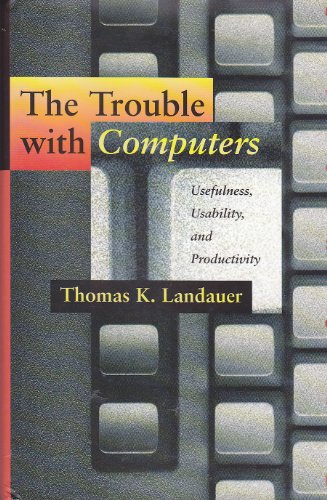
Despite enormous investments in computers over the last twenty years, productivity in the very service industries at which they were aimed virtually stagnated everywhere in the world.
If computers are not making businesses, organizations, or countries more productive, then why are we spending so much time and money on them? Cutting through a raft of technical data, Thomas Landauer explains and illustrates why computers are in trouble and why massive outlays for computing since 1973 have not resulted in comparable productivity payoffs. Citing some of his own successful research programs, as well as many others, Landauer offers solutions to the problems he describes.
While acknowledging that mismanagement, organizational barriers, learning curves, and hardware and software incompatibilities can play a part in the productivity paradox, Landauer targets two aspects of computer design as the main culprits: usefulness and usability. He marshals overwhelming evidence that computers rarely improve the efficiency of the information work they are designed for because they are too hard to use and do too little that is sufficiently useful. Their many features, designed to make them more marketable, merely increase cost and complexity. Landauer proposes that emerging techniques for user-centered development can turn the situation around.
Through task analysis, iterative design, trial use, and evaluation, computer systems can be made into powerful tools for the service economy, with the same enormous impact on productivity and standard of living that were the historical results of technological advances in energy use (the steam engine, electric motors), automation in textiles and other manufacture, and in agriculture. Landauer presents solid evidence for this claim, and for a huge benefit-to-cost ratio for user-centered design activities. He describes how to accomplish these necessary things, promising applications for better computer software designs in business, and the relation of user-centered design to business process reengineering, quality, and management.
Die Inhaltsangabe kann sich auf eine andere Ausgabe dieses Titels beziehen.
Über die Autorin bzw. den Autor
Thomas K. Landauer is Professor of Psychology at the University of Colorado.
„Über diesen Titel“ kann sich auf eine andere Ausgabe dieses Titels beziehen.
Suchergebnisse für The Trouble With Computers: Usefulness, Usability,...

Foto des Verkäufers
The Trouble with Computers
ISBN 10: 0262121867
ISBN 13: 9780262121866
Gebraucht
Hardcover
Erstausgabe
Anbieter: Cameron-Wolfe Booksellers, Taos, NM, USA
Verkäuferbewertung 5 von 5 Sternen

Clothbound Hardcover. Zustand: Fine Minus. First Edition. This book demonstrates why today's [read: ca. 1995!] computers are wrong for society, for business, and for people. (Have the problems been resolved since then?) CONTENTS: Preface; Prologue - The Trouble with Computers; The Productivity Puzzle; The Evidence; What Computers Do; The Porductivity Paradox; Solutions to the Puzzle; Excuses; Reasons; What's Wrong with Them?; Usefulness and Usability; Software Design, Development, and Deployment; Hype and Broken Promises or, Why Do We Love Them Still?; How to Fix Computers; The Track Record So Far; User-Centered Design; Here's How; User-Centered Design Methods, Development, Deployment or, What to Use Them For and How; What Then?; Fantasy Business Systems; Life, Love, and Intellect. 425 pages, illustrated. CONDITION: The book itself is bright, solid, square, and unmarked, with minimal shelf-wear (a couple light corner bumps). Its dustjacket - now in a clear mylar (removable) protective cover - is unmarked, and uncreased, with negligible shelf-wear (just miniscule crinkles at the spine ends). Artikel-Nr. ROL120
Gebraucht kaufen
EUR 4,58
EUR 4,44 Versand
Versand innerhalb von USA
Versand innerhalb von USA
Anzahl: 1 verfügbar
Beispielbild für diese ISBN
The Trouble with Computers: Usefulness, Usability, and Productivity
Anbieter: ThriftBooks-Atlanta, AUSTELL, GA, USA
Verkäuferbewertung 5 von 5 Sternen
Hardcover. Zustand: As New. No Jacket. Pages are clean and are not marred by notes or folds of any kind. ~ ThriftBooks: Read More, Spend Less. Artikel-Nr. G0262121867I2N00
Gebraucht kaufen
EUR 9,32
Versand gratis
Versand innerhalb von USA
Versand innerhalb von USA
Anzahl: 1 verfügbar
Beispielbild für diese ISBN
The Trouble with Computers: Usefulness, Usability, and Productivity
Anbieter: ThriftBooks-Dallas, Dallas, TX, USA
Verkäuferbewertung 5 von 5 Sternen
Hardcover. Zustand: Very Good. No Jacket. May have limited writing in cover pages. Pages are unmarked. ~ ThriftBooks: Read More, Spend Less. Artikel-Nr. G0262121867I4N00
Gebraucht kaufen
EUR 9,32
Versand gratis
Versand innerhalb von USA
Versand innerhalb von USA
Anzahl: 1 verfügbar
Beispielbild für diese ISBN
The Trouble with Computers: Usefulness, Usability, and Productivity
Anbieter: ThriftBooks-Atlanta, AUSTELL, GA, USA
Verkäuferbewertung 5 von 5 Sternen
Hardcover. Zustand: Good. No Jacket. Pages can have notes/highlighting. Spine may show signs of wear. ~ ThriftBooks: Read More, Spend Less. Artikel-Nr. G0262121867I3N00
Gebraucht kaufen
EUR 9,32
Versand gratis
Versand innerhalb von USA
Versand innerhalb von USA
Anzahl: 1 verfügbar
Beispielbild für diese ISBN
The Trouble with Computers: Usefulness, Usability, and Productivity
Anbieter: ThriftBooks-Atlanta, AUSTELL, GA, USA
Verkäuferbewertung 5 von 5 Sternen
Hardcover. Zustand: Very Good. No Jacket. May have limited writing in cover pages. Pages are unmarked. ~ ThriftBooks: Read More, Spend Less. Artikel-Nr. G0262121867I4N00
Gebraucht kaufen
EUR 9,32
Versand gratis
Versand innerhalb von USA
Versand innerhalb von USA
Anzahl: 1 verfügbar
Beispielbild für diese ISBN
The Trouble with Computers : Usefulness, Usability, and Productivity
Anbieter: Better World Books, Mishawaka, IN, USA
Verkäuferbewertung 5 von 5 Sternen
Zustand: Good. Former library copy. Pages intact with minimal writing/highlighting. The binding may be loose and creased. Dust jackets/supplements are not included. Includes library markings. Stock photo provided. Product includes identifying sticker. Better World Books: Buy Books. Do Good. Artikel-Nr. 38880051-6
Gebraucht kaufen
EUR 10,60
Versand gratis
Versand innerhalb von USA
Versand innerhalb von USA
Anzahl: 2 verfügbar
Beispielbild für diese ISBN
The Trouble with Computers: Usefulness, Usability, and Productivity
Verlag:
The MIT Press., Cambridge,MA, 1995
ISBN 10: 0262121867
ISBN 13: 9780262121866
Gebraucht
Hardcover
Anbieter: Doss-Haus Books, Redondo Beach, CA, USA
Verkäuferbewertung 5 von 5 Sternen
Hardcover. Zustand: Fine. Zustand des Schutzumschlags: Fine. Hardcover 1995 edition. Text, dust jacket and boards in fine condition. Binding firm. Pages unmarked and clean. (425 pages) Size: 8vo - over 7¾" - 9¾" tall. Book. Artikel-Nr. 020407
Gebraucht kaufen
EUR 6,87
EUR 5,33 Versand
Versand innerhalb von USA
Versand innerhalb von USA
Anzahl: 1 verfügbar
Foto des Verkäufers
Trouble with Computers - Usefulness, Usability, and Productivity
Anbieter: Blue Mountain Collectibles, LLC, Front Royal, VA, USA
Verkäuferbewertung 4 von 5 Sternen

Hardcover. Zustand: New. Artikel-Nr. BK9986
Neu kaufen
EUR 14,65
EUR 5,78 Versand
Versand innerhalb von USA
Versand innerhalb von USA
Anzahl: 1 verfügbar
Beispielbild für diese ISBN
The Trouble with Computers: Usefulness, Usability and Productivity
Anbieter: AwesomeBooks, Wallingford, Vereinigtes Königreich
Verkäuferbewertung 5 von 5 Sternen
Hardcover. Zustand: Very Good. The Trouble with Computers: Usefulness, Usability and Productivity This book is in very good condition and will be shipped within 24 hours of ordering. The cover may have some limited signs of wear but the pages are clean, intact and the spine remains undamaged. This book has clearly been well maintained and looked after thus far. Money back guarantee if you are not satisfied. See all our books here, order more than 1 book and get discounted shipping. Artikel-Nr. 7719-9780262121866
Gebraucht kaufen
EUR 23,04
EUR 4,86 Versand
Versand von Vereinigtes Königreich nach USA
Versand von Vereinigtes Königreich nach USA
Anzahl: 2 verfügbar
Beispielbild für diese ISBN
The Trouble with Computers: Usefulness, Usability and Productivity
Anbieter: Bahamut Media, Reading, Vereinigtes Königreich
Verkäuferbewertung 4 von 5 Sternen
Hardcover. Zustand: Very Good. This book is in very good condition and will be shipped within 24 hours of ordering. The cover may have some limited signs of wear but the pages are clean, intact and the spine remains undamaged. This book has clearly been well maintained and looked after thus far. Money back guarantee if you are not satisfied. See all our books here, order more than 1 book and get discounted shipping. Artikel-Nr. 6545-9780262121866
Gebraucht kaufen
EUR 21,13
EUR 8,23 Versand
Versand von Vereinigtes Königreich nach USA
Versand von Vereinigtes Königreich nach USA
Anzahl: 2 verfügbar