
Verwandte Artikel zu The Aims of Higher Education: Problems of Morality...
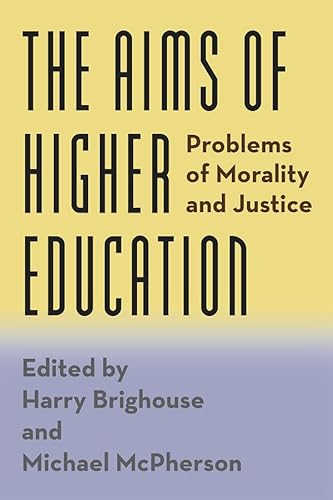
The Aims of Higher Education: Problems of Morality and Justice (Emersion: Emergent Village resources for communities of faith) - Softcover
Inhaltsangabe
In this book, philosopher Harry Brighouse and Spencer Foundation president Michael McPherson bring together leading philosophers to think about some of the most fundamental questions that higher education faces. Looking beyond the din of arguments over how universities should be financed, how they should be run, and what their contributions to the economy are, the contributors to this volume set their sights on higher issues: ones of moral and political value. The result is an accessible clarification of the crucial concepts and goals we so often skip over—even as they underlie our educational policies and practices.
The contributors tackle the biggest questions in higher education: What are the proper aims of the university? What role do the liberal arts play in fulfilling those aims? What is the justification for the humanities? How should we conceive of critical reflection, and how should we teach it to our students? How should professors approach their intellectual relationship with students, both in social interaction and through curriculum? What obligations do elite institutions have to correct for their historical role in racial and social inequality? And, perhaps most important of all: How can the university serve as a model of justice? The result is a refreshingly thoughtful approach to higher education and what it can, and should, be doing.
Die Inhaltsangabe kann sich auf eine andere Ausgabe dieses Titels beziehen.
Über die Autorin bzw. den Autor
Harry Brighouse is professor of philosophy at the University of Wisconsin–Madison. He is the author of several books, including School Choice and Social Justice and On Education, and is, most recently, coauthor of Family Values: The Ethics of Parent-Child Relationships. Michael McPherson is president of the Spencer Foundation and was previously the president of Macalester College in St. Paul. Prior to that he was professor of economics, chairman of the Economics Department, and dean of faculty at Williams College. He is coauthor or editor of several books, including Economic Analysis, Moral Philosophy, and Public Policy and cofounder of the journal Economics and Philosophy.
Auszug. © Genehmigter Nachdruck. Alle Rechte vorbehalten.
The Aims of Higher Education
Problems of Morality and Justice
By Harry Brighouse, Michael McPhersonThe University of Chicago Press
Copyright © 2015 The University of Chicago
All rights reserved.
ISBN: 978-0-226-25948-2All rights reserved.
Contents
ONE / Introduction: Problems of Morality and Justice in Higher Education HARRY BRIGHOUSE AND MICHAEL MCPHERSON,
TWO / What Makes a University Education Worthwhile? AMY GUTMANN,
THREE / Defending the Humanities in a Liberal Society CHRISTOPHER BERTRAM,
FOUR / Academic Friendship PAUL WEITHMAN,
FIVE / Autonomy as Intellectual Virtue KYLA EBELS-DUGGAN,
SIX / Education and Social Moral Epistemology ALLEN BUCHANAN,
SEVEN / Righting Historical Injustice in Higher Education LIONEL K. MCPHERSON,
EIGHT / Modeling Justice in Higher Education ERIN I. KELLY,
NINE / Conclusion: Future Research on Values in Higher Education HARRY BRIGHOUSE AND MICHAEL MCPHERSON,
Acknowledgments,
Contributors,
Index,
CHAPTER 1
Introduction:
Problems of Morality and Justice in Higher Education
Harry Brighouse and Michael McPherson
About 60 percent of Americans have higher education, and some 40 percent graduate with some sort of post–high school degree. Graduating from college has a significant effect on one's lifetime earnings, on the kind of work one is able to perform, and on one's health and longevity. It is a prerequisite for many lucrative careers, and graduating from a more selective college often gives someone an advantage over a competitor from a less selective one in professional labor markets. In other words, access to higher education is an important factor in the competition for the benefits our society distributes unequally. But higher education is also a factor in creating those benefits. Education makes people more productive economically and more capable socially, and it enables them to use their leisure time in more fulfilling ways.
College is not just good for the income and life prospects of graduates. They also get to enjoy the experience of being in college itself—a time that is widely regarded as one of self- exploration in which they can learn more about their own talents and inclinations and how these fit into the wider world. Furthermore, students can accumulate knowledge and understanding of the world and develop their talents. In other words, they learn. This is why, in addition to advantaging graduates in labor-market competition, higher education also makes them more productive: it contributes to the creation of the pool of unequally distributed benefits that graduates are better placed to win.
Most students do not attend highly selective colleges: they go to colleges for which the only qualification is a high school diploma or a GED. But highly selective colleges play a crucial role in the formation of elites in our society. They educate the young people who will later form large proportions of lawmakers, businessmen and businesswomen, education and public sector leaders, and judges at the state, national, and even international levels, as well as most other high-status professionals.
So it is natural that highly selective higher education should be the focus of a great deal of public policy and scholarly debate. What role should the liberal arts have in a college education? Should colleges orient themselves to the educational demands of the business sector? What is the role of highly selective colleges in the public sphere? To what extent should they be subsidized, either directly or indirectly, by the public? Should they simply teach students skills and academic knowledge, or should they play a role in shaping character, and if so, to what end? Should highly selective colleges' admissions practices give an edge to racial minorities, legacies, or poor students? How much should the public purse subsidize disadvantaged students attending such institutions?
These debates are fundamentally about values, and we believe that moral and political philosophers can contribute in useful ways. Deciding exactly which policies and practices we should adopt demands careful attention to the empirical evidence supplied by social science. It also requires thinking about what we ought to value—about questions of distributive justice and of what constitutes a valuable education. Philosophers are trained to identify value considerations in great detail—to specify them with just a little more precision than would ever be needed for practical purposes. In our experiences, disagreements about policy and practice often proceed with minimal attention to the values assumed on either side. However, all sides can benefit from more clarity about which moral values are in play.
We can crudely divide the moral issues concerning higher education into three overlapping categories. The first concerns what students should learn. Should college prepare students to be maximally productive, economically speaking? Should it focus on developing citizens with powerful deliberative capacities and the inclination to use them for the public good? Should it challenge the opinions and religious and cultural assumptions students bring with them? Should it shape students' views about what is valuable in life and valuable to learn? Or should it respond to their preferences and allow them to shape their own values? Should it do all or just some of these things? Should different colleges aim at different balances?
The second category concerns who should attend college. Should college be just for the few elite who will occupy privileged positions in our society? Should college be a prerequisite for all professions? Should parental income and wealth influence who goes to which college, and whether somebody goes at all? Should everybody, or nearly everybody, go to college, just as everybody goes to high school? Should colleges attend to diversity considerations in regulating access? Should we have some institutions that are much more selective than others?
The third category concerns the relationship between universities and the wider world. Should universities pursue commercially sponsored research? Who should own the knowledge that the universities produce? Should universities enjoy the benefits of tax-exempt status? Should they be involved in running public services, such as hospitals and schools? When and how should interested parties outside universities have a say in what is taught, and in what ways?
We charged the authors of the chapters in this volume with addressing some of these fundamental questions about the values underlying debates about higher education and asked them to do so in ways that would be interesting and accessible to other philosophers, scholars, policy makers, administrators, students, and members of the general public who are engaged in the debates. We invited contributors who we were confident had an informed interest in the selective and very selective colleges segment of higher education and who had a record of producing distinguished philosophical work. All have been students and teachers, and several either have been or currently are leaders and administrators. We did not assign a question to each contributor, but instead gave them free rein to address the questions that most interested them. Their contributions mostly engage with questions that clearly arise in the segment of higher education they inhabit. We did not ask the authors to attempt to work out the extent or ways in which their conclusions might apply to other segments of higher...
„Über diesen Titel“ kann sich auf eine andere Ausgabe dieses Titels beziehen.
Suchergebnisse für The Aims of Higher Education: Problems of Morality...

Beispielbild für diese ISBN
The Aims of Higher Education
Anbieter: PBShop.store US, Wood Dale, IL, USA
Verkäuferbewertung 5 von 5 Sternen

PAP. Zustand: New. New Book. Shipped from UK. Established seller since 2000. Artikel-Nr. FW-9780226259482
Beispielbild für diese ISBN
The Aims of Higher Education
Anbieter: PBShop.store UK, Fairford, GLOS, Vereinigtes Königreich
Verkäuferbewertung 5 von 5 Sternen
PAP. Zustand: New. New Book. Shipped from UK. Established seller since 2000. Artikel-Nr. FW-9780226259482
Neu kaufen
EUR 34,31
EUR 4,97 Versand
Versand von Vereinigtes Königreich nach USA
Versand von Vereinigtes Königreich nach USA
Anzahl: 15 verfügbar
Beispielbild für diese ISBN
The Aims of Higher Education: Problems of Morality and Justice (Emersion: Emergent Village resources for communities of faith)
Verlag:
University of Chicago Press, 2015
ISBN 10: 022625948X
ISBN 13: 9780226259482
Gebraucht
Paperback
Anbieter: WorldofBooks, Goring-By-Sea, WS, Vereinigtes Königreich
Verkäuferbewertung 5 von 5 Sternen
Paperback. Zustand: Very Good. The book has been read, but is in excellent condition. Pages are intact and not marred by notes or highlighting. The spine remains undamaged. Artikel-Nr. GOR011315630
Gebraucht kaufen
EUR 36,61
EUR 6,69 Versand
Versand von Vereinigtes Königreich nach USA
Versand von Vereinigtes Königreich nach USA
Anzahl: 1 verfügbar
Beispielbild für diese ISBN
The Aims of Higher Education
Anbieter: Majestic Books, Hounslow, Vereinigtes Königreich
Verkäuferbewertung 4 von 5 Sternen

Zustand: New. pp. 192. Artikel-Nr. 311924302
Neu kaufen
EUR 37,00
EUR 7,76 Versand
Versand von Vereinigtes Königreich nach USA
Versand von Vereinigtes Königreich nach USA
Anzahl: 3 verfügbar
Beispielbild für diese ISBN
The Aims of Higher Education
Verlag:
The University of Chicago Press, 2015
ISBN 10: 022625948X
ISBN 13: 9780226259482
Neu
Softcover
Anbieter: Kennys Bookstore, Olney, MD, USA
Verkäuferbewertung 5 von 5 Sternen
Zustand: New. Looking beyond the arguments over how universities should be financed, how they should be run, and what their contributions to the economy are, the contributors to this book set their sights on higher issues: ones of moral and political value. What are the proper aims of the university? What role do the liberal arts play in fulfilling those aims? Editor(s): Brighouse, Harry; McPherson, Michael. Num Pages: 192 pages, 2 line drawings. BIC Classification: JNA; JNF; JNM. Category: (G) General (US: Trade). Dimension: 60 x 90 x 10. Weight in Grams: 227. . 2015. Paperback. . . . . Books ship from the US and Ireland. Artikel-Nr. V9780226259482
Neu kaufen
EUR 37,22
EUR 9,36 Versand
Versand innerhalb von USA
Versand innerhalb von USA
Anzahl: Mehr als 20 verfügbar
Beispielbild für diese ISBN
The Aims of Higher Education: Problems of Morality and Justice
Anbieter: Ria Christie Collections, Uxbridge, Vereinigtes Königreich
Verkäuferbewertung 5 von 5 Sternen
Zustand: New. In English. Artikel-Nr. ria9780226259482_new
Neu kaufen
EUR 37,63
EUR 11,19 Versand
Versand von Vereinigtes Königreich nach USA
Versand von Vereinigtes Königreich nach USA
Anzahl: Mehr als 20 verfügbar
Beispielbild für diese ISBN
The Aims of Higher Education Problems of Morality and Justice
Anbieter: Revaluation Books, Exeter, Vereinigtes Königreich
Verkäuferbewertung 5 von 5 Sternen
Paperback. Zustand: Brand New. 192 pages. 8.75x6.00x0.50 inches. In Stock. Artikel-Nr. x-022625948X
Neu kaufen
EUR 46,81
EUR 11,94 Versand
Versand von Vereinigtes Königreich nach USA
Versand von Vereinigtes Königreich nach USA
Anzahl: 2 verfügbar
Foto des Verkäufers
The Aims of Higher Education
Anbieter: moluna, Greven, Deutschland
Verkäuferbewertung 5 von 5 Sternen
Gebunden. Zustand: New. Looking beyond the arguments over how universities should be financed, how they should be run, and what their contributions to the economy are, the contributors to this book set their sights on higher issues: ones of moral and political value. What are the . Artikel-Nr. 37307619
Neu kaufen
EUR 40,95
EUR 48,99 Versand
Versand von Deutschland nach USA
Versand von Deutschland nach USA
Anzahl: Mehr als 20 verfügbar
Foto des Verkäufers
The Aims of Higher Education : Problems of Morality and Justice
Verlag:
University Of Chicago Press Mai 2015, 2015
ISBN 10: 022625948X
ISBN 13: 9780226259482
Neu
Taschenbuch
Anbieter: AHA-BUCH GmbH, Einbeck, Deutschland
Verkäuferbewertung 5 von 5 Sternen
Taschenbuch. Zustand: Neu. Neuware - In this book, philosopher Harry Brighouse and Spencer Foundation president Michael McPherson bring together leading philosophers to think about some of the most fundamental questions that higher education faces. Looking beyond the din of arguments over how universities should be financed, how they should be run, and what their contributions to the economy are, the contributors to this volume set their sights on higher issues: ones of moral and political value. The result is an accessible clarification of the crucial concepts and goals we so often skip over-even as they underlie our educational policies and practices. The contributors tackle the biggest questions in higher education: What are the proper aims of the university What role do the liberal arts play in fulfilling those aims What is the justification for the humanities How should we conceive of critical reflection, and how should we teach it to our students How should professors approach their intellectual relationship with students, both in social interaction and through curriculum What obligations do elite institutions have to correct for their historical role in racial and social inequality And, perhaps most important of all: How can the university serve as a model of justice The result is a refreshingly thoughtful approach to higher education and what it can, and should, be doing. Artikel-Nr. 9780226259482
Neu kaufen
EUR 56,56
EUR 35,00 Versand
Versand von Deutschland nach USA
Versand von Deutschland nach USA
Anzahl: 1 verfügbar