
Verwandte Artikel zu You Are Not a Rock: A Step-by-step Guide to Better...
Inhaltsangabe
Mental health is . . . being yourself.
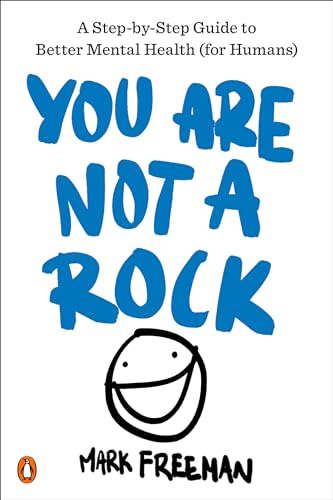
A prescriptive and positive guide, illustrated with line drawings, making the case that mental well-being, like physical health, can be strengthened over time and with specific techniques
We all want to feel less anxiety, guilt, anger and sadness. We want to obsess less and be less lonely, free ourselves from our demons, compulsive habits, and stress. But as humans (unlike rocks) we experience all of these. And paradoxically, trying to avoid and control them only makes things worse.
Having struggled with serious mental illness for many years himself, Mark Freeman has become a dedicated mental-health advocate and coach. He makes the case that instead of trying to feel less and avoid pain and stress, we need to build emotional fitness, especially our capacity for strength, balance and focus. With wit, compassion, and depth of experience and anecdotes, he shows that we can recover from many mental disorders, from mild to very serious, at all ages and stages of life, and even if other methods have failed. Freeman's innovative approach makes use of a range of therapeutic techniques, mindfulness training, peer support, humor, and common sense.
Die Inhaltsangabe kann sich auf eine andere Ausgabe dieses Titels beziehen.
Über die Autorin bzw. den Autor
Mark Freeman is a mental health coach and human-centered design workshop facilitator based in Toronto. After recovering from severe mental illness himself, he now focuses on leveraging technology and design to help others navigate the complex changes necessary to improve and maintain great mental health and fitness. He is the co-founder of the online mental health community Everybody Has a Brain, and he is a Stanford Medicine X ePatient Scholar.
Auszug. © Genehmigter Nachdruck. Alle Rechte vorbehalten.
You Are Not a Rock
A Step-by-Step Guide to Better Mental Health (for Humans)
By Mark FreemanPenguin Publishing Group
Copyright © 2018 Mark Freeman
All rights reserved.
ISBN: 978-0-14-313260-8All rights reserved.
Step 1
Understand that you are not a rock
I want to share a true story with you. It's about some rocks. And it goes like this:
One day, early in the twenty-first century, up on a mountain in the Italian Alps, there were two very large rocks. They sat on the side of a mountain, overlooking a farm on the road between Ronchi and Cortaccia, Strada Provinciale 19 (in case you're planning a road trip).
On that particular day, there were external, contextual factors affecting the rocks, factors over which they had no control. Those contextual factors caused a landslide. And the rocks fell off the mountain.
They tumbled down the slope toward the farm. There was a single-lane country road at the bottom of the slope running alongside the farmhouse and the adjoining barn. One of the rocks landed on the road and stopped directly in front of the entrance to the farmhouse. It was a massive rock. It reached up to the roof of the farmhouse. With some extra momentum, it would have destroyed the house and everything (including everybody) inside.
The other, similarly enormous rock, however, didn't stop at the road. It rolled right across it, into the three-hundred-year-old barn on the other side. The force of the impact destroyed the barn, scattering wall planks and whole sections of the roof across the yard. The rock continued on down into the valley, getting an inefficient head start on the annual wine pressing, coming to rest beside an even larger rock that had fallen off the mountain many years before.
If rocks could feel, how do you think that rock would have felt after it did that? Embarrassed? Guilty? Desperate to blame the landslide? Angry at the other rock for not following through on their plan? Do you think that other rock was obsessing about the carnage it would have caused if it hadn't stopped?
How would you have felt if you were either of those rocks? Have you ever spent an hour thinking about what to write in a text message because you were afraid of saying the wrong thing and ruining a relationship? Have you reread and rewritten work e-mails over and over again, anxious about getting fired or seeming incompetent? Does responsibility make you anxious? Do you spend days obsessing about mistakes in your past? Do you wish you could get rid of those memories? Do you hear people in your head shouting at you for screwing up? Do you spend hours trying to rationalize why you're not to blame for things going wrong in your life?
So here's my point: Those are all very human experiences. Those rocks in that valley in Italy will never have any of those experiences. I said "If rocks could feel." They can't, they're rocks. You are not a rock. You feel things.
Be human
You probably approach physical fitness like a human. If you want to build strength, you lift heavy things that make you feel weak. If you want to increase endurance, you run until you're sweating and aching and ready to stop, and you keep running a little bit farther so that next time it won't be so difficult. If you want to be more flexible, you stretch into stiffness again and again until your flexibility increases. You try to go beyond last week's limits. You fail and fail and call it practice. You do squats and dead lifts until your legs are wobbly and so sore the next day that you can't sit down on the toilet, and you call that a good workout.
This paradoxical practice of doing the difficult thing so that the difficult thing isn't difficult is how humans change. This is a concept most people understand. If you told somebody that you plan to become stronger by avoiding strenuous exercise, even people who don't exercise would know that's ridiculous.
But there are probably many people around you who encourage you to approach mental health in the exact opposite way. They tell you not to do the difficult things. Avoid anxiety, feel less stress, don't think bad thoughts, watch out for triggers, get rid of uncertainty, man up, don't be so emotional, don't feel bad (everything will be okay). This is not how humans develop abilities to handle difficult challenges. Trying to avoid difficult things makes difficult things more difficult.
This is so important to understand as you get started on building better emotional fitness. You can develop your ability to handle emotions by feeling more, especially by feeling more of the feelings that challenge you. By lifting heavy emotions, lifting heavy emotions becomes easier. You can feel a greater range of emotions and you can feel them more deeply.
Poor mental health doesn't fall from the sky. Mental illness is like heart disease-you work your way up to it through a complex mix of environmental, genetic, and educational factors combined with each decision you make at home, at work, at school, and in relationships wherever you might be, every single minute of the day. Turning away from feelings, or trying to control them, cover them up, or chase after them, are the deep-fried pepperoni sticks, triple-decker cheeseburgers, and supersized routines of the mental health world. Sure, you might crave them, and they'll feel good, and you'll never be able to blame a specific junk food for giving you a heart attack, but when they become a regular part of your everyday life, the results are always nasty.
In the first two chapters, I'll cover two concepts that are fundamental to building better mental health and emotional fitness. It's important that we have a shared idea about what exercises for mental health look like and why we do them. So I'll repeat:
You are not a rock. You feel things.
I wanted to be a rock
In the past, I constantly chose to do things inside my head and outside of it not to feel things. I didn't want to feel uncertain, or hated, or alone, or broke, or trapped, or ugly, or hurt, or unhappy, or guilty, or anxious. . . . There were so many feelings I didn't want to feel! I basically wanted to be a rock.
Rocks don't have varying levels of improvable mental health. Rocks don't imagine stabbing other rocks. Rocks don't get jealous or struggle with their sexuality or question the meaning of existence. Rocks don't convince themselves that other rocks are trying to poison them.
When we're trying not to feel things, we're trying to be rocks. So it's not surprising that we sink the moment we're thrown into uncertainty. Rocks sink.
Rocks will always feel less anxiety than you do. They will beat you every single time at feeling less guilt and regret. No rock will ever make as many mistakes as you will. No matter how much you practice meditation, you will always be more easily distracted and less focused than the most mediocre pebble in a muddy ditch. You will never worry as little as a rock worries. You will never be able to suppress your cravings as well as a rock does. No rock will ever relapse as many times as you do. No rock will ever fail as many times as you fail.
As you work through the exercises in this book and you live your life, remember that rock in that vineyard in Italy not thinking or feeling about the antique barn it obliterated. You are not like that rock. You cannot be like that rock. You can spend your entire life trying to be like that rock but you'll only make yourself more miserable and you'll probably destroy much more than a barn.
You cannot build better mental health by trying to avoid being human. If you want to improve your mental health, it won't happen...
„Über diesen Titel“ kann sich auf eine andere Ausgabe dieses Titels beziehen.
Suchergebnisse für You Are Not a Rock: A Step-by-step Guide to Better...

Foto des Verkäufers
You Are Not a Rock: A Step-by-Step Guide to Better Mental Health (for Humans)
Anbieter: Dream Books Co., Denver, CO, USA
Verkäuferbewertung 5 von 5 Sternen

Zustand: acceptable. This copy has clearly been enjoyedâ"expect noticeable shelf wear and some minor creases to the cover. Binding is strong, and all pages are legible. May contain previous library markings or stamps. Artikel-Nr. DBV.0143132601.A
Gebraucht kaufen
EUR 4,32
Versand gratis
Versand innerhalb von USA
Versand innerhalb von USA
Anzahl: 1 verfügbar
Beispielbild für diese ISBN
You Are Not a Rock A StepBySte
Anbieter: World of Books (was SecondSale), Montgomery, IL, USA
Verkäuferbewertung 5 von 5 Sternen
Zustand: Very Good. Item in very good condition! Textbooks may not include supplemental items i.e. CDs, access codes etc. Artikel-Nr. 00108197660
Gebraucht kaufen
EUR 5,97
Versand gratis
Versand innerhalb von USA
Versand innerhalb von USA
Anzahl: 1 verfügbar
Beispielbild für diese ISBN
You Are Not a Rock: A Step-By-Step Guide to Better Mental Health (for Humans)
Anbieter: ThriftBooks-Dallas, Dallas, TX, USA
Verkäuferbewertung 5 von 5 Sternen
Paperback. Zustand: Fair. No Jacket. Readable copy. Pages may have considerable notes/highlighting. ~ ThriftBooks: Read More, Spend Less. Artikel-Nr. G0143132601I5N00
Gebraucht kaufen
EUR 6,30
Versand gratis
Versand innerhalb von USA
Versand innerhalb von USA
Anzahl: 1 verfügbar
Beispielbild für diese ISBN
You Are Not a Rock: A Step-By-Step Guide to Better Mental Health (for Humans)
Anbieter: ThriftBooks-Atlanta, AUSTELL, GA, USA
Verkäuferbewertung 5 von 5 Sternen
Paperback. Zustand: Fair. No Jacket. Former library book; Readable copy. Pages may have considerable notes/highlighting. ~ ThriftBooks: Read More, Spend Less. Artikel-Nr. G0143132601I5N10
Gebraucht kaufen
EUR 6,30
Versand gratis
Versand innerhalb von USA
Versand innerhalb von USA
Anzahl: 1 verfügbar
Beispielbild für diese ISBN
You Are Not a Rock : A Step-By-Step Guide to Better Mental Health (for Humans)
Verlag:
Penguin Publishing Group, 2018
ISBN 10: 0143132601
ISBN 13: 9780143132608
Gebraucht
Softcover
Anbieter: Better World Books: West, Reno, NV, USA
Verkäuferbewertung 5 von 5 Sternen
Zustand: Very Good. Pages intact with possible writing/highlighting. Binding strong with minor wear. Dust jackets/supplements may not be included. Stock photo provided. Product includes identifying sticker. Better World Books: Buy Books. Do Good. Artikel-Nr. 15747130-6
Gebraucht kaufen
EUR 9,70
Versand gratis
Versand innerhalb von USA
Versand innerhalb von USA
Anzahl: 1 verfügbar
Beispielbild für diese ISBN
You Are Not a Rock
Anbieter: PBShop.store US, Wood Dale, IL, USA
Verkäuferbewertung 5 von 5 Sternen
PAP. Zustand: New. New Book. Shipped from UK. Established seller since 2000. Artikel-Nr. WB-9780143132608
Foto des Verkäufers
You Are Not a Rock: A Step-By-Step Guide to Better Mental Health (for Humans)
Anbieter: WeBuyBooks, Rossendale, LANCS, Vereinigtes Königreich
Verkäuferbewertung 5 von 5 Sternen
paperback. Zustand: Good. Most items will be dispatched the same or the next working day. A copy that has been read but remains in clean condition. All of the pages are intact and the cover is intact and the spine may show signs of wear. The book may have minor markings which are not specifically mentioned. A tan to the pages. Artikel-Nr. rev1670527969
Gebraucht kaufen
EUR 11,86
EUR 6,35 Versand
Versand von Vereinigtes Königreich nach USA
Versand von Vereinigtes Königreich nach USA
Anzahl: 1 verfügbar
Beispielbild für diese ISBN
You Are Not a Rock: A Step-By-Step Guide to Better Mental Health (for Humans)
Anbieter: WorldofBooks, Goring-By-Sea, WS, Vereinigtes Königreich
Verkäuferbewertung 5 von 5 Sternen
Paperback. Zustand: Very Good. The book has been read, but is in excellent condition. Pages are intact and not marred by notes or highlighting. The spine remains undamaged. Artikel-Nr. GOR011036359
Gebraucht kaufen
EUR 11,96
EUR 6,54 Versand
Versand von Vereinigtes Königreich nach USA
Versand von Vereinigtes Königreich nach USA
Anzahl: 3 verfügbar
Beispielbild für diese ISBN
You Are Not a Rock
Anbieter: Majestic Books, Hounslow, Vereinigtes Königreich
Verkäuferbewertung 4 von 5 Sternen

Zustand: New. pp. 272. Artikel-Nr. 384638670
Neu kaufen
EUR 19,32
EUR 7,59 Versand
Versand von Vereinigtes Königreich nach USA
Versand von Vereinigtes Königreich nach USA
Anzahl: 3 verfügbar
Beispielbild für diese ISBN
You Are Not a Rock: A Step-by-step Guide to Better Mental Health (for Humans)
Anbieter: Revaluation Books, Exeter, Vereinigtes Königreich
Verkäuferbewertung 5 von 5 Sternen
Paperback. Zustand: Brand New. 272 pages. 8.00x5.50x0.50 inches. In Stock. Artikel-Nr. xr0143132601
Neu kaufen
EUR 17,73
EUR 11,68 Versand
Versand von Vereinigtes Königreich nach USA
Versand von Vereinigtes Königreich nach USA
Anzahl: 2 verfügbar