
Inhaltsangabe
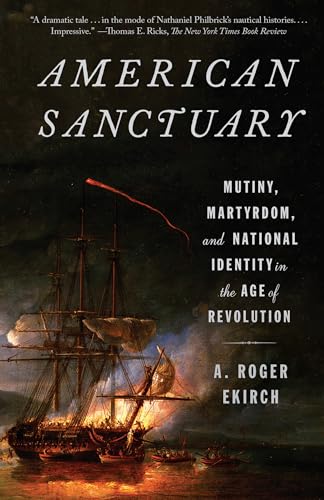
In 1797 the bloodiest mutiny ever suffered by the Royal Navy took place on the British frigate HMS Hermione off the coast of Puerto Rico. Jonathan Robbins, a reputed American sailor who had been impressed into service, made his way to American shores. President John Adams bowed to Britain’s request for his extradition. Convicted of murder and piracy by a court-martial in Jamaica, Robbins was hanged. Adams’s catastrophic miscalculation ignited a political firestorm, only to be fanned by Robbins’s failure to receive his constitutional rights of due process and trial by jury by an American court.
American Sanctuary brilliantly lays out in riveting detail the story of how the Robbins affair, amid the turbulent presidential campaign of 1800, inflamed the new nation and set in motion a constitutional crisis, resulting in Adams’s defeat and Thomas Jefferson’s election as the third president of the United States. Robbins’s martyrdom led directly to the country’s historic decision to grant political asylum to foreign refugees—a major achievement in fulfilling the promise of American independence.
Die Inhaltsangabe kann sich auf eine andere Ausgabe dieses Titels beziehen.
Über die Autorin bzw. den Autor
A. ROGER EKIRCH was born in Washington, DC, and raised in Alexandria, Virginia. He is the author of “Poor Carolina,” Bound for America, Birthright, and At Day’s Close. His writing has appeared in The New York Times, The Wall Street Journal, and The Huffington Post. He holds degrees from Dartmouth College and Johns Hopkins University, and has received a Guggenheim fellowship. He lives in Roanoke, Virginia, and is a professor of history at Virginia Tech.
Auszug. © Genehmigter Nachdruck. Alle Rechte vorbehalten.
CHAPTER 1
Men-of-War
At high tide on a September morning in 1782, not quite a year since Britain’s humiliating capitulation at the Battle of Yorktown, His Majesty’s Ship Hermione, her coppered hull slathered with grease, slid stern-first down a wooden slipway into the swollen waters of the River Avon, fed by the swift currents of the Severn estuary. A launch was no easy feat, nor was it free of peril, but the port of Bristol, England’s “metropolis of the west,” had been building ships since the thirteenth century. Before a rapt crowd lining the stone quay—sailors, shipwrights, and merchant princes—heavy ropes, tethered fast to the bow, were cast off with ceremonial fanfare. Slowly the tide-borne frigate began to slip away from the dry dock of Sydenham Teast, directly across the Avon from the elegant townhouses of Queen Square. With a surplus of warships at royal wharves waiting to be built or repaired, private docks such as Teast’s reaped the rewards of government contracts.
It was a promising start. Fitted out in a naval yard, the Hermione was commissioned for duty the following spring—too late, owing to a halt in hostilities that February, to enter the American War of Independence. Two-decked, three-masted, and square-rigged in the fashion of frigates, she was the first in a new class designed by Sir Edward Hunt, bearing a rounder midsection, much like the profile of a tulip, to lend stability. The clean-lined hull ran 129 feet in length with a beam of nearly 36 feet. Of 714 tons burden, she was notably larger than the slavers that Teast’s shipyard furnished for Bristol’s lucrative African trade, designed instead for a naval company of 220 men. Costs of construction, fittings, sails, rigging, and armament exceeded £16,000. In addition to six carronades, devised with a large caliber for firing at close range, the Hermione received 32 cast-iron cannons, among them 26 twelve-pounders for the main deck. Unlike larger, more powerful men-of-war that boasted two or even three gun decks, with lower ports vulnerable to ocean swells, the main battery of the Hermione, lying well above the waterline, promised greater versatility in heavy weather.
In the annals of classical mythology, Homer tells of the “rose-lipped” Hermione, the only daughter of Menelaus, king of Sparta, and Helen, whose abduction ignited the Trojan War. For many Britons, however, the frigate’s name conjured halcyon memories of wartime riches and national glory. Years back, in May 1762, toward the close of the Seven Years’ War, two British warships cruising off the southern coast of Portugal captured a Spanish treasure galleon named the Hermione just a day’s sail from the port of Cádiz, home to Spanish fleets for nearly two centuries. Striking her colors before firing a single shot, the enemy prize had been en route from Peru with a glittering cargo of gold dust, jewels, and silver estimated at £700,000 to £800,000, the “richest capture” in the history of the Royal Navy. Such was the outpouring of joy in Britain that the name “Hermione” graced newborns and racehorses alike. In August, throngs gathered from Portsmouth to London, anxious to glimpse twenty heavily laden wagons transporting the treasure under military escort to Tower Hill. George III viewed from an upper chamber in St. James’s Palace the convoy’s arrival in the capital, which was followed by a marching band. “The air was rent with the shouts of the populace,” described a newspaper. Less happily, major Spanish banking houses from Barcelona to Málaga collapsed; chaos reigned among Andalusian merchants; and the Hermione’s captain, on returning home, forfeited his head.
###
In the decade that followed the Treaty of Paris of 1783—years that saw a resurgence of transatlantic traffic; the Royal Navy’s startling expansion to keep pace with rival fleets; and the spiraling descent of the French monarchy, corrupted by debt and decay, into revolution—an anxious peace descended on Europe like a bank of dark, low-hanging clouds lit by fitful flashes of sheet lightning. In the course of losing most of its American colonies, England had acquired a host of familiar enemies nursing grudges old and new. More than once, the country teetered on the brink of fresh hostilities, in 1787 with France over rival claimants in the Netherlands, and three years later with Spain in the Pacific Northwest.
As much as ever, the realm’s safety depended upon naval superiority. During the Revolutionary War, control of the English Channel had been surrendered, sparking widespread fears of foreign invasion. Little wonder, with the looming prospect of peace, that the Admiralty, at the urging of England’s fledgling prime minister, William Pitt the Younger, set about rebuilding the fleet with an aggressive program of extensive repairs and new construction. Already the country’s largest industrial infrastructure, naval dockyards stretching from Deptford to Portsmouth resounded with newfound urgency. “The great naval preparations now making militate against every idea of peace,” observed the Reading Mercury in January 1783.
All the while, British warships plied the North Atlantic. With the Channel fleet guarding the homeland, frigates, prized for their speed, firepower, and maneuverability, played a pivotal role in projecting British power overseas—displaying the flag, keeping sea-lanes open, and escorting commercial convoys. First designed by the French in the late seventeenth century, frigates typically cruised the seas either alone, in pairs, or in small squadrons detached from battle fleets. Not uncommonly, they roamed out of signaling range from other vessels. Though smaller than line ships armed with “heavier metal,” they were the most glamorous vessels in the Royal Navy, famed for their aura of adventure as well as for their autonomy and sailing prowess. “Star captains” was how an English poet described the small number of officers fortunate enough to receive a command.
Adding to their allure was the prospect of prize money. Upon the capture of an enemy warship, merchantman, or privateer, everyone from the admiral of the fleet to the cabin boy, according to rank, reaped a portion of the spoils, with captains due a quarter share. In 1790, when war with Spain appeared imminent, a young officer, on hearing rumors of his posting to a frigate, immediately wrote his sister. Acknowledging the larger sums paid to captains of line-of-battle ships, he assured her, “If I can get her into the W’t Indies, I will make the Dons pay me the difference once or twice a month.”
Besides periodic patrols of home waters and routine repairs in royal shipyards, the Hermione spent long spells cruising the Caribbean. When spring yielded to summer, it was not unusual to find her farther north—safe from hurricanes—policing British fishing banks off Newfoundland. Even then, uncertain trade winds, fickle currents, and mercurial weather could render familiar seas hazardous. During a harrowing trip from Halifax, Nova Scotia, to Ireland in 1789, fierce storms, exhausted provisions, and the deaths of ten seamen forced the Hermione’s crew to take refuge in the Spanish port of Corunna. Sixteen bedraggled survivors were left to die in a hospital as the stricken vessel beat on for Ireland.
Only after extensive repairs at a cost in excess of £20,000 did the Hermione return to the West Indies three years later in a squadron of seven...
„Über diesen Titel“ kann sich auf eine andere Ausgabe dieses Titels beziehen.
Weitere beliebte Ausgaben desselben Titels

Suchergebnisse für American Sanctuary: Mutiny, Martyrdom, and National...

Beispielbild für diese ISBN
American Sanctuary: Mutiny, Martyrdom, and National Identity in the Age of Revolution
Anbieter: ThriftBooks-Dallas, Dallas, TX, USA
Verkäuferbewertung 5 von 5 Sternen

Paperback. Zustand: Good. No Jacket. Pages can have notes/highlighting. Spine may show signs of wear. ~ ThriftBooks: Read More, Spend Less. Artikel-Nr. G0525563636I3N00
Gebraucht kaufen
EUR 6,20
Versand gratis
Versand innerhalb von USA
Versand innerhalb von USA
Anzahl: 1 verfügbar
Beispielbild für diese ISBN
American Sanctuary: Mutiny, Martyrdom, and National Identity in the Age of Revolution
Anbieter: ThriftBooks-Atlanta, AUSTELL, GA, USA
Verkäuferbewertung 5 von 5 Sternen
Paperback. Zustand: Good. No Jacket. Pages can have notes/highlighting. Spine may show signs of wear. ~ ThriftBooks: Read More, Spend Less. Artikel-Nr. G0525563636I3N00
Gebraucht kaufen
EUR 6,20
Versand gratis
Versand innerhalb von USA
Versand innerhalb von USA
Anzahl: 1 verfügbar
Beispielbild für diese ISBN
American Sanctuary : Mutiny, Martyrdom, and National Identity in the Age of Revolution
Verlag:
Knopf Doubleday Publishing Group, 2018
ISBN 10: 0525563636
ISBN 13: 9780525563631
Gebraucht
Softcover
Anbieter: Better World Books, Mishawaka, IN, USA
Verkäuferbewertung 5 von 5 Sternen
Zustand: Good. Reprint. Pages intact with minimal writing/highlighting. The binding may be loose and creased. Dust jackets/supplements are not included. Stock photo provided. Product includes identifying sticker. Better World Books: Buy Books. Do Good. Artikel-Nr. 40405828-6
Gebraucht kaufen
EUR 6,54
Versand gratis
Versand innerhalb von USA
Versand innerhalb von USA
Anzahl: 1 verfügbar
Beispielbild für diese ISBN
American Sanctuary: Mutiny, Martyrdom, and National Identity in the Age of Revolution
Anbieter: WorldofBooks, Goring-By-Sea, WS, Vereinigtes Königreich
Verkäuferbewertung 5 von 5 Sternen
Paperback. Zustand: Very Good. The book has been read, but is in excellent condition. Pages are intact and not marred by notes or highlighting. The spine remains undamaged. Artikel-Nr. GOR010355725
Gebraucht kaufen
EUR 3,14
EUR 6,42 Versand
Versand von Vereinigtes Königreich nach USA
Versand von Vereinigtes Königreich nach USA
Anzahl: 2 verfügbar
Beispielbild für diese ISBN
American Sanctuary: Mutiny, Martyrdom, and National Identity in the Age of Revolution
Verlag:
Knopf Doubleday Publishing Group, 2018
ISBN 10: 0525563636
ISBN 13: 9780525563631
Gebraucht
paperback
Anbieter: AwesomeBooks, Wallingford, Vereinigtes Königreich
Verkäuferbewertung 5 von 5 Sternen
paperback. Zustand: Very Good. American Sanctuary: Mutiny, Martyrdom, and National Identity in the Age of Revolution This book is in very good condition and will be shipped within 24 hours of ordering. The cover may have some limited signs of wear but the pages are clean, intact and the spine remains undamaged. This book has clearly been well maintained and looked after thus far. Money back guarantee if you are not satisfied. See all our books here, order more than 1 book and get discounted shipping. . Artikel-Nr. 7719-9780525563631
Gebraucht kaufen
EUR 10,18
EUR 5,72 Versand
Versand von Vereinigtes Königreich nach USA
Versand von Vereinigtes Königreich nach USA
Anzahl: 1 verfügbar
Beispielbild für diese ISBN
American Sanctuary: Mutiny, Martyrdom, and National Identity in the Age of Revolution
Verlag:
Knopf Doubleday Publishing Group -, 2018
ISBN 10: 0525563636
ISBN 13: 9780525563631
Gebraucht
paperback
Anbieter: Bahamut Media, Reading, Vereinigtes Königreich
Verkäuferbewertung 5 von 5 Sternen
paperback. Zustand: Very Good. Shipped within 24 hours from our UK warehouse. Clean, undamaged book with no damage to pages and minimal wear to the cover. Spine still tight, in very good condition. Remember if you are not happy, you are covered by our 100% money back guarantee. Artikel-Nr. 6545-9780525563631
Gebraucht kaufen
EUR 10,18
EUR 8,00 Versand
Versand von Vereinigtes Königreich nach USA
Versand von Vereinigtes Königreich nach USA
Anzahl: 1 verfügbar
Beispielbild für diese ISBN
American Sanctuary
Anbieter: PBShop.store UK, Fairford, GLOS, Vereinigtes Königreich
Verkäuferbewertung 4 von 5 Sternen

PAP. Zustand: New. New Book. Shipped from UK. Established seller since 2000. Artikel-Nr. GO-9780525563631
Neu kaufen
EUR 14,50
EUR 4,77 Versand
Versand von Vereinigtes Königreich nach USA
Versand von Vereinigtes Königreich nach USA
Anzahl: 3 verfügbar
Beispielbild für diese ISBN
American Sanctuary: Mutiny, Martyrdom, and National Identity in the Age of Revolution
Anbieter: Majestic Books, Hounslow, Vereinigtes Königreich
Verkäuferbewertung 4 von 5 Sternen
Zustand: New. Artikel-Nr. 370834635
Neu kaufen
EUR 14,18
EUR 7,45 Versand
Versand von Vereinigtes Königreich nach USA
Versand von Vereinigtes Königreich nach USA
Anzahl: 3 verfügbar
Beispielbild für diese ISBN
American Sanctuary
Anbieter: Kennys Bookstore, Olney, MD, USA
Verkäuferbewertung 5 von 5 Sternen
Zustand: New. 2018. Reprint. Paperback. . . . . . Books ship from the US and Ireland. Artikel-Nr. V9780525563631
Neu kaufen
EUR 22,76
EUR 9,10 Versand
Versand innerhalb von USA
Versand innerhalb von USA
Anzahl: 3 verfügbar
Beispielbild für diese ISBN
American Sanctuary: Mutiny, Martyrdom, and National Identity in the Age of Revolution
Anbieter: Revaluation Books, Exeter, Vereinigtes Königreich
Verkäuferbewertung 5 von 5 Sternen
Paperback. Zustand: Brand New. reprint edition. 320 pages. 8.00x5.25x0.75 inches. In Stock. Artikel-Nr. zk0525563636
Neu kaufen
EUR 26,22
EUR 11,46 Versand
Versand von Vereinigtes Königreich nach USA
Versand von Vereinigtes Königreich nach USA
Anzahl: 1 verfügbar