
Tim brown (4 Ergebnisse)

- Softcover
Anbieter: BooksRun, Philadelphia, PA, USABooksRun
Verkäufer/-in kontaktierenVerkäufer/-in mit 5 SternenZustand: Gebraucht - Gut
EUR 9,37
Versand nach gratisVersand innerhalb von USAAnzahl: 1 verfügbar
Paperback. Zustand: Very Good. It's a well-cared-for item that has seen limited use. The item may show minor signs of wear. All the text is legible, with all pages included. It may have slight markings and/or highlighting.

Verlag: Printed for Dan. Brown, Tim. Goodwin, John Walthoe, M. Newborough, John Nicholson, Benj. Took, D. Midwinter, and Fran. Coggan. 1707 1707
- Erstausgabe
Anbieter: Jarndyce, The 19th Century Booksellers, London, , Vereinigtes KönigreichJarndyce, The 19th Century Booksellers
Verkäufer/-in kontaktierenVerkäufer/-in mit 4 SternenZustand: Gebraucht
EUR 1.115,61
EUR 40,54 VersandVersand von Vereinigtes Königreich nach USAAnzahl: 1 verfügbar
[584]pp, woodcut crests in text. 8vo. Titlepage a little dusty & creased, light mottling to some pages, occasional marks but generally a clean copy. Contemporary unlettered calf, raised bands; rubbed, some wear to head & tail of spine & corners, upper joint a little cracked. Lacing rear e.p., new leading e.p. & pastedown, tear t…o rear pastedown. Ownership name of Jo. Borret, 1714 at head of titlepage. ESTC T96984. First published in 1656, Blount appears to be the first English lexicographer to have exhibited a consciousness of language as a living, growing organism, changing from year to year. In Blount's To the Reader printed in the first edition, he fears that his 'labor would find no end, since our English tongue daily changes habit'. Blount however offers no protest against change, he saw change as inevitable. This conception led the author to appreciate the difficulty in compiling a satisfactory dictionary and to realise the necessity of frequent revision, once the volume was published. He was also the first to acknowledge his sources. See: Starnes, D.T. English Dictionaries of the Seventeenth Century. Studies in English, July 8, 1937.
 Weitere Bilder
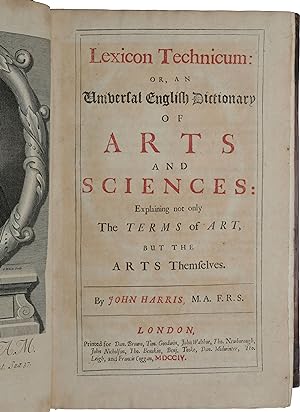
Verlag: Printed for Dan Brown, Tim. Goodwin, John Walthoe, Tho. Newborough, John Nicholson, Tho. Benskin, Benj. Tooke, Dan. Midwinter, Tho. Leigh, and Francis Coggan, London 1704
- Erstausgabe
Anbieter: SOPHIA RARE BOOKS, Koebenhavn V, , DänemarkSOPHIA RARE BOOKS
Verkäufer/-in kontaktierenVerkäufer/-in mit 4 SternenZustand: Gebraucht
EUR 8.899,78
Versand nach gratisVersand von Dänemark nach USAAnzahl: 1 verfügbar
First edition. THE FIRST TECHNICAL DICTIONARY IN ANY LANGUAGE (PMM 171) . First edition of perhaps the most important single source for the history of science and engineering at the end of the scientific revolution. Its emphasis on technology, comparatively poorly covered by seventeenth century books, is particularly valuable pr…imary material, while the author's access to Newton and others has been frequently emphasized. "Harris' most famous work was the Lexicon technicum, the first edition of which appeared in 1704. This was the first general scientific encyclopedia, and for it Harris drew upon some of the greatest authorities of the day. In physics, astronomy, and mathematics he turned to Newton; in botany he consulted John Ray and Joseph Tournefort; in other areas he drew upon Halley, Robert Boyle, Nehemiah Grew, John Woodward, John Wilkins, William Derham, and John Collins" (DSB). "The preface of vol. I mentions Newton many times as a source, and lengthy excepts from his works appear under such headings as comets, fluxions, gravity, heat, moon, motion, telescopes, tides ." (Babson). "John Harris . was the earliest lexicographer to distinguish between a word-book (dictionary, in modern parlance) and a subject-book (encyclopaedia proper), thereby overcoming the confusion which Isidore had introduced a thousand years earlier. His Lexicon technicum appears to be the first technical dictionary in any language. The most famous of his contributors was Isaac Newton" (PMM 171a). "Harris, who was an improvident divine and scientist, gave emphasis to practical and scientific subjects at the expense of the humanities. As a Fellow of the Royal Society (and its acting Vive-President for a time), he had ready access to many of the greatest scholars of the day, and his use of the works of such scientists as Ray and Newton is probably the first example of an encyclopaedia-maker drawing directly on the advice and help of experts and, as such, is the original precursor of the modern system of inviting contributions from specialists . Harris's encyclopaedia was distinguished not only for its excellent plates, but also for its text-line drawings and diagrams, and for its provision of bibliographies of the more important scientific subjects. So far, England had been translating French encyclopaedias for domestic use; within a few years the leading French encyclopaedia was to be based on the English works of Harris and his successors . to Harris must go the honours of compiling the first true English encyclopaedia" (Collison, p. 99 & 103). A second edition of vol. I was published in 1708, two years before the first edition of vol. II, and it is relatively unusual therefore to find the first edition of both volumes together. The subscription list in Vol. II has Newton down for a large paper copy of the Lexicon. Provenance: Armorial bookplate of Robert Raymond, one of the subscribers, on front pastedown of each volume, with motto Aequam Servare Mentem. First volume inscribed 'June 29, 1704' on front free endpaper. "John Harris (1666-1719) was one of the most influential mathematics teachers in London, and one of the first to adopt Newton's natural philosophy. He was elected Fellow of the Royal Society in 1696, and for a short period (1709-10) he was Secretary, but he suffered Hans Sloane's opposition. In 1698 he delivered the Boyle lectures at St Paul's Cathedral. As a teacher, Harris was never connected with an institution: in around 1698 he began to give free public lectures on mathematics at the Marine Coffee-House in Birchin Lane . Harris's most successful work was the Lexicon Technicum, a huge scientific dictionary in two volumes" (Guicciardini, p. 14). "Although Newton's influence on science and on philosophy was primarily produced by the Principia, the men and women of the eighteenth century were aware that the Newtonian philosophy embraced more than the combination of mathematics and empirical evidence which characterized that great work. We may gain some insight into the ways in which Newton influenced science and philosophy by reference to the Lexicon Technicum of John Harris . "Not surprisingly, the primary entry in the Lexicon Technicum under the heading 'NEWTONIAN Philosophy' is 'the doctrine of the universe, and particularly of the heavenly bodies; their laws, affections, etc., as delivered by Isaac Newton.' The dictionary, however, goes on to record some other senses in which at that time the term 'Newtonian philosophy' was used. One further sense was 'the corpuscular philosophy, as it now stands corrected and reformed by the discoveries and improvements made in several parts thereof by Sir I. Newton.' As the Lexicon explains, this aspect of 'Newtonian philosophy' was primarily founded on the third book of Newton's Opticks (the part containing the Queries) and sundry papers such as the 'De natura acidorum,' first published in 1710 in the second volume of Harris's Lexicon. "A third meaning of the term 'Newtonian Philosophy,' according to the Lexicon, was 'the method or order which Sir I. Newton observes in philosophizing.' This 'method' of doing science was said to consist of the 'drawing of conclusions directly from phaenomena, exclusive of all previous hypotheses; the beginning from simple principles; deducing the first powers and laws of nature from a few select phaenomena, and then applying those laws, etc., to account for other things.' "The fourth and fifth meanings of 'Newtonian Philosophy,' as given in the Lexicon, refer rather particularly to the Principia. The third equates the 'Newtonian Philosophy' with the 'Mechanical and Mathematical Philosophy.' In this philosophy, 'Physical bodies are considered mathematically; and . geometry and mechanics are applied to the solution of phaenomena.' The fourth meaning is 'that part of physical knowledge, which Sir I. Newton has handled, improved, and demonstrated in his Principia.' Finally, there is the sixth sense of this term: 'the new principles which Sir I.
 Weitere Bilder
Verlag: printed for Dan. Brown, Tim. Goodwin, John Walthoe, M. Newborough, John Nicholson , Benj. Took, D. Midwinter, and Fran. Coggan, London 1707
- Erstausgabe
Anbieter: Rulon-Miller Books (ABAA / ILAB), St. Paul, MN, USARulon-Miller Books (ABAA / ILAB)
Verkäufer/-in kontaktierenVerkäufer/-in mit 5 SternenZustand: Gebraucht
EUR 1.056,85
EUR 10,37 VersandVersand innerhalb von USAAnzahl: 1 verfügbar
First Edition. First edition, 8vo, pp. [584]; woodcut illustrations in the text, primarily heraldic; leaves B7 and B8 with odd smudge (not obscuring any text); slight worm track to margins of first several leaves; all else very good and sound in recent mottled calf-backed marbled boards, gilt-lettered direct on spine. "The first… English dictionary to make any considerable use of woodcuts; the next development in this respect does not appear until 1727, when Bailey in his Universal Etymological English Dictionary, Volume II, illustrates scientific as well as heraldic terms" (Starnes & Noyes, p. 94). Often passed off as a later edition of Blount because of its similar title and design, this dictionary, while owing a debt to Blount, is in fact a new work by an anonymous author who placed an emphasis on science, which Starnes & Noyes call "the most formative and forward-looking feature" of it. In fact, pages [7-8] are proposals for printing Harris' Lexicon Technicum. Alston V, 89.


