

Gesamtpreis (1 Artikel Artikel):
Versandziel:

basic books okt 1999 (6 Ergebnisse)
Direkt zu den wichtigsten Suchergebnissen
Suchfilter
Produktart
- Alle Product Types
- Bücher (6)
- Magazine & Zeitschriften (Keine weiteren Ergebnisse entsprechen dieser Verfeinerung)
- Comics (Keine weiteren Ergebnisse entsprechen dieser Verfeinerung)
- Noten (Keine weiteren Ergebnisse entsprechen dieser Verfeinerung)
- Kunst, Grafik & Poster (Keine weiteren Ergebnisse entsprechen dieser Verfeinerung)
- Fotografien (Keine weiteren Ergebnisse entsprechen dieser Verfeinerung)
- Karten (Keine weiteren Ergebnisse entsprechen dieser Verfeinerung)
- Manuskripte & Papierantiquitäten (Keine weiteren Ergebnisse entsprechen dieser Verfeinerung)
Zustand Mehr dazu
- Neu (6)
- Wie Neu, Sehr Gut oder Gut Bis Sehr Gut (Keine weiteren Ergebnisse entsprechen dieser Verfeinerung)
- Gut oder Befriedigend (Keine weiteren Ergebnisse entsprechen dieser Verfeinerung)
- Ausreichend oder Schlecht (Keine weiteren Ergebnisse entsprechen dieser Verfeinerung)
- Wie beschrieben (Keine weiteren Ergebnisse entsprechen dieser Verfeinerung)
Einband
- alle Einbände
- Hardcover (Keine weiteren Ergebnisse entsprechen dieser Verfeinerung)
- Softcover (6)
Weitere Eigenschaften
- Erstausgabe (Keine weiteren Ergebnisse entsprechen dieser Verfeinerung)
- Signiert (Keine weiteren Ergebnisse entsprechen dieser Verfeinerung)
- Schutzumschlag (Keine weiteren Ergebnisse entsprechen dieser Verfeinerung)
- Angebotsfoto (6)
Sprache (1)
Preis
- Beliebiger Preis
- Weniger als EUR 20 (Keine weiteren Ergebnisse entsprechen dieser Verfeinerung)
- EUR 20 bis EUR 45
- Mehr als EUR 45
Gratisversand
- Kostenloser Versand nach USA (Keine weiteren Ergebnisse entsprechen dieser Verfeinerung)
Land des Verkäufers
Verkäuferbewertung
-
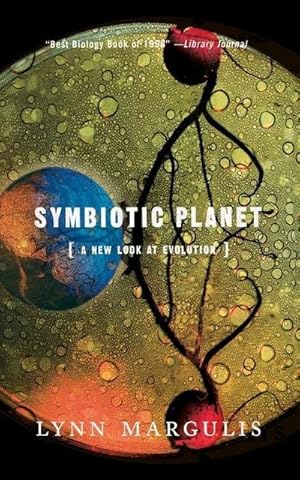
Symbiotic Planet : A New Look at Evolution
Buch 9 von 14: Science MastersAnbieter: AHA-BUCH GmbH, Einbeck, Deutschland
Verkäuferbewertung 5 von 5 Sternen

Taschenbuch. Zustand: Neu. Neuware - Although Charles Darwin's theory of evolution laid the foundations of modern biology, it did not tell the whole story. Most remarkably, The Origin of Species said very little about, of all things, the origins of species. Darwin and his modern successors have shown very convincingly how inherited variations are naturally selected, but they leave unanswered how variant organisms come to be in the first place. In Symbiotic Planet, renowned scientist Lynn Margulis shows that symbiosis, which simply means members of different species living in physical contact with each other, is crucial to the origins of evolutionary novelty. Ranging from bacteria, the smallest kinds of life, to the largest -- the living Earth itself -- Margulis explains the symbiotic origins of many of evolution's most important innovations. The very cells we're made of started as symbiotic unions of different kinds of bacteria. Sex -- and its inevitable corollary, death -- arose when failed attempts at cannibalism resulted in seasonally repeated mergers of some of our tiniest ancestors. Dry land became forested only after symbioses of algae and fungi evolved into plants. Since all living things are bathed by the same waters and atmosphere, all the inhabitants of Earth belong to a symbiotic union. Gaia, the finely tuned largest ecosystem of the Earth's surface, is just symbiosis as seen from space. Along the way, Margulis describes her initiation into the world of science and the early steps in the present revolution in evolutionary biology; the importance of species classification for how we think about the living world; and the way 'academic apartheid' can block scientific advancement. Written with enthusiasm and authority, this is a book that could change the way you view our living Earth.
-

One Renegade Cell : How Cancer Begins
Buch 3 von 14: Science MastersAnbieter: AHA-BUCH GmbH, Einbeck, Deutschland
Verkäuferbewertung 5 von 5 Sternen
Taschenbuch. Zustand: Neu. Neuware - Cancer research has reached a major turning point. The quality and quantity of information gathered about this disease in the past twenty years has revolutionized our understanding of its origins and behavior. No one is better qualified to comment on these dramatic leaps forward than molecular biologist Robert A. Weinberg, director of one of the leading cancer research centers in the world. In One Renegade Cell , Weinberg presents an accessible and state-of-the-art account of how the disease begins and how, one day, it will be cured. Weinberg tells how the roots of cancer were uncovered in 1909 and when the first cancer-causing virus was discovered. He then moves forward to the discovery of the role of chemical carcinogens and radiation in triggering cancer, and relates the remarkable story of the discoveries of oncogenes and tumor suppressor genes, the master controllers of normal and malignant cell proliferation. This book, which presumes little prior knowledge of biology, describes the revolution in biomedical research that has finally uncovered the forces driving malignant growth. Drawing on insights that simply were not available until recently, the discoveries presented in One Renegade Cell have already begun to profoundly alter the way that we diagnose and treat human cancers.
-

Once Upon a Number : The Hidden Mathematical Logic of Stories
Anbieter: AHA-BUCH GmbH, Einbeck, Deutschland
Verkäuferbewertung 5 von 5 Sternen
Taschenbuch. Zustand: Neu. Neuware - Named one of the Best Nonfiction Books of 1998 by the 'Los Angeles Times, ' this book takes a surprising and humorous look at the similarities between narrative and numbers.
-

The Universe, the Eleventh Dimension, and Everything : What We Know and How We Know It
Anbieter: AHA-BUCH GmbH, Einbeck, Deutschland
Verkäuferbewertung 5 von 5 Sternen
Taschenbuch. Zustand: Neu. Neuware - The author of 'Time's Arrows, Cosmic Questions' and 'Achilles in the Quantum Universe' offers a succinct explanation of three fundamental concepts in science: cosmic evolution, the search for the theory of matter, and the origins of life. 10 illustrations.
-

Philosophy in the Flesh
Anbieter: AHA-BUCH GmbH, Einbeck, Deutschland
Verkäuferbewertung 5 von 5 Sternen
Taschenbuch. Zustand: Neu. Neuware - What are human beings like How is knowledge possible What is truth Where do moral values come from Questions like these have stood at the centre of Western philosophy for centuries. In addressing them, philosophers have made certain fundamental assumptions,that we can know our own minds by introspection, that most of our thinking about the world is literal, and that reason is disembodied and universal,that are now called into question by well-established results of cognitive science. It has been shown empirically that:Most thought is unconscious. We have no direct conscious access to the mechanisms of thought and language. Our ideas go by too quickly and at too deep a level for us to observe them in any simple way.Abstract concepts are mostly metaphorical. Much of the subject matter of philosopy, such as the nature of time, morality, causation, the mind, and the self, relies heavily on basic metaphors derived from bodily experience. What is literal in our reasoning about such concepts is minimal and conceptually impoverished. All the richness comes from metaphor. For instance, we have two mutually incompatible metaphors for time, both of which represent it as movement through space: in one it is a flow past us and in the other a spatial dimension we move along.Mind is embodied. Thought requires a body,not in the trivial sense that you need a physical brain to think with, but in the profound sense that the very structure of our thoughts comes from the nature of the body. Nearly all of our unconscious metaphors are based on common bodily experiences.Most of the central themes of the Western philosophical tradition are called into question by these findings. The Cartesian person, with a mind wholly separate from the body, does not exist. The Kantian person, capable of moral action according to the dictates of a universal reason, does not exist. The phenomenological person, capable of knowing his or her mind entirely through introspection alone, does not exist. The utilitarian person, the Chomskian person, the poststructuralist person, the computational person, and the person defined by analytic philosopy all do not exist.Then what does Lakoff and Johnson show that a philosopy responsible to the science of mind offers radically new and detailed understandings of what a person is. After first describing the philosophical stance that must follow from taking cognitive science seriously, they re-examine the basic concepts of the mind, time, causation, morality, and the self: then they rethink a host of philosophical traditions, from the classical Greeks through Kantian morality through modern analytic philosopy. They reveal the metaphorical structure underlying each mode of thought and show how the metaphysics of each theory flows from its metaphors. Finally, they take on two major issues of twentieth-century philosopy: how we conceive rationality, and how we conceive language. Philosopy in the Flesh reveals a radically new understanding of what it means to be human and calls for a thorough rethinking of the Western philosophical tradition. This is philosopy as it has never been seen before.
-

Official Negligence : How Rodney King and the Riots Changed Los Angeles and the LAPD
Anbieter: AHA-BUCH GmbH, Einbeck, Deutschland
Verkäuferbewertung 5 von 5 Sternen
Taschenbuch. Zustand: Neu. Neuware - Renowned journalist Lou Cannon tells the definitive story of the Rodney King beating, the failure of the LAPD and Los Angeles government, and the subsequent horror of the LA riots.
