
Gesamtpreis (1 Artikel Artikel):
Versandziel:

title julio (3 Ergebnisse)
Direkt zu den wichtigsten Suchergebnissen
Suchfilter
Produktart
- Alle Product Types
- Bücher (3)
- Magazine & Zeitschriften (Keine weiteren Ergebnisse entsprechen dieser Verfeinerung)
- Comics (Keine weiteren Ergebnisse entsprechen dieser Verfeinerung)
- Noten (Keine weiteren Ergebnisse entsprechen dieser Verfeinerung)
- Kunst, Grafik & Poster (Keine weiteren Ergebnisse entsprechen dieser Verfeinerung)
- Fotografien (Keine weiteren Ergebnisse entsprechen dieser Verfeinerung)
- Karten (Keine weiteren Ergebnisse entsprechen dieser Verfeinerung)
- Manuskripte & Papierantiquitäten (Keine weiteren Ergebnisse entsprechen dieser Verfeinerung)
Zustand Mehr dazu
- Neu (Keine weiteren Ergebnisse entsprechen dieser Verfeinerung)
- Wie Neu, Sehr Gut oder Gut Bis Sehr Gut (Keine weiteren Ergebnisse entsprechen dieser Verfeinerung)
- Gut oder Befriedigend (2)
- Ausreichend oder Schlecht (Keine weiteren Ergebnisse entsprechen dieser Verfeinerung)
- Wie beschrieben (1)
Einband
- alle Einbände
- Hardcover (Keine weiteren Ergebnisse entsprechen dieser Verfeinerung)
- Softcover (2)
Weitere Eigenschaften
- Erstausgabe (Keine weiteren Ergebnisse entsprechen dieser Verfeinerung)
- Signiert (Keine weiteren Ergebnisse entsprechen dieser Verfeinerung)
- Schutzumschlag (Keine weiteren Ergebnisse entsprechen dieser Verfeinerung)
- Angebotsfoto (2)
Sprache (1)
Gratisversand
- Kostenloser Versand nach USA (Keine weiteren Ergebnisse entsprechen dieser Verfeinerung)
Land des Verkäufers
Verkäuferbewertung
-
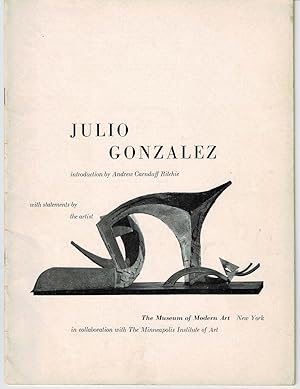
JULIO GONZALEZ. Introduction by Andrew Carnduff Ritchie with Statements by the artist. (Cover Title).
Verlag: New York: The Museum of Modern Art, (1956). (1956)., 1956
Anbieter: Blue Mountain Books & Manuscripts, Ltd., Cadyville, NY, USA
Verkäuferbewertung 5 von 5 Sternen

Zustand: Good. - Quarto, 10 inches high by 7-1/2 inches wide. Softcover, bound in black and white pictorial wrappers. The covers are slightly soiled & creased. 48 pages, including the wrappers, profusely illustrated in black & white with images of Gonzalez' work. A previous owner's name is penned at the top of the first page. The corners of the pages are bumped and the top corners of several pages at the rear are creased. Good. The Museum of Modern Art Bulletin: Volume XXIII, Numbers 1-2, 1955-1956. Published in collaboration with The Minneapolis Institute of Art.The Spanish sculptor Julio Gonzalez (1876-1942) is known for the creative use of iron in his work.
-

TEORIA ETICA DEL TEATRO. (In Teatro '70, No. 30/31, Julio-Agosto 1972). (Cover title).
Verlag: (Buenos Aires, Argentina: Centro Dramatico Buenos Aires), (1972). (1972)., 1972
Anbieter: Blue Mountain Books & Manuscripts, Ltd., Cadyville, NY, USA
Verkäuferbewertung 5 von 5 Sternen
Zustand: Good. - Octavo, softcover bound in printed black wrappers. The binding is rubbed & slightly bumped. 93 pages. There is a stamp "sin valor comercial" on the front endpaper. Good. This double-issue of the Argentine journal Teatro '70 consists of a series of interviews with Polish director Jerzy Grotowski. The text is in Spanish.Scarce.
-
Descriptio secundum antiquos, agri Batavi & Frisii una cum conterminis sive notitia Germaniae Inferioris, cis & ultra Rhenum, quà hodie est in dicione VII Foederatorum. Repraesentata tabulis geographicis V & commentario in loca omnia, hoc tractu, Romanis scriptoribus & monumentis, quà Latinis, quà Graecis, memorata, a C. Julio Caesare, ad Justinianum Aug. Cuncta, ad litterarum ordinem, sic digesta, ut ipse commentarius sit tabularum quasi index, ex quo depromtu facillimum, quae lector desiderare poterit. [Volume 2 with title:] Descriptio Frisiae inter Scaldis portum veterem & Amisiam, .
Verlag: Henricus Wetstein (vol. 2 adds Rudolf & Gerard Wetstein),, Amsterdam,, 1697
Anbieter: ASHER Rare Books, T Goy Houten, Niederlande
Verkäuferbewertung 5 von 5 Sternen
EUR 3.250,00
EUR 25,00 Versand
Versand von Niederlande nach USAAnzahl: 1 verfügbar
In den Warenkorb2 volumes bound as 1. First and only edition, posthumously published, of Menso Alting the younger's description of the Low Countries. The work consists of two parts, the first part treating the Low Countries in antiquity according to classical authors, with finely engraved maps of the area and engravings of relics of antique culture such as inscriptions and tombstones, and in an appendix a comment on the Ptolemean map of greater Germany (from the Rhein to the Vistula in Poland) with map. The second part deals with the Medieval period, describing the places in alphabetical order and also with fine engraved maps, a table and indexes. Possibly the most extensive and detailed topographical work of the era.Menso Alting (1617-1678) hailed from a family of reformed theologians and he was the son of the German professor of theology and rector of the University of Groningen Heinrich Alting. After his studies he became secretary and functionary at Selwerd and later judge at Sappemeer and eventually mayor of Groningen between 1686 and 1712. The engraved maps are the work of Jan and Caspar Luyken and Jan Goeree. The is a magnificent display of typographic materials, with the 6-page author's preface in Christoffel van Dijck's Ascendonica roman (about 21 point, leaded or cast on a larger body).Some of the plates are detached. Internally generally in very good condition, binding slightly rubbed, somewhat loose in the spine and with the headband at the foot damaged and stained, but still in good condition.l Brunet VI, 25131; Klaversma & Hannema 50-51; NNBW, 1, 100; STCN 841733023; Tiele 36-37; Van der Aa, 1, 223-224; Van Eeghen & Van de Kellen, 294. Contemporary blind-tooled vellum, sewn on 7 supports, each board with a double frame of multiple fillets (the inner and outer connected by diagonals at the corners) with a large strapwork centrepiece and inside each corner of the inner frame a stamp showing an acorn with two flowers, red sprinkled edges, headbands in white and reddish brown, with author and title finely lettered in ink in the style of roman type across the spine in the 2nd of 8 compartments. Richly engraved frontispiece (with title and imprint) by Jan Goeree (plate size 33.5 x 21 cm, with a map, 8 allegorical female figures, 2 putti, 2 oval portraits and a geometrical device in a circle), 2 letterpress title-pages in black and red, volume I with 6 double-page engraved maps (5 by Jan and Caspar Luyken, 1 by Goerée), 3 full-page engraved plates and a letterpress table, and numerous engravings in text; volume II with 9 double-page engraved maps by Gerard de Broen and a double-page letterpress table. Further with at least 3 series of woodcut decorated initial letters (the largest 38 mm) and at least 3 woodcut tailpieces (at least some of this "woodcut" material is actually printed from metal sand-castings made from woodcut patterns and mounted on wood). Pages: [24], 132, [20], 18, [2]; [32], 216, [40] pp. Including: [IDEM]. Descriptio Frisiae inter Scaldis portum veterem & Amisiam.Amsterdam, apud Henricus Wetstein, 1701.


![Bild des Verkäufers für Descriptio secundum antiquos, agri Batavi & Frisii una cum conterminis sive notitia Germaniae Inferioris, cis & ultra Rhenum, quà hodie est in dicione VII Foederatorum. Repraesentata tabulis geographicis V & commentario in loca omnia, hoc tractu, Romanis scriptoribus & monumentis, quà Latinis, quà Graecis, memorata, a C. Julio Caesare, ad Justinianum Aug. Cuncta, ad litterarum ordinem, sic digesta, ut ipse commentarius sit tabularum quasi index, ex quo depromtu facillimum, quae lector desiderare poterit. [Volume 2 with title:] Descriptio Frisiae inter Scaldis portum veterem & Amisiam, . zum Verkauf von ASHER Rare Books](https://pictures.abebooks.com/inventory/md/md31463358431.jpg)