
Gesamtpreis (1 Artikel Artikel):
Versandziel:

statistical inductive inference minimum message von wallace c s (8 Ergebnisse)
Direkt zu den wichtigsten Suchergebnissen
Suchfilter
Produktart
- Alle Product Types
- Bücher (8)
- Magazine & Zeitschriften (Keine weiteren Ergebnisse entsprechen dieser Verfeinerung)
- Comics (Keine weiteren Ergebnisse entsprechen dieser Verfeinerung)
- Noten (Keine weiteren Ergebnisse entsprechen dieser Verfeinerung)
- Kunst, Grafik & Poster (Keine weiteren Ergebnisse entsprechen dieser Verfeinerung)
- Fotografien (Keine weiteren Ergebnisse entsprechen dieser Verfeinerung)
- Karten (Keine weiteren Ergebnisse entsprechen dieser Verfeinerung)
- Manuskripte & Papierantiquitäten (Keine weiteren Ergebnisse entsprechen dieser Verfeinerung)
Zustand Mehr dazu
- Neu (7)
- Wie Neu, Sehr Gut oder Gut Bis Sehr Gut (Keine weiteren Ergebnisse entsprechen dieser Verfeinerung)
- Gut oder Befriedigend (Keine weiteren Ergebnisse entsprechen dieser Verfeinerung)
- Ausreichend oder Schlecht (Keine weiteren Ergebnisse entsprechen dieser Verfeinerung)
- Wie beschrieben (1)
Einband
Weitere Eigenschaften
- Erstausgabe (Keine weiteren Ergebnisse entsprechen dieser Verfeinerung)
- Signiert (Keine weiteren Ergebnisse entsprechen dieser Verfeinerung)
- Schutzumschlag (Keine weiteren Ergebnisse entsprechen dieser Verfeinerung)
- Angebotsfoto (4)
Sprache (2)
Preis
- Beliebiger Preis
- Weniger als EUR 20 (Keine weiteren Ergebnisse entsprechen dieser Verfeinerung)
- EUR 20 bis EUR 45
- Mehr als EUR 45
Gratisversand
Land des Verkäufers
Verkäuferbewertung
-
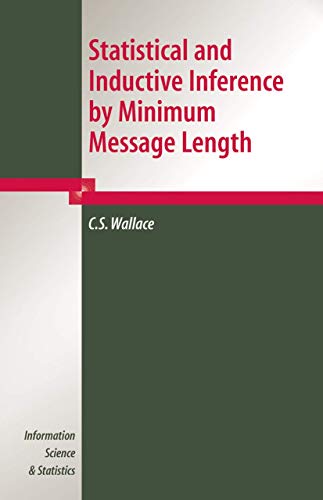
Statistical And Inductive Inference By Minimum Message Length (Hb)
Buch 3 von 20: Information Science and StatisticsAnbieter: Romtrade Corp., STERLING HEIGHTS, MI, USA
Verkäuferbewertung 5 von 5 Sternen

Zustand: New. This is a Brand-new US Edition. This Item may be shipped from US or any other country as we have multiple locations worldwide.
-

Statistical and Inductive Inference by Minimum Message Length.
Verlag: Springer, 2005., 2005
Anbieter: The Book Firm, Subiaco, WA, Australien
Verkäuferbewertung 2 von 5 Sternen

Hardcover. Slight sunning to top edge of front cover and spine, otherwise very good condition. No dustjacket. Part of the Springer Information Science & Statistics series. 429pp. ISBN-10 038723795X ISBN-13: ISBN-13: 9780387237954.
-
STATISTICAL AND INDUCTIVE INFERENCE BY MINIMUM MESSAGE LENGTH
Buch 3 von 20: Information Science and StatisticsAnbieter: Romtrade Corp., STERLING HEIGHTS, MI, USA
Verkäuferbewertung 5 von 5 Sternen
Zustand: New. This is a Brand-new US Edition. This Item may be shipped from US or any other country as we have multiple locations worldwide.
-
Statistical And Inductive Inference By Minimum Message Length
Buch 3 von 20: Information Science and StatisticsAnbieter: Romtrade Corp., STERLING HEIGHTS, MI, USA
Verkäuferbewertung 5 von 5 Sternen
Zustand: New. This is a Brand-new US Edition. This Item may be shipped from US or any other country as we have multiple locations worldwide.
-
Taschenbuch. Zustand: Neu. Statistical and Inductive Inference by Minimum Message Length | C. S. Wallace | Taschenbuch | xvi | Englisch | 2010 | Humana | EAN 9781441920157 | Verantwortliche Person für die EU: Springer Verlag GmbH, Tiergartenstr. 17, 69121 Heidelberg, juergen[dot]hartmann[at]springer[dot]com | Anbieter: preigu.
-
Statistical and Inductive Inference by Minimum Message Length
Buch 3 von 20: Information Science and StatisticsAnbieter: AHA-BUCH GmbH, Einbeck, Deutschland
Verkäuferbewertung 5 von 5 Sternen
Taschenbuch. Zustand: Neu. Druck auf Anfrage Neuware - Printed after ordering - Mythanksareduetothemanypeoplewhohaveassistedintheworkreported here and in the preparation of this book. The work is incomplete and this account of it rougher than it might be. Such virtues as it has owe much to others; the faults are all mine. MyworkleadingtothisbookbeganwhenDavidBoultonandIattempted to develop a method for intrinsic classi cation. Given data on a sample from some population, we aimed to discover whether the population should be considered to be a mixture of di erent types, classes or species of thing, and, if so, how many classes were present, what each class looked like, and which things in the sample belonged to which class. I saw the problem as one of Bayesian inference, but with prior probability densities replaced by discrete probabilities re ecting the precision to which the data would allow parameters to be estimated. Boulton, however, proposed that a classi cation of the sample was a way of brie y encoding the data: once each class was described and each thing assigned to a class, the data for a thing would be partially implied by the characteristics of its class, and hence require little further description. After some weeks' arguing our cases, we decided on the maths for each approach, and soon discovered they gave essentially the same results. Without Boulton's insight, we may never have made the connection between inference and brief encoding, which is the heart of this work.
-
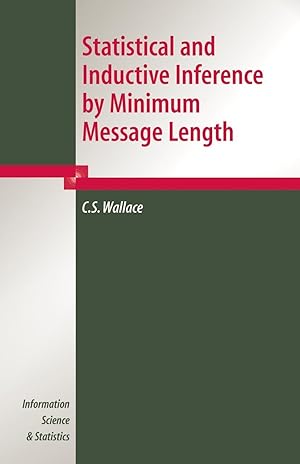
Statistical and Inductive Inference by Minimum Message Length
Buch 3 von 20: Information Science and StatisticsEUR 175,05
EUR 48,99 shipping
Versand von Deutschland nach USAAnzahl: Mehr als 20 verfügbar
In den WarenkorbZustand: New. Since 1965, Professor Wallace and others have been developing an approach tostatistical estimation, hypothesis testing, model selection and their applications in the Artificial Intelligence field of Machine LearningMythanksareduetothemanypeoplewh.
-

Statistical and Inductive Inference by Minimum Message Length
Buch 3 von 20: Information Science and StatisticsSprache: Englisch
Verlag: Springer New York Mai 2005, 2005
ISBN 10: 038723795X ISBN 13: 9780387237954
Anbieter: AHA-BUCH GmbH, Einbeck, Deutschland
Verkäuferbewertung 5 von 5 Sternen
Buch. Zustand: Neu. Neuware - Mythanksareduetothemanypeoplewhohaveassistedintheworkreported here and in the preparation of this book. The work is incomplete and this account of it rougher than it might be. Such virtues as it has owe much to others; the faults are all mine. MyworkleadingtothisbookbeganwhenDavidBoultonandIattempted to develop a method for intrinsic classi cation. Given data on a sample from some population, we aimed to discover whether the population should be considered to be a mixture of di erent types, classes or species of thing, and, if so, how many classes were present, what each class looked like, and which things in the sample belonged to which class. I saw the problem as one of Bayesian inference, but with prior probability densities replaced by discrete probabilities re ecting the precision to which the data would allow parameters to be estimated. Boulton, however, proposed that a classi cation of the sample was a way of brie y encoding the data: once each class was described and each thing assigned to a class, the data for a thing would be partially implied by the characteristics of its class, and hence require little further description. After some weeks' arguing our cases, we decided on the maths for each approach, and soon discovered they gave essentially the same results. Without Boulton's insight, we may never have made the connection between inference and brief encoding, which is the heart of this work.


