

Gesamtpreis (1 Artikel Artikel):
Versandziel:

sequential analysis von siegmund david (9 Ergebnisse)
Direkt zu den wichtigsten Suchergebnissen
Suchfilter
Produktart
- Alle Product Types
- Bücher (9)
- Magazine & Zeitschriften (Keine weiteren Ergebnisse entsprechen dieser Verfeinerung)
- Comics (Keine weiteren Ergebnisse entsprechen dieser Verfeinerung)
- Noten (Keine weiteren Ergebnisse entsprechen dieser Verfeinerung)
- Kunst, Grafik & Poster (Keine weiteren Ergebnisse entsprechen dieser Verfeinerung)
- Fotografien (Keine weiteren Ergebnisse entsprechen dieser Verfeinerung)
- Karten (Keine weiteren Ergebnisse entsprechen dieser Verfeinerung)
- Manuskripte & Papierantiquitäten (Keine weiteren Ergebnisse entsprechen dieser Verfeinerung)
Zustand Mehr dazu
- Neu (7)
- Wie Neu, Sehr Gut oder Gut Bis Sehr Gut (Keine weiteren Ergebnisse entsprechen dieser Verfeinerung)
- Gut oder Befriedigend (2)
- Ausreichend oder Schlecht (Keine weiteren Ergebnisse entsprechen dieser Verfeinerung)
- Wie beschrieben (Keine weiteren Ergebnisse entsprechen dieser Verfeinerung)
Einband
Weitere Eigenschaften
- Erstausgabe (Keine weiteren Ergebnisse entsprechen dieser Verfeinerung)
- Signiert (Keine weiteren Ergebnisse entsprechen dieser Verfeinerung)
- Schutzumschlag (Keine weiteren Ergebnisse entsprechen dieser Verfeinerung)
- Angebotsfoto (5)
Sprache (1)
Preis
- Beliebiger Preis
- Weniger als EUR 20 (Keine weiteren Ergebnisse entsprechen dieser Verfeinerung)
- EUR 20 bis EUR 45 (Keine weiteren Ergebnisse entsprechen dieser Verfeinerung)
- Mehr als EUR 45
Gratisversand
Land des Verkäufers
Verkäuferbewertung
-
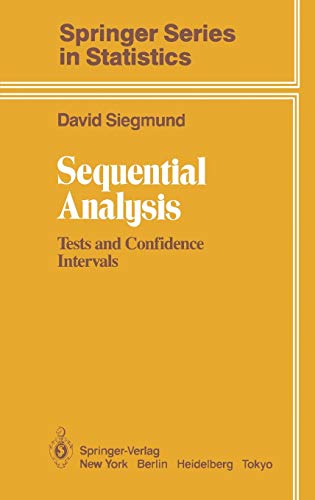
Sequential Analysis: Tests and Confidence Intervals (Springer Series in Statistics)
Buch 7 von 160: Springer Series in StatisticsAnbieter: World of Books (was SecondSale), Montgomery, IL, USA
Verkäuferbewertung 5 von 5 Sternen

Zustand: Very Good. Item in very good condition! Textbooks may not include supplemental items i.e. CDs, access codes etc.
-
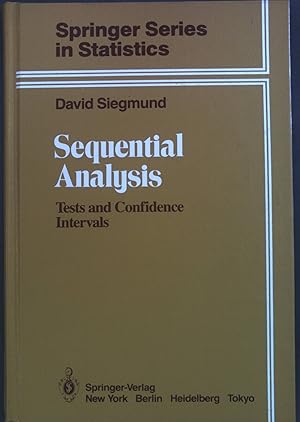
Sequential analysis : tests and confidence intervals. Springer series in statistics
Buch 7 von 160: Springer Series in StatisticsAnbieter: books4less (Versandantiquariat Petra Gros GmbH & Co. KG), Welling, Deutschland
Verkäuferbewertung 5 von 5 Sternen
gebundene Ausgabe. Zustand: Gut. XI, 272 Seiten; Der Erhaltungszustand des hier angebotenen Werks ist trotz seiner Bibliotheksnutzung sehr sauber. Es befindet sich neben dem Rückenschild lediglich ein Bibliotheksstempel im Buch; ordnungsgemäß entwidmet. In ENGLISCHER Sprache. Sprache: Englisch Gewicht in Gramm: 580.
-

Sequential Analysis: Tests and Confidence Intervals
Buch 7 von 160: Springer Series in StatisticsAnbieter: Ria Christie Collections, Uxbridge, Vereinigtes Königreich
Verkäuferbewertung 5 von 5 Sternen
EUR 54,50
EUR 13,88 Versand
Versand von Vereinigtes Königreich nach USAAnzahl: Mehr als 20 verfügbar
In den WarenkorbZustand: New. In.
-

Sequential Analysis: Tests and Confidence Intervals (Springer Series in Statistics)
Buch 7 von 160: Springer Series in StatisticsAnbieter: Ria Christie Collections, Uxbridge, Vereinigtes Königreich
Verkäuferbewertung 5 von 5 Sternen
EUR 140,02
EUR 13,88 Versand
Versand von Vereinigtes Königreich nach USAAnzahl: Mehr als 20 verfügbar
In den WarenkorbZustand: New. In.
-
Sequential Analysis: Tests and Confidence Intervals (Springer Series in Statistics)
Buch 7 von 160: Springer Series in StatisticsAnbieter: Ria Christie Collections, Uxbridge, Vereinigtes Königreich
Verkäuferbewertung 5 von 5 Sternen
EUR 140,02
EUR 13,88 Versand
Versand von Vereinigtes Königreich nach USAAnzahl: Mehr als 20 verfügbar
In den WarenkorbZustand: New. In.
-

EUR 118,61
EUR 48,99 Versand
Versand von Deutschland nach USAAnzahl: Mehr als 20 verfügbar
In den WarenkorbZustand: New.
-
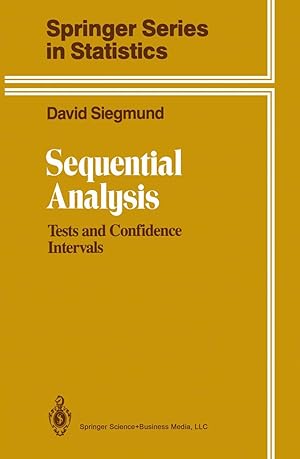
EUR 119,56
EUR 48,99 Versand
Versand von Deutschland nach USAAnzahl: Mehr als 20 verfügbar
In den WarenkorbGebunden. Zustand: New.
-
Taschenbuch. Zustand: Neu. Sequential Analysis | Tests and Confidence Intervals | David Siegmund | Taschenbuch | xi | Englisch | 2010 | Springer | EAN 9781441930750 | Verantwortliche Person für die EU: Springer Verlag GmbH, Tiergartenstr. 17, 69121 Heidelberg, juergen[dot]hartmann[at]springer[dot]com | Anbieter: preigu.
-
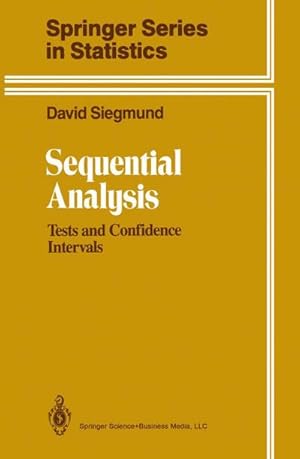
Sequential Analysis : Tests and Confidence Intervals
Buch 7 von 160: Springer Series in StatisticsSprache: Englisch
Verlag: Springer New York, Springer US, 2010
ISBN 10: 1441930752 ISBN 13: 9781441930750
Anbieter: AHA-BUCH GmbH, Einbeck, Deutschland
Verkäuferbewertung 5 von 5 Sternen
Taschenbuch. Zustand: Neu. Druck auf Anfrage Neuware - Printed after ordering - The modern theory of Sequential Analysis came into existence simultaneously in the United States and Great Britain in response to demands for more efficient sampling inspection procedures during World War II. The develop ments were admirably summarized by their principal architect, A. Wald, in his book Sequential Analysis (1947). In spite of the extraordinary accomplishments of this period, there remained some dissatisfaction with the sequential probability ratio test and Wald's analysis of it. (i) The open-ended continuation region with the concomitant possibility of taking an arbitrarily large number of observations seems intol erable in practice. (ii) Wald's elegant approximations based on 'neglecting the excess' of the log likelihood ratio over the stopping boundaries are not especially accurate and do not allow one to study the effect oftaking observa tions in groups rather than one at a time. (iii) The beautiful optimality property of the sequential probability ratio test applies only to the artificial problem of testing a simple hypothesis against a simple alternative. In response to these issues and to new motivation from the direction of controlled clinical trials numerous modifications of the sequential probability ratio test were proposed and their properties studied-often by simulation or lengthy numerical computation. (A notable exception is Anderson, 1960; see III.7.) In the past decade it has become possible to give a more complete theoretical analysis of many of the proposals and hence to understand them better.

