Gesamtpreis (1 Artikel Artikel):
Versandziel:

senryu von blyth (11 Ergebnisse)
Direkt zu den wichtigsten Suchergebnissen
Suchfilter
Produktart
- Alle Product Types
- Bücher (11)
- Magazine & Zeitschriften (Keine weiteren Ergebnisse entsprechen dieser Verfeinerung)
- Comics (Keine weiteren Ergebnisse entsprechen dieser Verfeinerung)
- Noten (Keine weiteren Ergebnisse entsprechen dieser Verfeinerung)
- Kunst, Grafik & Poster (Keine weiteren Ergebnisse entsprechen dieser Verfeinerung)
- Fotografien (Keine weiteren Ergebnisse entsprechen dieser Verfeinerung)
- Karten (Keine weiteren Ergebnisse entsprechen dieser Verfeinerung)
- Manuskripte & Papierantiquitäten (Keine weiteren Ergebnisse entsprechen dieser Verfeinerung)
Zustand Mehr dazu
- Neu (Keine weiteren Ergebnisse entsprechen dieser Verfeinerung)
- Wie Neu, Sehr Gut oder Gut Bis Sehr Gut (Keine weiteren Ergebnisse entsprechen dieser Verfeinerung)
- Gut oder Befriedigend (4)
- Ausreichend oder Schlecht (1)
- Wie beschrieben (6)
Einband
- alle Einbände
- Hardcover (10)
- Softcover (Keine weiteren Ergebnisse entsprechen dieser Verfeinerung)
Weitere Eigenschaften
- Erstausgabe (6)
- Signiert (Keine weiteren Ergebnisse entsprechen dieser Verfeinerung)
- Schutzumschlag (6)
- Angebotsfoto (8)
Sprache (3)
Preis
- Beliebiger Preis
- Weniger als EUR 20 (Keine weiteren Ergebnisse entsprechen dieser Verfeinerung)
- EUR 20 bis EUR 45 (Keine weiteren Ergebnisse entsprechen dieser Verfeinerung)
- Mehr als EUR 45
Gratisversand
- Kostenloser Versand nach USA (Keine weiteren Ergebnisse entsprechen dieser Verfeinerung)
Land des Verkäufers
Verkäuferbewertung
-

Senryu; Japanese Satirical Verses
Verlag: The Hokuseido Press, 1949
Anbieter: A Squared Books (Don Dewhirst), South Lyon, MI, USA
Verkäuferbewertung 5 von 5 Sternen

Hardcover. Zustand: Fair. 1949; illustrated paper covered boards with blue titles; spine and front cover are becoming detached, but are present; corners are scuffed; 8vo - over 7 3/4" to 9 3/4" tall; Interior is clean and unmarked; 230 pages. Photos available upon request.
-
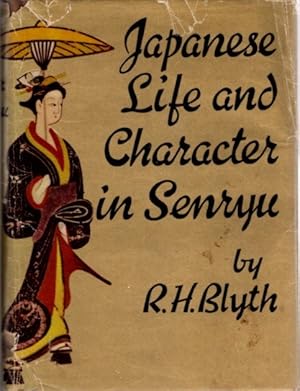
Japanese Life and Character in Senryu
Sprache: Englisch
Verlag: The Hokuseido Press, 1960
Anbieter: A Squared Books (Don Dewhirst), South Lyon, MI, USA
Verkäuferbewertung 5 von 5 Sternen
hardcover. Zustand: Very Good. Zustand des Schutzumschlags: Very Good. stock photo does not represent this listing; 1960; tan cloth covered boards; illustrated white and blue paper jacket encased in a matte dustjacket; wear and discoloration around edges; 8vo, 7 3/4" to 9 3/4" tall; interior is clean and unmarked; 630 pages. Photos available upon request.
-
Senryu Japanese Satirical Verses
Verlag: Hokuseido, 1949
Anbieter: Blue Mountain Collectibles, LLC, Front Royal, VA, USA
Verkäuferbewertung 4 von 5 Sternen

Erstausgabe
Hardcover. Zustand: Very Good. First Edition.
-

Senryu
Sprache: Japanisch
Verlag: Hokuseido
Anbieter: Robinson Street Books, IOBA, Binghamton, NY, USA
Verbandsmitglied: IOBA
Verkäuferbewertung 4 von 5 Sternen
Hardcover. Zustand: Collectible; Good. Prompt Shipment, shipped in Boxes, Tracking PROVIDEDGood hardcover, no dust jacket. Clean, lightly tanned pages. Wear at head and heel of spine, corner tips. 8vo. 230pp.
-

Senryu Japanese Satirical Verses
Verlag: The Hokuseido Press, 1949
Anbieter: Halper's Books, Tel Aviv, Israel
Verkäuferbewertung 4 von 5 Sternen
Hardcover. Zustand: Good. Zustand des Schutzumschlags: Fair. dust jacket ripped on top on the front as well as on the top in the back and near the middle spine, aging evident on inside of boards and pages facing boards, beautiful art work, tight binding, great copy.
-

SENRYU: Japanese Satirical Verses
Verlag: Hokuseido, Tokyo, 1949
Anbieter: By The Way Books, Richmond, TX, USA
Verkäuferbewertung 5 von 5 Sternen
Erstausgabe
First edition. Illustrated cloth binding; Fold frontis with folding captioned facing tissue; Twelve color plates with captioned facing tissues; In text cartoon like drawings throughout; 230 pages. Hardbound in very good condition in good dust jacket.
-
Senryu. Japanese Satirical Verses. Translated and Explained.
Verlag: The Hokuseido Press,, Tokio, (Japon), 1949
Anbieter: Llibreria Antiquària Delstres, Canet de Mar, B, Spanien
Verkäuferbewertung 3 von 5 Sternen

Erstausgabe
Primera edición. Frontispicio plegado en color, y hoja de guarda transparente con la explicación de los dibujos . IV-230 páginas. Ilustrado con 13 láminas en color fuera de texto y dibujos en el texto. Encuadernación en tela editorial ilustrada. Buen estado. 21,5x15 cm.
-
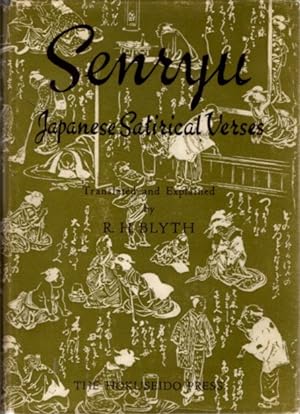
SENRYU: Japanese Satirical Verses
Verlag: Hokuseido, Tokyo, 1949
Anbieter: By The Way Books, Richmond, TX, USA
Verkäuferbewertung 5 von 5 Sternen
Erstausgabe
First edition. Illustrated cloth binding; Fold frontis with folding captioned facing tissue; Twelve color plates with captioned facing tissues; In text cartoon like drawings throughout; 230 pages. Hardbound in very good condition in near very good dust jacket; Wear to jacket spine ends with minor loss to the head.
-
JAPANESE LIFE AND CHARACTER IN SENRYU
Verlag: Hokuseido, Tokyo, 1960
Anbieter: By The Way Books, Richmond, TX, USA
Verkäuferbewertung 5 von 5 Sternen
Erstausgabe
First edition. 18 color plates with captioned facing tissues; 630 pages. Hardbound in very good condition in fair dust jacket; Jacket very worn and torn with some missing pieces; In slipcase which is somewhat worn and creased.
-

Japanese Life and Character in Senryu
Verlag: The Hokuseido Press, Japan, 1960
Anbieter: RareNonFiction, IOBA, Ladysmith, BC, Kanada
Verbandsmitglied: IOBA
Verkäuferbewertung 5 von 5 Sternen
Erstausgabe
Hardcover. Zustand: Very Good. Zustand des Schutzumschlags: Good. First Edition. 630 pages. Index. "Senryu enable us, as they enabled the Japanese, to understand and forgive others, and, what is vastly more important, to understand and forgive ourselves. Not only the life and character of the Japanese, but our own life and character are to be seen in this book, which is thus not merely a picture, but a mirror. Look well in it!" - from dust jacket. Decorated endpapers. Tissue-protected colour frontisplate. Book clean with light wear. Pencil underlining and marginalia to some pages. Moderate lean to spine. Binding tight. Average wear and soiling to dust jacket which bears a couple of short openings and several coffee drops. A sound copy.; 8vo - over 7¾" - 9¾" tall; Japanese Life and Character in Senryu Culture Literature History Japan Writing.
-
JAPANESE LIFE AND CHARACTER IN SENRYU
Anbieter: RARE ORIENTAL BOOK CO., ABAA, ILAB, Aptos, CA, USA
Verkäuferbewertung 5 von 5 Sternen
[Tokyo 1960,] Hokuseido. Brown cloth, very good, 630p., color frontis, 5 color, 13 b.w. plates, index, bibliography, epilogue, exceptionally crisp, clean, nice copy, 5.5 x 21.5 cm., dj. in mylar protector. FIRST & ONLY EDITION SCARCE This excellent monograph covers the chronologicl survey of Senryu, from Genroku to Meiji, Taisho, Showa, a Year of Sen- ryu, and subject matter of the Senryu, with full text in English, Japanese characters & Romanized characters. Blyth rightlyi claims Senryu as true poetry & truly representative of the Japanese spirit. The whole of Japanese life is revea- led in these pages.Way cool. Reginald Horace Blyth is always R A R E ! **** A very well written, readable set of books. The celebrated Zen master D.T. Suzuki described Blyth as "one of the most eminent exponents of Japanese culture." **** ZEN AND HAIKU: Blyth's studies on Haiku, Japanese humor and Zen are "unique contributions towards East-West understanding." Blyth lived & worked in the east 40 years, until his death in 1964. The history of Zen is the history of moments. It cannot be, like the history of ideas, or even the history of the freedom of thought, an account of development, systematization, criticism, modification, replacement and so forth. Zen seems to become deeper sometimes, shallower, broader, narrower sometimes, but there is no progress of the ordinary kind. It is a history only in the sense of being a list of names of great men in the attainment of great and so forth. Zen seems to become deeper sometimes, shallower, broader, narrower sometimes, but there is no progress of the ordinary kind. It is a history only in the sense of being a list of names of great men in the attainment of great Buddha-hood. * BLYTH'S CONTRIBUTION: Blyth lived and worked in the East for forty years, until his death in 1964 at the age of sixty-six. From the time of his internment in Japan during World War II, Blyth wrote assiduously. In the 1950's, his "ZEN IN ENGLISH LITERATURE" and "ORIENTAL CLASSICS" and "HAIKU" reached enthusiastic readers in America and Europe. Aldous Huxley describes Blyth's work as "illuminating." As William J. Higginson writes in his "HAIKU HANDBOOK," thanks to Blyth "a new interest in Japanese Haiku began to grow among poets of the immediate post World War II generation." . Blyth's Contribution to cross-cultural understanding was manifold. In 1945, Blyth assumed a post as professor of English at Tokyo's Gakushuin University, the former Peers' School. For almost twenty years he tutored Crown Prince Akihito, the present Emperor. Blyth played a leading role in Emperor Hirohito's historical declaration of January 1, 1946, that he was a human being rather than a god. Blyth edited numerous writings from English and American literature, making them available to avid Japanese readers. **** BIBLIOGRAPHY: * Zen in English Literature and Oriental Classics, The Hokuseido Press, 1942 Haiku, 1949-1952, in four volumes: Vol.1: Eastern Culture. Vol.2: Spring. Vol.3: Summer-Autumn. Vol.4: Autumn-Winter. The Hokuseido Press . Japanese Satirical Verses, The Hokuseido Press, 1949 Japanese Humour, Japan Travel Bureau, 1957 Japanese Life and Character in Senryu, 1959. Oriental Humor, 1959. . Zen and Zen Classics, in five volumes: Vol.1: General Introduction,from the Upanishads to . Huineng.1960. Vol.2: History of Zen.1964. Vol.3: History of Zen.1970. Vol.4: Mumonkan.1966. Vol.5: Twenty-Five Zen Essays.1962. The Hokuseido Press. [Note: this set's numbering is complicated, see us for complete information on what comprises a full set.] . Edo Satirical Verse Anthologies, 1961. The Hokuseido Press. A History of Haiku in two volumes: Vol.1: From the Beginnings up to Issa. Vol.2: From Issa up to the Present.1963.The Hokuseido Press. Games Zen Masters Play: Writings of R. H. Blyth, 1976. * For more on Blyth see Wikipedia:.