Gesamtpreis (1 Artikel Artikel):
Versandziel:

principles population production affected (20 Ergebnisse)
Direkt zu den wichtigsten Suchergebnissen
Suchfilter
Produktart
- Alle Product Types
- Bücher (20)
- Magazine & Zeitschriften (Keine weiteren Ergebnisse entsprechen dieser Verfeinerung)
- Comics (Keine weiteren Ergebnisse entsprechen dieser Verfeinerung)
- Noten (Keine weiteren Ergebnisse entsprechen dieser Verfeinerung)
- Kunst, Grafik & Poster (Keine weiteren Ergebnisse entsprechen dieser Verfeinerung)
- Fotografien (Keine weiteren Ergebnisse entsprechen dieser Verfeinerung)
- Karten (Keine weiteren Ergebnisse entsprechen dieser Verfeinerung)
- Manuskripte & Papierantiquitäten (Keine weiteren Ergebnisse entsprechen dieser Verfeinerung)
Zustand Mehr dazu
- Neu (11)
- Wie Neu, Sehr Gut oder Gut Bis Sehr Gut (Keine weiteren Ergebnisse entsprechen dieser Verfeinerung)
- Gut oder Befriedigend (3)
- Ausreichend oder Schlecht (Keine weiteren Ergebnisse entsprechen dieser Verfeinerung)
- Wie beschrieben (6)
Einband
Weitere Eigenschaften
- Erstausgabe (2)
- Signiert (Keine weiteren Ergebnisse entsprechen dieser Verfeinerung)
- Schutzumschlag (Keine weiteren Ergebnisse entsprechen dieser Verfeinerung)
- Angebotsfoto (8)
Sprache (2)
Gratisversand
Land des Verkäufers
Verkäuferbewertung
-

The Principles of Population and Production as They are Affected By the Progress of Society with a View to Moral and Political Consequences
Sprache: Englisch
Verlag: Irish University Press, Shannon, Ireland, 1971
ISBN 10: 0716517779 ISBN 13: 9780716517771
Anbieter: PsychoBabel & Skoob Books, Didcot, Vereinigtes Königreich
Verkäuferbewertung 5 von 5 Sternen

EUR 9,53
EUR 14,45 Versand
Versand von Vereinigtes Königreich nach USAAnzahl: 1 verfügbar
In den WarenkorbHardcover. Zustand: Very Good. Hardcover without jacket. Unabridged photolithographic facsimile reprint of the 1816 edition. Very few minor marks on exterior. Pages are clean and sound. The Development of Industrial Society series. TS. Used.
-
The Principles of Population and Production As They Are Affected by the Progress of Society with a View to Moral and Political Consequences
Anbieter: Green Ink Booksellers, Hay-on-Wye, POWYS, Vereinigtes Königreich
Verkäuferbewertung 5 von 5 Sternen
EUR 17,86
EUR 13,88 Versand
Versand von Vereinigtes Königreich nach USAAnzahl: 1 verfügbar
In den WarenkorbZustand: Very Good. No Jacket. - Reprint of 1816 Edition - Clean bright tight w/ only minor shelf wear book - xi/493 pages.
-
The Principles of Population and Production As They Are Affected by the Progress of Society with a View to Moral and Political Consequences
Anbieter: Green Ink Booksellers, Hay-on-Wye, POWYS, Vereinigtes Königreich
Verkäuferbewertung 5 von 5 Sternen
EUR 17,86
EUR 13,88 Versand
Versand von Vereinigtes Königreich nach USAAnzahl: 1 verfügbar
In den WarenkorbZustand: Very Good. No Jacket. - Reprint of 1816 Edition - Clean bright tight w/ only minor shelf wear book - xi/493 pages.
-

The Principles of Population and Production, as They Are Affected by the Progress of Society: With a View to Moral and Political Consequences (Classic Reprint)
Anbieter: PBShop.store US, Wood Dale, IL, USA
Verkäuferbewertung 5 von 5 Sternen
PAP. Zustand: New. New Book. Shipped from UK. Established seller since 2000.
-

The Principles of Population and Production, As They Are Affected by the Progress of Society; with a View to Moral and Political Consequences
Sprache: Englisch
Verlag: Shannon, Irish University Press, 1971
ISBN 10: 0716517779 ISBN 13: 9780716517771
Fine Facsimile Reprint. Fine copy in the original gilt-blocked cloth. Particularly and surprisingly well-preserved; tight, bright, clean and especially sharp-cornered. ; 493 pages; Physical desc. : [5], xl, 494p. ; 22cm. Reprint of the 1816 edition. Series: The Development of industrial society series. Subjects: Population. Malthusianism 3 Kg.
-
The Principles of Population and Production, as They Are Affected by the Progress of Society: With a View to Moral and Political Consequences (Classic Reprint)
Anbieter: PBShop.store UK, Fairford, GLOS, Vereinigtes Königreich
Verkäuferbewertung 4 von 5 Sternen

EUR 27,92
EUR 6,79 Versand
Versand von Vereinigtes Königreich nach USAAnzahl: 15 verfügbar
In den WarenkorbPAP. Zustand: New. New Book. Shipped from UK. Established seller since 2000.
-

The Principles of Population and Production, as They Are Affected by the Progress of Society: With a View to Moral and Political Consequences (Classic Reprint)
Anbieter: PBShop.store US, Wood Dale, IL, USA
Verkäuferbewertung 5 von 5 Sternen
HRD. Zustand: New. New Book. Shipped from UK. Established seller since 2000.
-
The Principles of Population and Production, as They Are Affected by the Progress of Society: With a View to Moral and Political Consequences (Classic Reprint)
Anbieter: PBShop.store UK, Fairford, GLOS, Vereinigtes Königreich
Verkäuferbewertung 4 von 5 Sternen
EUR 33,77
EUR 6,79 Versand
Versand von Vereinigtes Königreich nach USAAnzahl: 15 verfügbar
In den WarenkorbHRD. Zustand: New. New Book. Shipped from UK. Established seller since 2000.
-

The Principles of Population and Production, as They Are Affected by the Progress of Society With a View to Moral and Political Consequences 1
Anbieter: PBShop.store US, Wood Dale, IL, USA
Verkäuferbewertung 5 von 5 Sternen
PAP. Zustand: New. New Book. Shipped from UK. Established seller since 2000.
-
The Principles of Population and Production, as They Are Affected by the Progress of Society With a View to Moral and Political Consequences 1
Anbieter: PBShop.store UK, Fairford, GLOS, Vereinigtes Königreich
Verkäuferbewertung 4 von 5 Sternen
EUR 26,34
EUR 6,79 Versand
Versand von Vereinigtes Königreich nach USAAnzahl: 15 verfügbar
In den WarenkorbPAP. Zustand: New. New Book. Shipped from UK. Established seller since 2000.
-

The Principles Of Population And Production As They Are Affected By The Progress Of Society: With A View To Moral And Politicial Consequences
Anbieter: Ria Christie Collections, Uxbridge, Vereinigtes Königreich
Verkäuferbewertung 5 von 5 Sternen
EUR 31,21
EUR 13,85 Versand
Versand von Vereinigtes Königreich nach USAAnzahl: Mehr als 20 verfügbar
In den WarenkorbZustand: New. In.
-

THE PRINCIPLES OF POPULATION AND PRODUCTION. As They are Affected by The Progress of Society, with a View to Moral and Political Consequences.
Verlag: Augustus M. Kelley, New York NY 1969., 1969
Anbieter: Hay Cinema Bookshop Limited, Hay on Wye, Vereinigtes Königreich
Verkäuferbewertung 5 von 5 Sternen
EUR 13,10
EUR 21,97 Versand
Versand von Vereinigtes Königreich nach USAAnzahl: 1 verfügbar
In den WarenkorbReprint of 1816 edition. 8vo. xl + 493pp. Very good in original gilt lettered brown boards with red and black title patches to spine. Reprints of Economic Classics series. US$15.
-
THE PRINCIPLES OF POPULATION AND PRODUCTION. As They are Affected by The Progress of Society, with a View to Moral and Political Consequences.
Verlag: Augustus M. Kelley, New York NY 1969., 1969
Anbieter: Hay Cinema Bookshop Limited, Hay on Wye, Vereinigtes Königreich
Verkäuferbewertung 5 von 5 Sternen
EUR 13,10
EUR 21,97 Versand
Versand von Vereinigtes Königreich nach USAAnzahl: 1 verfügbar
In den WarenkorbReprint of 1816 edition. 8vo. xl + 493pp. Very good in original gilt lettered brown boards with red and black title patches to spine. Reprints of Economic Classics series. US$15.
-

The Principles Of Population And Production As They Are Affected By The Progress Of Society: With A View To Moral And Politicial Consequences
Anbieter: Ria Christie Collections, Uxbridge, Vereinigtes Königreich
Verkäuferbewertung 5 von 5 Sternen
EUR 39,73
EUR 13,85 Versand
Versand von Vereinigtes Königreich nach USAAnzahl: Mehr als 20 verfügbar
In den WarenkorbZustand: New. In.
-

EUR 34,44
EUR 48,99 Versand
Versand von Deutschland nach USAAnzahl: Mehr als 20 verfügbar
In den WarenkorbKartoniert / Broschiert. Zustand: New.
-

EUR 44,77
EUR 48,99 Versand
Versand von Deutschland nach USAAnzahl: Mehr als 20 verfügbar
In den WarenkorbGebunden. Zustand: New.
-

The Principles Of Population And Production As They Are Affected By The Progress Of Society: With A View To Moral And Politicial Consequences
Sprache: Englisch
Verlag: Creative Media Partners, LLC Okt 2022, 2022
ISBN 10: 1018190511 ISBN 13: 9781018190518
Anbieter: AHA-BUCH GmbH, Einbeck, Deutschland
Verkäuferbewertung 5 von 5 Sternen
Taschenbuch. Zustand: Neu. Neuware.
-
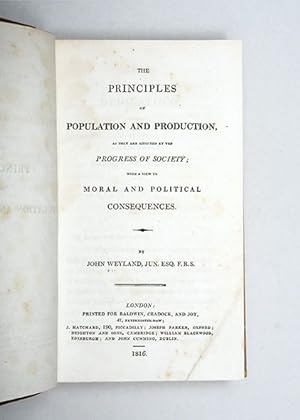
The principles of population and production, as they are affected by the progress of society; with a view to moral and political consequences.
Verlag: London, printed for Baldwin, Cradock, and Joy 1816, 1816
Anbieter: Antiquariaat Matthys de Jongh, Zutphen, Niederlande
Verkäuferbewertung 5 von 5 Sternen
Erstausgabe
EUR 1.950,00
EUR 30,00 Versand
Versand von Niederlande nach USAAnzahl: 1 verfügbar
In den Warenkorb. XL,493 [errata on p.493],[1]p. Contemp. tree calf gilt back, marbled endpapers. Light foxing to first and last blanks only. A fine copy indeed. First edition. A major criticism of Malthus' population theory, answered by Malthus the next year in the appendix to the fifth edition of his Essay on population'. Malthus thought much higher of it than of the other object of the appendix, the Inquiry' of James Grahame which appeared the same year, 'a slight work without any very distinct object in view . Mr. Weyland's work is of a much more elaborate desciption [and] has also a very definite object in view'. Weyland believed that an increase of population was recommendable and argued that a higher birthrate in the countryside was needed to compensate for the higher mortality rate in towns. He holds that 'population has a natural tendency to keep within the powers of the soil to afford it subsistence in every gradation through which society passes [and] this tendency can never be destroyed, and can only be altered or diverted from its natural course . by grossly impolitic laws, or pernicious customs, either accelerating the progress of population considerably beyond its natural rate, or depressing the productive energies of the soil considerably below its natural powers' (p.21). Weyland was a landowner and magistrate from Oxfordshire and author of several books on the poor laws and related subjects. *Kress B.6837. Goldsmiths' 21429. Einaudi 6027. Bonar p.378-380.
-
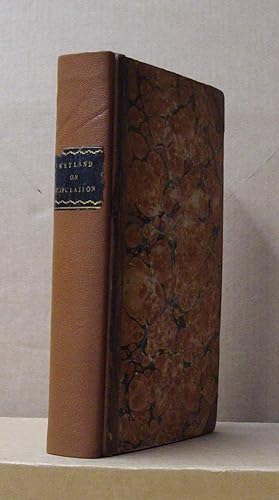
The Principles of Population and Production, as they are affected by the Progress of Society; with a view to Moral and Political Consequences.
Verlag: Baldwin, Cradock, and Joy, London., 1816
Anbieter: Peter Ellis, Bookseller, ABA, ILAB, London, Vereinigtes Königreich
Verkäuferbewertung 5 von 5 Sternen
EUR 684,79
EUR 17,34 Versand
Versand von Vereinigtes Königreich nach USAAnzahl: 1 verfügbar
In den WarenkorbFirst edition. Octavo. pp xl, 493, [i] adverts. Period quarter leather with marbled boards, recently rebacked and with endpapers renewed. The author's major work, a direct challenge to Malthusian warnings of the dangers of population growth. Indeed, Weyland argues that economic progress depends on the stimulus provided by such growth to a level ''just beyond the plentiful supply of the people's want''. Malthus was stung to an intemperate rebuttal in an appendix to the fifth edition of his Essay on the Principle of Population: "It is quite inconceivable how a man of sense could bewilder himself in such a maze of futile calculations, and come to conclusions so diametrically opposite to experience."Ownership signature on second blank. Some foxing to prelims. Faint traces of damp to inner margins of first gathering. Very good. The title-page raises some questions: it shares some of the foxing of the surrounding pages, but is printed on slightly thinner paper (an early facsimile insert?, a later facsimile insert on period paper?). Scarce: there was only one nineteenth century edition.
-
The Principles of Population and Production, as they are affected by the progress of society; with a view to moral and political consequences.
Verlag: London: Printed for Baldwin, Cradock, and Joy, 1816, 1816
Anbieter: Peter Harrington. ABA/ ILAB., London, Vereinigtes Königreich
Verbandsmitglied: ABA ILAB PBFA
Verkäuferbewertung 5 von 5 Sternen
Erstausgabe
EUR 2.084,15
EUR 25,44 Versand
Versand von Vereinigtes Königreich nach USAAnzahl: 1 verfügbar
In den WarenkorbFirst edition of an important criticism of Malthus's Principles of Population, which Malthus responded to in the appendix to his fifth edition of the Principles the following year. Though Malthus rejected Weyland's conclusions in his response, he respected his adversary, thinking much higher of the work than the other object of the appendix, James Grahame's Inquiry into the Principle of Population: "a slight work without any very distinct object in view. Mr. Weyland's work is of a much more elaborate description [and] has also a very definite object in view" (Malthus, Principles, 1817, pp. 388, 397-8). John Weyland (1774-1854), a magistrate and a writer on the poor laws, praised Malthus for having raised the subject of population from the level of academic discussion to that of scientific inquiry. However, his conclusion on the subject of population was the exact opposite, advocating an increase in population. Weyland argued that a society in which one-third of the population lived in towns had "arrived at its point of non-reproduction" (Weyland, Principles, p. 109). With infant mortality higher in towns, the state should "keep an additional set of healthy breeders for the community; and that all unnecessary expense may be spared, it must place them in situations most favourable to child-bearing, and to the health of children, and most favourable also to their morals, that is to say, in the country villages" (ibid, p. 172). Weyland consequently encouraged the expansion of parish relief in the countryside to encourage reproduction, a proposal which horrified Malthus, who pictured, if Weyland's proposals were adopted, an endpoint of the whole of the working classes on poor relief: "what a dreadful picture does it present! what a scene of equality, indolence, rags and dependence, among one-half or three fourths of the society" (Malthus, Principles, 1817, p. 417). Despite Malthus's horror, "Weyland's principal object was to show that the poor laws were both beneficent and necessary, and were not a cause of pauperism, which he attributed to a lack of moral and religious instruction among the poor. Although his assertion that the population had reached a state of 'non-reproduction' was demonstrably absurd (despite the lack of issue from his own marriage), his advocacy of poor relief for large families where the wage-earner could not provide for all his children interested promoters of family allowances a century later" (ODNB). Einaudi 6027; Goldsmiths' 21429; Kress B.6837; Malthus MH.2.24; see Bonar, Malthus and his work, pp. 376-380 and James, Population Malthus, pp. 372-374. Octavo (205 x 124 mm). Recent quarter sheep, twin black and purple labels, marbled sides. With half-title. Binding fine save for light sunning to spine, contents generally clean save for light foxing at extremities and light stain to pp. 84-5 and 94-5, pp. 454-8 bound upside down; a very good copy.