
Phenomenological critique mathematisation question (11 Ergebnisse)

Sprache: Englisch
Verlag: Springer, 2016
Serie: Contributions to Phenomenology, Buch 73 von 119. Buch 73 von 119 - Contributions to Phenomenology
- Softcover
Anbieter: Ria Christie Collections, Uxbridge, Vereinigtes KönigreichRia Christie Collections
Verkäufer/-in kontaktierenVerkäufer/-in mit 5 SternenZustand: Neu
EUR 61,22
EUR 14,02 VersandVersand von Vereinigtes Königreich nach USAAnzahl: Mehr als 20 verfügbar
Zustand: New. In.

Sprache: Englisch
Verlag: Springer, 2014
Serie: Contributions to Phenomenology, Buch 73 von 119. Buch 73 von 119 - Contributions to Phenomenology
- Hardcover
Anbieter: Ria Christie Collections, Uxbridge, Vereinigtes KönigreichRia Christie Collections
Verkäufer/-in kontaktierenVerkäufer/-in mit 5 SternenZustand: Neu
EUR 61,22
EUR 14,02 VersandVersand von Vereinigtes Königreich nach USAAnzahl: Mehr als 20 verfügbar
Zustand: New. In.
The Phenomenological Critique of Mathematisation and the Question of Responsibility: Formalisation and the Life-world
Ucník, Lubica (Editor)/ Chvatík, Ivan (Editor)/ Williams, Anita (Editor)
Sprache: Englisch
Verlag: Springer Verlag, 2014
Serie: Contributions to Phenomenology, Buch 73 von 119. Buch 73 von 119 - Contributions to Phenomenology
- Hardcover
Anbieter: Revaluation Books, Exeter, Vereinigtes KönigreichRevaluation Books
Verkäufer/-in kontaktierenVerkäufer/-in mit 5 SternenZustand: Neu
EUR 80,88
EUR 14,63 VersandVersand von Vereinigtes Königreich nach USAAnzahl: 2 verfügbar
Hardcover. Zustand: Brand New. 2015 edition. 220 pages. 9.25x6.25x0.75 inches. In Stock.
Sprache: Englisch
Verlag: Springer International Publishing, 2014
Serie: Contributions to Phenomenology, Buch 73 von 119. Buch 73 von 119 - Contributions to Phenomenology
- Hardcover
Anbieter: moluna, Greven, Deutschlandmoluna
Verkäufer/-in kontaktierenVerkäufer/-in mit 5 SternenZustand: Neu
EUR 48,37
EUR 48,99 VersandVersand von Deutschland nach USAAnzahl: Mehr als 20 verfügbar
Gebunden. Zustand: New.
Sprache: Englisch
Verlag: Springer International Publishing, 2016
Serie: Contributions to Phenomenology, Buch 73 von 119. Buch 73 von 119 - Contributions to Phenomenology
- Softcover
Anbieter: moluna, Greven, Deutschlandmoluna
Verkäufer/-in kontaktierenVerkäufer/-in mit 5 SternenZustand: Neu
EUR 48,37
EUR 48,99 VersandVersand von Deutschland nach USAAnzahl: Mehr als 20 verfügbar
Zustand: New.
The Phenomenological Critique of Mathematisation and the Question of Responsibility: Formalisation and the Life-world
Ucník, Lubica (Editor)/ Chvatík, Ivan (Editor)/ Williams, Anita (Editor)
Sprache: Englisch
Verlag: Springer Verlag, 2016
Serie: Contributions to Phenomenology, Buch 73 von 119. Buch 73 von 119 - Contributions to Phenomenology
- Softcover
Anbieter: Revaluation Books, Exeter, Vereinigtes KönigreichRevaluation Books
Verkäufer/-in kontaktierenVerkäufer/-in mit 5 SternenZustand: Neu
EUR 78,88
EUR 35,10 VersandVersand von Vereinigtes Königreich nach USAAnzahl: 2 verfügbar
Paperback. Zustand: Brand New. reprint edition. 236 pages. 9.25x6.10x0.54 inches. In Stock.

Sprache: Englisch
Verlag: Springer International Publishing, 2016
Serie: Contributions to Phenomenology, Buch 73 von 119. Buch 73 von 119 - Contributions to Phenomenology
- Softcover
Anbieter: AHA-BUCH GmbH, Einbeck, DeutschlandAHA-BUCH GmbH
Verkäufer/-in kontaktierenVerkäufer/-in mit 5 SternenZustand: Neu
EUR 53,49
EUR 61,83 VersandVersand von Deutschland nach USAAnzahl: 1 verfügbar
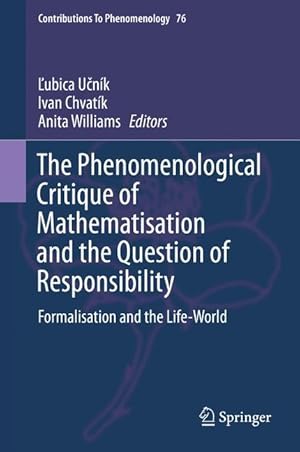
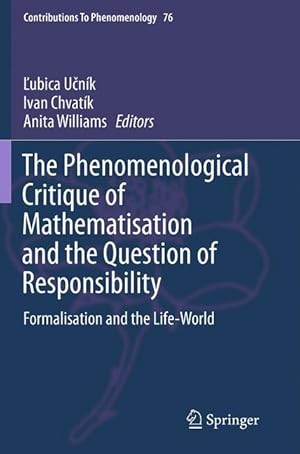
Taschenbuch. Zustand: Neu. Druck auf Anfrage Neuware - Printed after ordering - This edited collection discusses phenomenological critiques of formalism and their relevance to the problem of responsibility and the life-world. The book deals with themes of formalization of knowledge in connection to the life-world, the natural wo…rld, the history of science and our responsibility for both our epistemic claims and the world in which we live. Readers will discover critiques of formalization, the life-world and responsibility, and a collation and comparison of Patocka's and Husserl's work on these themes. Considerable literature on Husserl is presented here and the two themes of epistemic responsibility and the life-world are discussed together. This work specifically emphasizes the interrelatedness of these existential aspects of his work - self-responsibility and the crisis - as not only epistemological, but also related to human life. This volume also introduces Jan Patocka to English-speaking readers as a phenomenologist in his own right. Patocka shows us, in particular, the significance of the modern abyss between our thinking and the world. Readers will discover that this abyss is of concern for our everyday experience because it leads to a rupture in our understanding of the world: between the world of our living and its scientific construct. We see that Patocka continually emphasized the relevance of Husserl's work to existential questions relating to human responsibility and the life-world, which he admits is left largely implicit in Husserl's work. This edited collection will spark discussion on the question of responsibility against the backdrop of formalized knowledge which is increasingly inaccessible to human understanding. Despite the complexity of some of the analyzed ideas, this book discusses these themes in a clear and readable way. This work is scholarly, exact in its discussion and authoritative in its reading, but at the same time accessible to anyone motivated to understand these debates.

Sprache: Englisch
Verlag: Springer, Springer International Publishing, 2014
Serie: Contributions to Phenomenology, Buch 73 von 119. Buch 73 von 119 - Contributions to Phenomenology
- Hardcover
Anbieter: AHA-BUCH GmbH, Einbeck, DeutschlandAHA-BUCH GmbH
Verkäufer/-in kontaktierenVerkäufer/-in mit 5 SternenZustand: Neu
EUR 53,49
EUR 62,62 VersandVersand von Deutschland nach USAAnzahl: 1 verfügbar
Buch. Zustand: Neu. Druck auf Anfrage Neuware - Printed after ordering - This edited collection discusses phenomenological critiques of formalism and their relevance to the problem of responsibility and the life-world. The book deals with themes of formalization of knowledge in connection to the life-world, the natural world, th…e history of science and our responsibility for both our epistemic claims and the world in which we live. Readers will discover critiques of formalization, the life-world and responsibility, and a collation and comparison of Patocka's and Husserl's work on these themes. Considerable literature on Husserl is presented here and the two themes of epistemic responsibility and the life-world are discussed together. This work specifically emphasizes the interrelatedness of these existential aspects of his work - self-responsibility and the crisis - as not only epistemological, but also related to human life. This volume also introduces Jan Patocka to English-speaking readers as a phenomenologist in his own right. Patocka shows us, in particular, the significance of the modern abyss between our thinking and the world. Readers will discover that this abyss is of concern for our everyday experience because it leads to a rupture in our understanding of the world: between the world of our living and its scientific construct. We see that Patocka continually emphasized the relevance of Husserl's work to existential questions relating to human responsibility and the life-world, which he admits is left largely implicit in Husserl's work. This edited collection will spark discussion on the question of responsibility against the backdrop of formalized knowledge which is increasingly inaccessible to human understanding. Despite the complexity of some of the analyzed ideas, this book discusses these themes in a clear and readable way. This work is scholarly, exact in its discussion and authoritative in its reading, but at the same time accessible to anyone motivated to understand these debates.

Sprache: Englisch
Verlag: Springer, 2016
Serie: Contributions to Phenomenology, Buch 73 von 119. Buch 73 von 119 - Contributions to Phenomenology
- Softcover
Anbieter: preigu, Osnabrück, Deutschlandpreigu
Verkäufer/-in kontaktierenVerkäufer/-in mit 5 SternenZustand: Neu
EUR 50,40
EUR 70,00 VersandVersand von Deutschland nach USAAnzahl: 5 verfügbar
Taschenbuch. Zustand: Neu. The Phenomenological Critique of Mathematisation and the Question of Responsibility | Formalisation and the Life-World | ¿Ubica U¿ník (u. a.) | Taschenbuch | Contributions to Phenomenology | x | Englisch | 2016 | Springer | EAN 9783319384351 | Verantwortliche Person für die EU: Springer Verlag GmbH, Ti…ergartenstr. 17, 69121 Heidelberg, juergen[dot]hartmann[at]springer[dot]com | Anbieter: preigu.
Sprache: Englisch
Verlag: Springer, 2016
Serie: Contributions to Phenomenology, Buch 73 von 119. Buch 73 von 119 - Contributions to Phenomenology
- Softcover
Anbieter: Buchpark, Trebbin, DeutschlandBuchpark
Verkäufer/-in kontaktierenVerkäufer/-in mit 5 SternenZustand: Gebraucht - Sehr gut
EUR 40,86
EUR 105,00 VersandVersand von Deutschland nach USAAnzahl: 1 verfügbar
Zustand: Sehr gut. Zustand: Sehr gut | Sprache: Englisch | Produktart: Bücher | ¿This edited collection discusses phenomenological critiques of formalism and their relevance to the problem of responsibility and the life-world. The book deals with themes of formalization of knowledge in connection to the life-world, the natural w…orld, the history of science and our responsibility for both our epistemic claims and the world in which we live. Readers will discover critiques of formalization, the life-world and responsibility, and a collation and comparison of Pato¿käs and Husserl¿s work on these themes. Considerable literature on Husserl is presented here and the two themes of epistemic responsibility and the life-world are discussed together. This work specifically emphasizes the interrelatedness of these existential aspects of his work ¿ self-responsibility and the crisis ¿ as not only epistemological, but also related to human life. This volume also introduces Jan Pato¿ka to English-speaking readers as a phenomenologist in his own right. Pato¿ka shows us, in particular, the significance of the modern abyss between our thinking and the world. Readers will discover that this abyss is of concern for our everyday experience because it leads to a rupture in our understanding of the world: between the world of our living and its scientific construct. We see that Pato¿ka continually emphasized the relevance of Husserl¿s work to existential questions relating to human responsibility and the life-world, which he admits is left largely implicit in Husserl¿s work. This edited collection will spark discussion on the question of responsibility against the backdrop of formalized knowledge which is increasingly inaccessible to human understanding. Despite the complexity of some of the analyzed ideas, this book discusses these themes in a clear and readable way. This work is scholarly, exact in its discussion and authoritative in its reading, but at the same time accessible to anyone motivated to understand these debates.
Sprache: Englisch
Verlag: Palgrave Macmillan, 2014
Serie: Contributions to Phenomenology, Buch 73 von 119. Buch 73 von 119 - Contributions to Phenomenology
- Hardcover
Anbieter: Buchpark, Trebbin, DeutschlandBuchpark
Verkäufer/-in kontaktierenVerkäufer/-in mit 5 SternenZustand: Gebraucht - Sehr gut
EUR 43,31
EUR 105,00 VersandVersand von Deutschland nach USAAnzahl: 1 verfügbar
Zustand: Sehr gut. Zustand: Sehr gut | Sprache: Englisch | Produktart: Bücher | ¿This edited collection discusses phenomenological critiques of formalism and their relevance to the problem of responsibility and the life-world. The book deals with themes of formalization of knowledge in connection to the life-world, the natural w…orld, the history of science and our responsibility for both our epistemic claims and the world in which we live. Readers will discover critiques of formalization, the life-world and responsibility, and a collation and comparison of Pato¿käs and Husserl¿s work on these themes. Considerable literature on Husserl is presented here and the two themes of epistemic responsibility and the life-world are discussed together. This work specifically emphasizes the interrelatedness of these existential aspects of his work ¿ self-responsibility and the crisis ¿ as not only epistemological, but also related to human life. This volume also introduces Jan Pato¿ka to English-speaking readers as a phenomenologist in his own right. Pato¿ka shows us, in particular, the significance of the modern abyss between our thinking and the world. Readers will discover that this abyss is of concern for our everyday experience because it leads to a rupture in our understanding of the world: between the world of our living and its scientific construct. We see that Pato¿ka continually emphasized the relevance of Husserl¿s work to existential questions relating to human responsibility and the life-world, which he admits is left largely implicit in Husserl¿s work. This edited collection will spark discussion on the question of responsibility against the backdrop of formalized knowledge which is increasingly inaccessible to human understanding. Despite the complexity of some of the analyzed ideas, this book discusses these themes in a clear and readable way. This work is scholarly, exact in its discussion and authoritative in its reading, but at the same time accessible to anyone motivated to understand these debates.


