Gesamtpreis (1 Artikel Artikel):
Versandziel:

original painted mockups partial set (1 Ergebnisse)
Direkt zu den wichtigsten Suchergebnissen
Suchfilter
Produktart
- Alle Product Types
- Bücher (1)
- Magazine & Zeitschriften (Keine weiteren Ergebnisse entsprechen dieser Verfeinerung)
- Comics (Keine weiteren Ergebnisse entsprechen dieser Verfeinerung)
- Noten (Keine weiteren Ergebnisse entsprechen dieser Verfeinerung)
- Kunst, Grafik & Poster (Keine weiteren Ergebnisse entsprechen dieser Verfeinerung)
- Fotografien (Keine weiteren Ergebnisse entsprechen dieser Verfeinerung)
- Karten (Keine weiteren Ergebnisse entsprechen dieser Verfeinerung)
- Manuskripte & Papierantiquitäten (Keine weiteren Ergebnisse entsprechen dieser Verfeinerung)
Zustand Mehr dazu
- Neu (Keine weiteren Ergebnisse entsprechen dieser Verfeinerung)
- Wie Neu, Sehr Gut oder Gut Bis Sehr Gut (Keine weiteren Ergebnisse entsprechen dieser Verfeinerung)
- Gut oder Befriedigend (1)
- Ausreichend oder Schlecht (Keine weiteren Ergebnisse entsprechen dieser Verfeinerung)
- Wie beschrieben (Keine weiteren Ergebnisse entsprechen dieser Verfeinerung)
Einband
- alle Einbände
- Hardcover (Keine weiteren Ergebnisse entsprechen dieser Verfeinerung)
- Softcover (Keine weiteren Ergebnisse entsprechen dieser Verfeinerung)
Weitere Eigenschaften
- Erstausgabe (Keine weiteren Ergebnisse entsprechen dieser Verfeinerung)
- Signiert (Keine weiteren Ergebnisse entsprechen dieser Verfeinerung)
- Schutzumschlag (Keine weiteren Ergebnisse entsprechen dieser Verfeinerung)
- Angebotsfoto (1)
Sprache (1)
Preis
- Beliebiger Preis
- Weniger als EUR 20 (Keine weiteren Ergebnisse entsprechen dieser Verfeinerung)
- EUR 20 bis EUR 45 (Keine weiteren Ergebnisse entsprechen dieser Verfeinerung)
- Mehr als EUR 45
Gratisversand
Land des Verkäufers
Verkäuferbewertung
-
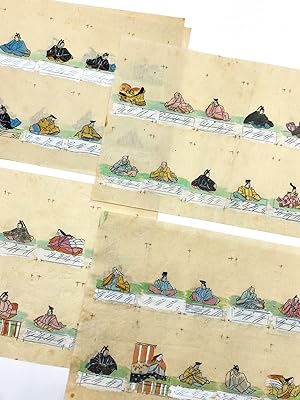
Original Painted Mockups For A Partial Set Of The Hyakunin Isshu Karuta
Verlag: n.p., [Japan], 1870
Anbieter: Type Punch Matrix, Silver Spring, MD, USA
Verkäuferbewertung 5 von 5 Sternen

Zustand: Very good plus. Beautiful drafted set of partial sheets for the creation of cards used in the traditional game on classical Japanese poetry. The aristocratic poet Fujiwara no Teika selected the poems of the HYAKUNIN ISSHU during the Heian period (794-1185), Japan's literary and artistic "Golden Age." These hundred poems soon became the standard introduction to waka poetry in Japan - the first encounter with the canon, much as Caesar's GALLIC WARS has been the gateway for students of Latin. The HYAKUNIN ISSU was also often the only source accessible to women, children, and members of the lower classes who wanted to explore this historically elite tradition; indeed, one fifth of the poets included are women, such as Murasaki Shikibu, author of THE TALE OF GENJI. Over the centuries, this compilation became a stable body of shared knowledge reflected in many aspects of Japanese cultural life, from clothing design to Noh theater to the art of Hokusai. The collection is still taught in schools, and most educated Japanese adults can recite poems from it. In this game, players pull cards that contain lines excerpted from one of the hundred poems in the HYAKUNIN ISSU, which they must then match with the card that contains the remaining poem. While this collection of sheets is incomplete (with only 60 cards out of 100 depicted), it includes a wide variety of images: eleven of the figures here are women, depicted with pre Meiji-era fashions including long, unbound hair (especially celebrated in Heian-era works like THE TALE OF GENJI); whitened faces; and high drawn eyebrows far up on the forehead; among the men authors depicted are gentlemen with elaborate coiffures, monks with shaved heads and prayer beads, and a warrior with bow and arrow. The illustrative interpretations from the many versions of this game have developed into a kind of iconography of famous poets, exerting a strong impact on the popular image of the classical Japanese author. Sheets 9.5'' x 13.5'' each. 6 sheets of thin Japanese paper with ten hand-painted figures each in two rows of five, rectos only (60 figures total). Sheets numbered at lower right corner 1-4 and 10 (lacking leaves 5-9). Some light spotting and crinkling to edges of leaves, else bright and clear.