

Gesamtpreis (1 Artikel Artikel):
Versandziel:

mycotoxin protocols (9 Ergebnisse)
Direkt zu den wichtigsten Suchergebnissen
Suchfilter
Produktart
- Alle Product Types
- Bücher (9)
- Magazine & Zeitschriften (Keine weiteren Ergebnisse entsprechen dieser Verfeinerung)
- Comics (Keine weiteren Ergebnisse entsprechen dieser Verfeinerung)
- Noten (Keine weiteren Ergebnisse entsprechen dieser Verfeinerung)
- Kunst, Grafik & Poster (Keine weiteren Ergebnisse entsprechen dieser Verfeinerung)
- Fotografien (Keine weiteren Ergebnisse entsprechen dieser Verfeinerung)
- Karten (Keine weiteren Ergebnisse entsprechen dieser Verfeinerung)
- Manuskripte & Papierantiquitäten (Keine weiteren Ergebnisse entsprechen dieser Verfeinerung)
Zustand Mehr dazu
- Neu (9)
- Wie Neu, Sehr Gut oder Gut Bis Sehr Gut (Keine weiteren Ergebnisse entsprechen dieser Verfeinerung)
- Gut oder Befriedigend (Keine weiteren Ergebnisse entsprechen dieser Verfeinerung)
- Ausreichend oder Schlecht (Keine weiteren Ergebnisse entsprechen dieser Verfeinerung)
- Wie beschrieben (Keine weiteren Ergebnisse entsprechen dieser Verfeinerung)
Einband
Weitere Eigenschaften
- Erstausgabe (Keine weiteren Ergebnisse entsprechen dieser Verfeinerung)
- Signiert (Keine weiteren Ergebnisse entsprechen dieser Verfeinerung)
- Schutzumschlag (Keine weiteren Ergebnisse entsprechen dieser Verfeinerung)
- Angebotsfoto (4)
Sprache (1)
Preis
- Beliebiger Preis
- Weniger als EUR 20 (Keine weiteren Ergebnisse entsprechen dieser Verfeinerung)
- EUR 20 bis EUR 45
- Mehr als EUR 45
Gratisversand
Land des Verkäufers
Verkäuferbewertung
-

Mycotoxin Protocols
Anbieter: Majestic Books, Hounslow, Vereinigtes Königreich
Verkäuferbewertung 4 von 5 Sternen

EUR 25,82
EUR 7,46 Versand
Versand von Vereinigtes Königreich nach USAAnzahl: 1 verfügbar
In den WarenkorbZustand: New. pp. 260 Figures, Illus.
-
Mycotoxin Protocols
Anbieter: Romtrade Corp., STERLING HEIGHTS, MI, USA
Verkäuferbewertung 5 von 5 Sternen

Zustand: New. This is a Brand-new US Edition. This Item may be shipped from US or any other country as we have multiple locations worldwide.
-

Mycotoxin Protocols (Methods in Molecular Biology)
Anbieter: Revaluation Books, Exeter, Vereinigtes Königreich
Verkäuferbewertung 5 von 5 Sternen
EUR 153,24
EUR 11,48 Versand
Versand von Vereinigtes Königreich nach USAAnzahl: 2 verfügbar
In den WarenkorbPaperback. Zustand: Brand New. 256 pages. 9.10x6.00x0.63 inches. In Stock.
-

Taschenbuch. Zustand: Neu. Mycotoxin Protocols | Mary W. Trucksess (u. a.) | Taschenbuch | xii | Englisch | 2013 | Humana | EAN 9781489938725 | Verantwortliche Person für die EU: Humana Press in Springer Science + Business Media, Heidelberger Platz 3, 14197 Berlin, juergen[dot]hartmann[at]springer[dot]com | Anbieter: preigu.
-
Zustand: New. Editor(s): Trucksess, Mary W.; Pohland, Albert E. Series: Methods in Molecular Biology. Num Pages: 244 pages, biography. BIC Classification: MMG. Category: (P) Professional & Vocational. Dimension: 229 x 152 x 14. Weight in Grams: 385. . 2013. Softcover reprint of the original 1st ed. 2001. Paperback. . . . . Books ship from the US and Ireland.
-

Mycotoxin Protocols
Sprache: Englisch
Verlag: Humana Press, Humana Press Aug 2013, 2013
ISBN 10: 1489938729 ISBN 13: 9781489938725
Anbieter: buchversandmimpf2000, Emtmannsberg, BAYE, Deutschland
Verkäuferbewertung 5 von 5 Sternen
Taschenbuch. Zustand: Neu. Neuware -Mycotoxins produced by molds are common contaminants of many important crops, including wheat, corn, rice, and peanuts. Some mycotoxins are found in fruits and vegetables. These contaminants have a broad range of toxic effects, including carcinogenicity, neurotoxicity, and reproductive and developmental toxicity. The occurrence of mycotoxins in foods is an unavoidable worldwide problem. About 80 countries have imposed regulatory limits to minimize human and animal exposure to mycotoxins. Regulatory limits, including international standards, have tremendous economic impact and must be developed using science-based risk assessments. The purpose of Mycotoxin Protocols is to provide the scientific and technological basis for analytical methods for use in obtaining the exposure data needed for risk assessments. Mycotoxin Protocols is divided into four sections, which are interc- nected. The first section: Chapters 1¿5 describe the general techniques for mycotoxin analysis with emphasis on the importance of method validation based on statistical parameters; sampling procedures for collecting a sample as representative as possible of a bulk lot; the isolation of mycotoxins for use as analytical standards or for toxicological studies; the evaluation of purity and preparation of standards; and the detection and identification of impu- ties in isolated mycotoxins. Sections 2¿4: Chapters 6¿19 describe the most current chromatographic and immunochemical methods for studies on the major mycotoxins.Humana Press in Springer Science + Business Media, Heidelberger Platz 3, 14197 Berlin 260 pp. Englisch.
-
Zustand: New. Editor(s): Trucksess, Mary W.; Pohland, Albert E. Series: Methods in Molecular Biology. Num Pages: 244 pages, biography. BIC Classification: MMGT; PSD. Category: (P) Professional & Vocational; (UP) Postgraduate, Research & Scholarly; (UU) Undergraduate. Dimension: 235 x 155 x 15. Weight in Grams: 543. . 2000. Hardback. . . . . Books ship from the US and Ireland.
-

EUR 118,64
EUR 48,99 Versand
Versand von Deutschland nach USAAnzahl: Mehr als 20 verfügbar
In den WarenkorbGebunden. Zustand: New. Mycotoxins produced by molds are common contaminants of many important crops, including wheat, corn, rice, and peanuts. Some mycotoxins are found in fruits and vegetables. These contaminants have a broad range of toxic effects, including carcinogenicity, ne.
-
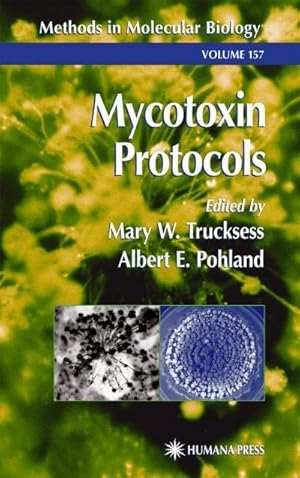
Mycotoxin Protocols
Anbieter: AHA-BUCH GmbH, Einbeck, Deutschland
Verkäuferbewertung 5 von 5 Sternen
Buch. Zustand: Neu. Neuware - Mycotoxins produced by molds are common contaminants of many important crops, including wheat, corn, rice, and peanuts. Some mycotoxins are found in fruits and vegetables. These contaminants have a broad range of toxic effects, including carcinogenicity, neurotoxicity, and reproductive and developmental toxicity. The occurrence of mycotoxins in foods is an unavoidable worldwide problem. About 80 countries have imposed regulatory limits to minimize human and animal exposure to mycotoxins. Regulatory limits, including international standards, have tremendous economic impact and must be developed using science-based risk assessments. The purpose of Mycotoxin Protocols is to provide the scientific and technological basis for analytical methods for use in obtaining the exposure data needed for risk assessments. Mycotoxin Protocols is divided into four sections, which are interc- nected. The first section: Chapters 1-5 describe the general techniques for mycotoxin analysis with emphasis on the importance of method validation based on statistical parameters; sampling procedures for collecting a sample as representative as possible of a bulk lot; the isolation of mycotoxins for use as analytical standards or for toxicological studies; the evaluation of purity and preparation of standards; and the detection and identification of impu- ties in isolated mycotoxins. Sections 2-4: Chapters 6-19 describe the most current chromatographic and immunochemical methods for studies on the major mycotoxins.

