
Gesamtpreis (1 Artikel Artikel):
Versandziel:

modeling verification real time systems (9 Ergebnisse)
Direkt zu den wichtigsten Suchergebnissen
Suchfilter
Produktart
- Alle Product Types
- Bücher (9)
- Magazine & Zeitschriften (Keine weiteren Ergebnisse entsprechen dieser Verfeinerung)
- Comics (Keine weiteren Ergebnisse entsprechen dieser Verfeinerung)
- Noten (Keine weiteren Ergebnisse entsprechen dieser Verfeinerung)
- Kunst, Grafik & Poster (Keine weiteren Ergebnisse entsprechen dieser Verfeinerung)
- Fotografien (Keine weiteren Ergebnisse entsprechen dieser Verfeinerung)
- Karten (Keine weiteren Ergebnisse entsprechen dieser Verfeinerung)
- Manuskripte & Papierantiquitäten (Keine weiteren Ergebnisse entsprechen dieser Verfeinerung)
Zustand Mehr dazu
- Neu (7)
- Wie Neu, Sehr Gut oder Gut Bis Sehr Gut (1)
- Gut oder Befriedigend (1)
- Ausreichend oder Schlecht (Keine weiteren Ergebnisse entsprechen dieser Verfeinerung)
- Wie beschrieben (Keine weiteren Ergebnisse entsprechen dieser Verfeinerung)
Einband
Weitere Eigenschaften
- Erstausgabe (Keine weiteren Ergebnisse entsprechen dieser Verfeinerung)
- Signiert (Keine weiteren Ergebnisse entsprechen dieser Verfeinerung)
- Schutzumschlag (Keine weiteren Ergebnisse entsprechen dieser Verfeinerung)
- Angebotsfoto (6)
Sprache (1)
Preis
- Beliebiger Preis
- Weniger als EUR 20 (Keine weiteren Ergebnisse entsprechen dieser Verfeinerung)
- EUR 20 bis EUR 45
- Mehr als EUR 45
Gratisversand
Land des Verkäufers
Verkäuferbewertung
-
Modeling and Verification of Real-Time Systems
Sprache: Englisch
Verlag: ISTE Ltd and John Wiley & Sons Inc, 2008
ISBN 10: 1848210132 ISBN 13: 9781848210134
Hardcover. Zustand: Très bon. Ancien livre de bibliothèque. Couverture différente. Edition 2008. Ammareal reverse jusqu'à 15% du prix net de cet article à des organisations caritatives. ENGLISH DESCRIPTION Book Condition: Used, Very good. Former library book. Different cover. Edition 2008. Ammareal gives back up to 15% of this item's net price to charity organizations.
-

Modeling, Verification, and Exploration of Task-Level Concurrency of Real-Time Embedded Systems
Anbieter: Better World Books, Mishawaka, IN, USA
Verkäuferbewertung 5 von 5 Sternen

Zustand: Good. Former library book; may include library markings. Used book that is in clean, average condition without any missing pages.
-

EUR 136,16
EUR 48,99 shipping
Versand von Deutschland nach USAAnzahl: Mehr als 20 verfügbar
In den WarenkorbZustand: New.
-

Taschenbuch. Zustand: Neu. Modeling, Verification and Exploration of Task-Level Concurrency in Real-Time Embedded Systems | Filip Thoen (u. a.) | Taschenbuch | xv | Englisch | 2012 | Springer | EAN 9781461369981 | Verantwortliche Person für die EU: Springer Verlag GmbH, Tiergartenstr. 17, 69121 Heidelberg, juergen[dot]hartmann[at]springer[dot]com | Anbieter: preigu.
-

EUR 178,14
EUR 48,99 shipping
Versand von Deutschland nach USAAnzahl: Mehr als 20 verfügbar
In den WarenkorbGebunden. Zustand: New.
-

Modeling, Verification and Exploration of Task-Level Concurrency in Real-Time Embedded Systems
Anbieter: AHA-BUCH GmbH, Einbeck, Deutschland
Verkäuferbewertung 5 von 5 Sternen
Taschenbuch. Zustand: Neu. Druck auf Anfrage Neuware - Printed after ordering - system is a complex object containing a significant percentage of elec A tronics that interacts with the Real World (physical environments, humans, etc. ) through sensing and actuating devices. A system is heterogeneous, i. e. , is characterized by the co-existence of a large number of components of disparate type and function (for example, programmable components such as micro processors and Digital Signal Processors (DSPs), analog components such as AID and D/A converters, sensors, transmitters and receivers). Any approach to system design today must include software concerns to be viable. In fact, it is now common knowledge that more than 70% of the development cost for complex systems such as automotive electronics and communication systems are due to software development. In addition, this percentage is increasing constantly. It has been my take for years that the so-called hardware-software co-design problem is formulated at a too low level to yield significant results in shorten ing design time to the point needed for next generation electronic devices and systems. The level of abstraction has to be raised to the Architecture-Function co-design problem, where Function refers to the operations that the system is supposed to carry out and Architecture is the set of supporting components for that functionality. The supporting components as we said above are heteroge neous and contain almost always programmable components.
-

Modeling, Verification and Exploration of Task-Level Concurrency in Real-Time Embedded Systems
Anbieter: Revaluation Books, Exeter, Vereinigtes Königreich
Verkäuferbewertung 5 von 5 Sternen
EUR 231,58
EUR 14,23 shipping
Versand von Vereinigtes Königreich nach USAAnzahl: 2 verfügbar
In den WarenkorbPaperback. Zustand: Brand New. reprint edition. 454 pages. 9.45x6.30x1.03 inches. In Stock.
-

EUR 261,07
EUR 48,99 shipping
Versand von Deutschland nach USAAnzahl: Mehr als 20 verfügbar
In den WarenkorbGebunden. Zustand: New. Topics addressed include mathematical models of real-time systems and associated formal verification techniques such as model checking, probabilistic modeling and verification, programming and description languages, and validation approaches based on testin.
-
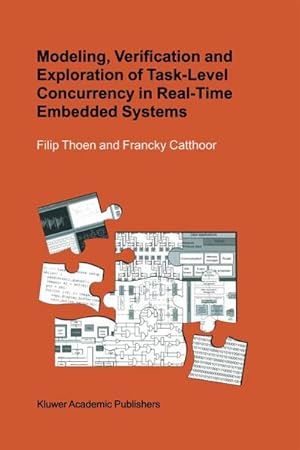
Modeling, Verification and Exploration of Task-Level Concurrency in Real-Time Embedded Systems
Anbieter: AHA-BUCH GmbH, Einbeck, Deutschland
Verkäuferbewertung 5 von 5 Sternen
Buch. Zustand: Neu. Neuware - system is a complex object containing a significant percentage of elec A tronics that interacts with the Real World (physical environments, humans, etc. ) through sensing and actuating devices. A system is heterogeneous, i. e. , is characterized by the co-existence of a large number of components of disparate type and function (for example, programmable components such as micro processors and Digital Signal Processors (DSPs), analog components such as AID and D/A converters, sensors, transmitters and receivers). Any approach to system design today must include software concerns to be viable. In fact, it is now common knowledge that more than 70% of the development cost for complex systems such as automotive electronics and communication systems are due to software development. In addition, this percentage is increasing constantly. It has been my take for years that the so-called hardware-software co-design problem is formulated at a too low level to yield significant results in shorten ing design time to the point needed for next generation electronic devices and systems. The level of abstraction has to be raised to the Architecture-Function co-design problem, where Function refers to the operations that the system is supposed to carry out and Architecture is the set of supporting components for that functionality. The supporting components as we said above are heteroge neous and contain almost always programmable components.

