

Gesamtpreis (1 Artikel Artikel):
Versandziel:

materials science static high (7 Ergebnisse)
Direkt zu den wichtigsten Suchergebnissen
Suchfilter
Produktart
- Alle Product Types
- Bücher (7)
- Magazine & Zeitschriften (Keine weiteren Ergebnisse entsprechen dieser Verfeinerung)
- Comics (Keine weiteren Ergebnisse entsprechen dieser Verfeinerung)
- Noten (Keine weiteren Ergebnisse entsprechen dieser Verfeinerung)
- Kunst, Grafik & Poster (Keine weiteren Ergebnisse entsprechen dieser Verfeinerung)
- Fotografien (Keine weiteren Ergebnisse entsprechen dieser Verfeinerung)
- Karten (Keine weiteren Ergebnisse entsprechen dieser Verfeinerung)
- Manuskripte & Papierantiquitäten (Keine weiteren Ergebnisse entsprechen dieser Verfeinerung)
Zustand Mehr dazu
- Neu (6)
- Wie Neu, Sehr Gut oder Gut Bis Sehr Gut (Keine weiteren Ergebnisse entsprechen dieser Verfeinerung)
- Gut oder Befriedigend (1)
- Ausreichend oder Schlecht (Keine weiteren Ergebnisse entsprechen dieser Verfeinerung)
- Wie beschrieben (Keine weiteren Ergebnisse entsprechen dieser Verfeinerung)
Einband
Weitere Eigenschaften
- Erstausgabe (1)
- Signiert (Keine weiteren Ergebnisse entsprechen dieser Verfeinerung)
- Schutzumschlag (Keine weiteren Ergebnisse entsprechen dieser Verfeinerung)
- Angebotsfoto (4)
Sprache (1)
Preis
- Beliebiger Preis
- Weniger als EUR 20 (Keine weiteren Ergebnisse entsprechen dieser Verfeinerung)
- EUR 20 bis EUR 45 (Keine weiteren Ergebnisse entsprechen dieser Verfeinerung)
- Mehr als EUR 45
Gratisversand
Land des Verkäufers
Verkäuferbewertung
-
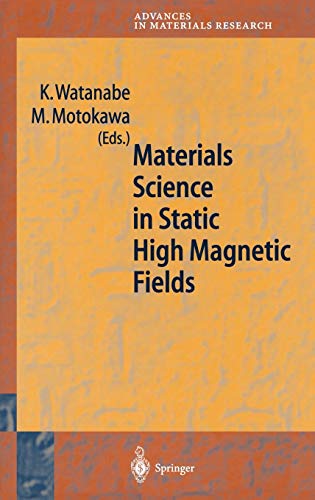
Materials Science in Static High Magnetic Fields
Sprache: Englisch
Verlag: Springer Berlin / Heidelberg, 2001
ISBN 10: 3540419950 ISBN 13: 9783540419952
Anbieter: Better World Books, Mishawaka, IN, USA
Verkäuferbewertung 5 von 5 Sternen

Erstausgabe
Zustand: Good. 1st Edition. Former library copy. Pages intact with minimal writing/highlighting. The binding may be loose and creased. Dust jackets/supplements are not included. Includes library markings. Stock photo provided. Product includes identifying sticker. Better World Books: Buy Books. Do Good.
-
Materials Science In Static High Magnetic Fields (Hb)
Anbieter: Romtrade Corp., STERLING HEIGHTS, MI, USA
Verkäuferbewertung 5 von 5 Sternen
Zustand: New. This is a Brand-new US Edition. This Item may be shipped from US or any other country as we have multiple locations worldwide.
-
Materials Science In Static High Magnetic Fields
Anbieter: Romtrade Corp., STERLING HEIGHTS, MI, USA
Verkäuferbewertung 5 von 5 Sternen
Zustand: New. This is a Brand-new US Edition. This Item may be shipped from US or any other country as we have multiple locations worldwide.
-

Materials Science in Static High Magnetic Fields
Sprache: Englisch
Verlag: Springer Berlin Heidelberg, 2001
ISBN 10: 3540419950 ISBN 13: 9783540419952
EUR 118,64
EUR 48,99 Versand
Versand von Deutschland nach USAAnzahl: Mehr als 20 verfügbar
In den WarenkorbGebunden. Zustand: New. Presents the most comprehensive review of the influence of highly intense magnetic fields on materials of various classes.|There is no strict definition of the term High Magnetic Field . It has been proposed to use this term for magnetic fields that.
-
Taschenbuch. Zustand: Neu. Materials Science in Static High Magnetic Fields | M. Motokawa (u. a.) | Taschenbuch | xx | Englisch | 2012 | Springer-Verlag GmbH | EAN 9783642626357 | Verantwortliche Person für die EU: Springer Verlag GmbH, Tiergartenstr. 17, 69121 Heidelberg, juergen[dot]hartmann[at]springer[dot]com | Anbieter: preigu.
-

Materials Science in Static High Magnetic Fields
Sprache: Englisch
Verlag: Springer Berlin Heidelberg, 2012
ISBN 10: 3642626351 ISBN 13: 9783642626357
Anbieter: AHA-BUCH GmbH, Einbeck, Deutschland
Verkäuferbewertung 5 von 5 Sternen
Taschenbuch. Zustand: Neu. Druck auf Anfrage Neuware - Printed after ordering - There is no strict definition of the term 'High Magnetic Field'. It has been proposed to use this term for magnetic fields that are technically difficult to generate and therefore need special equipment or large resources. Static fields above 20 T are apparently high magnetic fields in this sense, but in the case of pulsed field 40 T is easy to obtain and any field lower than this approximate limit should not be considered as 'high'. When a static field is used for materials processing, even 10 T is considered as 'high' because the long-term use of a conventional superconducting magnet is difficult. Recently, there has been much technical progress in producing high mag netic fields, both pulsed and static; in large part this is due to the devel opment of new materials. Complicated poly-helix coils are now replaced by simple Bitter coils made with plates of CuAg alloy with high strength and high conductivity; these are used in both water-cooled and hybrid magnets (now up to 45 Tat NHMFL, the US National High Magnetic Field Labora tory at Tallahassee, Florida). By using CuAg wire, a nondestructive pulsed field record of 80 T has been achieved at Osaka University. For daily use in experiments, 70-75 T should soon become available. Major facilities for static high fields worldwide are planning to generate fields over 40 T by increasing the electric power. On the other hand, the use of static high magnetic fields is expanding.
-

Materials Science in Static High Magnetic Fields
Sprache: Englisch
Verlag: Springer, Berlin, Springer Berlin Heidelberg, Springer, 2001
ISBN 10: 3540419950 ISBN 13: 9783540419952
Anbieter: AHA-BUCH GmbH, Einbeck, Deutschland
Verkäuferbewertung 5 von 5 Sternen
Buch. Zustand: Neu. Neuware - There is no strict definition of the term 'High Magnetic Field'. It has been proposed to use this term for magnetic fields that are technically difficult to generate and therefore need special equipment or large resources. Static fields above 20 T are apparently high magnetic fields in this sense, but in the case of pulsed field 40 T is easy to obtain and any field lower than this approximate limit should not be considered as 'high'. When a static field is used for materials processing, even 10 T is considered as 'high' because the long-term use of a conventional superconducting magnet is difficult. Recently, there has been much technical progress in producing high mag netic fields, both pulsed and static; in large part this is due to the devel opment of new materials. Complicated poly-helix coils are now replaced by simple Bitter coils made with plates of CuAg alloy with high strength and high conductivity; these are used in both water-cooled and hybrid magnets (now up to 45 Tat NHMFL, the US National High Magnetic Field Labora tory at Tallahassee, Florida). By using CuAg wire, a nondestructive pulsed field record of 80 T has been achieved at Osaka University. For daily use in experiments, 70-75 T should soon become available. Major facilities for static high fields worldwide are planning to generate fields over 40 T by increasing the electric power. On the other hand, the use of static high magnetic fields is expanding.


