Gesamtpreis (1 Artikel Artikel):
Versandziel:

lart arabe daprès monuments kaire von prisse davennes achille constant (3 Ergebnisse)
Direkt zu den wichtigsten Suchergebnissen
Suchfilter
Produktart
- Alle Product Types
- Bücher (3)
- Magazine & Zeitschriften (Keine weiteren Ergebnisse entsprechen dieser Verfeinerung)
- Comics (Keine weiteren Ergebnisse entsprechen dieser Verfeinerung)
- Noten (Keine weiteren Ergebnisse entsprechen dieser Verfeinerung)
- Kunst, Grafik & Poster (Keine weiteren Ergebnisse entsprechen dieser Verfeinerung)
- Fotografien (Keine weiteren Ergebnisse entsprechen dieser Verfeinerung)
- Karten (Keine weiteren Ergebnisse entsprechen dieser Verfeinerung)
- Manuskripte & Papierantiquitäten (Keine weiteren Ergebnisse entsprechen dieser Verfeinerung)
Zustand Mehr dazu
- Neu (Keine weiteren Ergebnisse entsprechen dieser Verfeinerung)
- Wie Neu, Sehr Gut oder Gut Bis Sehr Gut (2)
- Gut oder Befriedigend (Keine weiteren Ergebnisse entsprechen dieser Verfeinerung)
- Ausreichend oder Schlecht (Keine weiteren Ergebnisse entsprechen dieser Verfeinerung)
- Wie beschrieben (1)
Einband
- alle Einbände
- Hardcover (3)
- Softcover (Keine weiteren Ergebnisse entsprechen dieser Verfeinerung)
Weitere Eigenschaften
- Erstausgabe (1)
- Signiert (Keine weiteren Ergebnisse entsprechen dieser Verfeinerung)
- Schutzumschlag (Keine weiteren Ergebnisse entsprechen dieser Verfeinerung)
- Angebotsfoto (3)
Sprache (2)
Preis
- Beliebiger Preis
- Weniger als EUR 20 (Keine weiteren Ergebnisse entsprechen dieser Verfeinerung)
- EUR 20 bis EUR 45 (Keine weiteren Ergebnisse entsprechen dieser Verfeinerung)
- Mehr als EUR 45
Gratisversand
- Kostenloser Versand nach USA (Keine weiteren Ergebnisse entsprechen dieser Verfeinerung)
Land des Verkäufers
Verkäuferbewertung
-
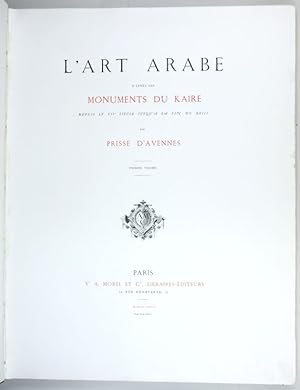
Arte Araba Al Cairo. L'Art Arabe d'après Les Monuments du Kaire depuis le VIIè Siècle Jusqu'a la fin du XVIIIè. THREE VOLUMES.
Verlag: Khayat Book & Publishing Company, S. A. L., Beirut
Sprache: Französisch
Anbieter: FOLIOS LIMITED, Oxford, Vereinigtes Königreich
Verkäuferbewertung 5 von 5 Sternen

EUR 944,69
EUR 34,39 shipping
Ships from Vereinigtes Königreich to USAAnzahl: 1 verfügbar
In den WarenkorbHardcover. Zustand: As New. Reprint. 199 plates of which some in colour, captions of the plates in French & Arabic, half-titles, colour vignettes on half-title pages, titles in red and balck, original gilt decorated half leather, set in mint condition, facsimile reprint of the first edition of 1877, bound in Italy by Legatoria Pegaso, reprinted by Eastern Art, Khayat Book & Publishing Company, S. A. L. Beirut, [ca. 1977]. Prisse d'Avennes was, in many ways, a paradox. An artist of consummate skill, he was also a writer, scientist, scholar, engineer and linguist, a genius who spent much of his life among the illiterate. French to the bone, he was of British blood; a European, he embraced Islam and took the name Edris-Effendi. By nature contentious, he alienated colleagues, yet succoured the sick and the poor. Of the hundreds of 19th century Western artists, scholars and writers who gravitated to the Islamic world following Napoleon's invasion of Egypt in 1798, few possessed so prodigious an intellect, such a trove of talents, so insatiable a curiosity or so passionate a commitment to record the historical and artistic patrimony of ancient Egypt and medieval Islam. He succeeded brilliantly, yet he failed to achieve the stature to which his successes entitled him, both during his lifetime and in the 111 years since his death. He remains, as arts writer Briony Llewellyn calls him, "a shadowy figure in the history both of Egyptology and of European response to Islamic art." Prisse d'Avennes was a fine artist and an outstandingly brilliant observer who recorded much that has since disappeared. In this monumental work he recorded Arab Art in Cairo through splendid plates of architectural studies, mosaics, ornaments, interior designs, textiles, carpets, civil and religious furniture, Islamic book binding, miniatures, and different types of Qur'anic script. [Reference: For the first edition see Creswell, 81]. Prisse wrote for scientific journals, published treatises and kept active in learned societies, while working on L'Histoire de L'Art Egyptien" and L'Art Arabe. He made excursions to Egypt, worked on the Egyptian exhibit for the World Exposition of 1867 and was director and chief hydrographics engineer for the French company charged by Isma'il Pasha to produce a plan for the exploitation of the lakes of northern Egypt. When the pasha cancelled the project at the last moment, Prisse resigned the post and, for the next 10 years, devoted himself exclusively to his masterworks, the astounding energies of his youth clearly intact. Apart from the literary demands, Prisse trained teams of artists especially to prepare the plates for his book, monitoring their work relentlessly, until each plate precisely replicated the original drawing. L'Histoire de I'Art Egyptien, published in its entirety in 1877 by the Librairie Scientifique of Paris, consisted of two volumes containing 160 plates and a separate volume of text written by P. Marchandon de la Faye on the basis of notes by Prisse, who was forced by circumstances to accept this arrangement. Illustrated sections on architecture, sculpture, paintings and industrial arts underscored the close correlation between the arts and the history of ancient Egypt, Prisse noted, revealed the course and progress of Egypt's civilisation, its surprising customs and its religious thought. Shown "with excellent splendour" at the World Exposition of 1878, L'Histoire de l'Art Egyptien became an important part of the body of Egyptology and, in that sense, Prisse's hopes were fulfilled. But for L'Art Arabe, he wanted more. He wanted to inspire the artists and architects of his time with fresh ideas to counter "the poverty of invention that so justly inflames those who profess to worship beauty." Above all, he wanted to stir the public to understand and appreciate the epoch whose art had graced a millennium and inspired the Renaissance. #18829.
-
L'Art arabe d'après les monuments du Kaire depuis le VIIe siècle jusqu'à la fin du XVIIIe
Verlag: P., Morel, 1877
Anbieter: Librairie de l'Avenue - Henri Veyrier, Saint-Ouen, FR, Frankreich
Verkäuferbewertung 5 von 5 Sternen
Couverture rigide. Zustand: Bon état. 3 volumes in-folio 573 x 400 mm, demi-basane cerise, dos à nerfs, faux-titre, titre & table à chaque volume, 200 planches lithographiées ou gravées, certaines d'après Giraud de Prangey, la plupart teintées. Rares rousseurs. Petits effrangements et légère humidité ou ternisseurs marginales pour une dizaine de planches, néanmoins très bon exemplaire. Les trois atlas seuls (sans le volume de texte de format in-4) du plus important ouvrage du XIXe siècle entièrement consacré à l'art arabe. Très richement illustré, il contient des vues lithographiées d'après le grand photographe Giraud de Prangey, l'un des premiers voyageurs français à prendre des photographies au Caire et à Jérusalem. Les belles planches représentent des vues de vestiges (extérieur et intérieur) et des détails d'ornementations (portes, heurtoirs, flambeaux, plats, etc.). in-folio.
-
L'Art Arabe d'après les monuments du Kaire depuis le VIIe siècle jusqu'la fin du XVIIIe.
Verlag: Paris, Morel, [1869-]1877., 1877
Anbieter: Antiquariat INLIBRIS Gilhofer Nfg. GmbH, Vienna, A, Österreich
Verbandsmitglied: ILAB VDA VDAO
Verkäuferbewertung 5 von 5 Sternen
Erstausgabe
1 volume of text (4to) and 3 vols. of plates (large folio). Text: 1 bl. f., title leaf, viii, 296 pp., 1 bl. f. With 34 lithogr. plates (all with tissue guards) and 73 text illustrations. Half morocco with giltstamped title to gilt spine. Spine rebacked. Plate volumes all with half title, title, list of contents and a total of 200 engraved plates (130 of which are chromolithographs and 48 tinted lithographs). Plate volumes bound uniformly with text volume in giltstamped half morocco with cloth covers. Very scarce first edition of this splendid, unsurpassed standard work on Islamic art. Prisse d'Avennes spent many years in Egypt after 1826, first as an engineer in the service of Mehmet Ali. After 1836 he explored Egypt disguised as an Arab and using the name Edris Effendi; during this period he carried out archaeological excavations in the valley of the Nile. In 1860, Prisse d'Avennes returned to France with a wealth of documentation and drawings, which he subsequently had reproduced by specially trained draughtsmen and published in this monumental set. "'Arab Art', however, is more than a monument to the author's tenacity, skill, and devotion. For the historian of architecture, it is a precise source, a unique documentary record [.] On an entirely different level, Prisse d'Avennes has provided today's architects, designers, artists, and illustrators with some of the finest examples of measured drawings, pattern details, and illustrations of selected aspects of the built environment of a medieval Islamic city. But 'Arab Art' is not merely an exercise in architectural description. Prisse d'Avennes writes about and records in the plates art forms ranging from elaborately decorated tiles to carpets and fabrics, to Korans and illuminated manuscripts. His text examines how these objects were made and the way they were used, and describes the value placed on them by contemporary society. The result is that his book offers invaluable glimpses of aspects of Arab life as they were viewed by a sympathetic West European" (preface to the 1963 London edition). - Beautiful, complete set (the last copy sold at auction was incomplete). Text and plates uncommonly clean and in an excellent state of preservation throughout, in contrast to the known copies in libraries and in institutional possession. - Ibrahim-Hilmy II, 138-140.