Gesamtpreis (1 Artikel Artikel):
Versandziel:

iton rishmi (4 Ergebnisse)
Direkt zu den wichtigsten Suchergebnissen
Suchfilter
Produktart
- Alle Product Types
- Bücher (4)
- Magazine & Zeitschriften (Keine weiteren Ergebnisse entsprechen dieser Verfeinerung)
- Comics (Keine weiteren Ergebnisse entsprechen dieser Verfeinerung)
- Noten (Keine weiteren Ergebnisse entsprechen dieser Verfeinerung)
- Kunst, Grafik & Poster (Keine weiteren Ergebnisse entsprechen dieser Verfeinerung)
- Fotografien (Keine weiteren Ergebnisse entsprechen dieser Verfeinerung)
- Karten (Keine weiteren Ergebnisse entsprechen dieser Verfeinerung)
- Manuskripte & Papierantiquitäten (Keine weiteren Ergebnisse entsprechen dieser Verfeinerung)
Zustand Mehr dazu
- Neu (Keine weiteren Ergebnisse entsprechen dieser Verfeinerung)
- Wie Neu, Sehr Gut oder Gut Bis Sehr Gut (Keine weiteren Ergebnisse entsprechen dieser Verfeinerung)
- Gut oder Befriedigend (1)
- Ausreichend oder Schlecht (Keine weiteren Ergebnisse entsprechen dieser Verfeinerung)
- Wie beschrieben (3)
Einband
- alle Einbände
- Hardcover (2)
- Softcover (Keine weiteren Ergebnisse entsprechen dieser Verfeinerung)
Weitere Eigenschaften
- Erstausgabe (2)
- Signiert (1)
- Schutzumschlag (Keine weiteren Ergebnisse entsprechen dieser Verfeinerung)
- Angebotsfoto (4)
Sprache (1)
Preis
- Beliebiger Preis
- Weniger als EUR 20 (Keine weiteren Ergebnisse entsprechen dieser Verfeinerung)
- EUR 20 bis EUR 45 (Keine weiteren Ergebnisse entsprechen dieser Verfeinerung)
- Mehr als EUR 45
Gratisversand
Land des Verkäufers
Verkäuferbewertung
-
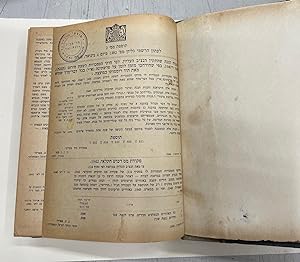
Declaration of the Establishment of the State of Israel. In: Iton Rishmi, Official Gazette of Israel, No.1.
Verlag: Tel Aviv 14 May ., 1948
Anbieter: Robert Frew Ltd. ABA ILAB, London, Vereinigtes Königreich
Verbandsmitglied: ABA ILAB PBFA
Verkäuferbewertung 5 von 5 Sternen

EUR 5.947,23
EUR 11,55 Versand
Versand von Vereinigtes Königreich nach USAAnzahl: 1 verfügbar
In den WarenkorbFirst printing of the Israeli Declaration of Independence. Folio (32.5 x 21.5 cm). pp.[4]. Unbound as issued, text in Hebrew. Housed in a bespoke box of half blue morocco over marbled boards. One hole punch to upper right, faint traces of a Hebrew stamp to recto of first leaf, generally in very good clean condition. Scarce first printing of the Israeli Declaration of Independence, the seminal historical document that established the first Jewish state in 2000 years. Originally published in the first issue of the Official Gazette of the Israeli provisional government, this landmark publication was printed on the first day of the birth of Israel. A bound set of "Iton Rishmi" reprinting this historic publication was issued later the same year. Formally entitled the Declaration of the Establishment of the State of Israel, the Israeli Declaration of Independence was proclaimed on May 14 1948, by David Ben-Gurion, the executive head of the World Zionist Organization, chairman of the Jewish Agency for Palestine, and, shortly after, the first Prime minister of Israel. It declared the establishment of a Jewish state in Eretz-Israel, to be known as the State of Israel. This was the first publication rescinding the 1937 White Paper that had restricted Jewish immigration to Palestine. With the names of all of the signing members of the Provisional Government, headed by David Ben-Gurion, printed on p. 2, this document heralded the end of British involvement in Palestine, and the start of unrestricted immigration into the new Jewish state. It publishes for the very first time the full declaration as read out by Ben-Gurion at 4 pm on Friday, 14 May 1948, in the Tel-Aviv Museum (known today as Independence Hall). It announced that the National Council was to become the Provisional Government of Israel until a Constituent Assembly was formed on 1 October 1948. The address investigates the impetus towards the declaration, including the Balfour Declaration, the British Mandate and the harrowing events of WWII, and looks forward to full co-operation with the United Nations. The state of Israel, it says, "will uphold the full social and political equality of all its citizens, without distinction of race, creed or sex".
-
HA-ITON RISHMI Shel Memshelet Palestina (PALESTINE GAZETTE- HEBREW ) 1939- 1945. 14 VOLUMES
Verlag: Government Printer, Jerusalem, 1939
Anbieter: M.POLLAK ANTIQUARIAT Est.1899, ABA, ILAB, Tel-Aviv, Israel
Verkäuferbewertung 4 von 5 Sternen

Erstausgabe
Half Cloth. Zustand: Very Good. First Edition. Some 12000pp for the 14 volumes. HEBREW LANGUAGE. Each colume with owner's stamp on the firtst page ( MODAI ADVOCATES -TEL AVIV) Some spotting on edges and front end papers. A few pages loose. General minimal wear. UNIFORM HALF CLOTH BINDING. A VERY GOOD COPY OF THIS RARE OFFFICIAL PUBLICATION FO THE PALESTINE MANDATE.
-
![Bild des Verkäufers für Iton Rishmi. [Official Gazette of Israel, no. 1]. zum Verkauf von Antiquariat INLIBRIS Gilhofer Nfg. GmbH](https://pictures.abebooks.com/inventory/md/md31480353499.jpg)
Iton Rishmi. [Official Gazette of Israel, no. 1].
Verlag: Tel Aviv, HaPo'el HaTza'ir printing press, for the Provisional Government (Hachrazah Al Hakamat Medinat Yisrael), 14. V. 1948., 1948
Anbieter: Antiquariat INLIBRIS Gilhofer Nfg. GmbH, Vienna, A, Österreich
Verbandsmitglied: ILAB VDA VDAO
Verkäuferbewertung 5 von 5 Sternen
Erstausgabe
EUR 12.500,00
EUR 30,00 Versand
Versand von Österreich nach USAAnzahl: 1 verfügbar
In den WarenkorbSmall folio (208 x 333 mm). 3, (1) pp. on a bifolium. First printing of the Israeli Declaration of Independence. This was the first publication rescinding the 1937 White Paper that had restricted Jewish immigration to Palestine. With the names of all of the signing members of the Provisional Government, headed by David Ben-Gurion, printed on p. 2, this document heralded the end of British involvement in Palestine, and the start of unrestricted immigration into the new Jewish state. It publishes for the very first time the full declaration as read out by Ben-Gurion at 4 pm on Friday, 14 May 1948, in the Tel-Aviv Museum (known today as Independence Hall). It announced that the National Council was to become the Provisional Government of Israel until a Constituent Assembly was formed on 1 October 1948. The address investigates the impetus towards the declaration, including the Balfour Declaration, the British Mandate and the harrowing events of WWII, and looks forward to full co-operation with the United Nations. The state of Israel, it says, "will uphold the full social and political equality of all its citizens, without distinction of race, creed or sex". - This very rare first issue is printed on lighter paper than the subsequent issues were. A few very minor edge flaws, but an uncommonly well preserved specimen of an iconic publication, printed on the first day of the birth of Israel.
-
![Bild des Verkäufers für Declaration of the Establishment of the State of Israel [in Hebrew]. In: Iton Rishmi [in Hebrew],Official Gazette of Israel. - [THE BIRTH OF ISRAEL] zum Verkauf von Herman H. J. Lynge & Søn ILAB-ABF](https://pictures.abebooks.com/inventory/md/md31363371602.jpg)
Declaration of the Establishment of the State of Israel [in Hebrew]. In: Iton Rishmi [in Hebrew],Official Gazette of Israel. - [THE BIRTH OF ISRAEL]
Anbieter: Herman H. J. Lynge & Søn ILAB-ABF, Copenhagen, Dänemark
Verkäuferbewertung 4 von 5 Sternen
Signiert
Tel Aviv, 14 May 1948. Folio. (4) pp. Unbound as issued. In near perfect condition. Scarce first printing of the Israeli Declaration of Independence, the seminal historical document that establishes the first Jewish state in 2.000 years. Contained in the first issue of the Official Gazette of the Israeli provisional government, this landmark publication was printed on the first day of the birth of Israel. A bound set of "Iton Rishmi" reprinting this historic publication was issued later the same year. Formally entitled the Declaration of the Establishment of the State of Israel, the Israeli Declaration of Independence was proclaimed on May 14 1948, by David Ben-Gurion, the executive head of the World Zionist Organization, chairman of the Jewish Agency for Palestine, and, shortly after, the first Prime minister of Israel. It declared the establishment of a Jewish state in Eretz-Israel, to be known as the State of Israel. "The Land of Israel was the birthplace of the Jewish people. Here, their spiritual, religious, and national identity was formed. Here, they achieved independence and created a culture of national and universal significance. Here, they wrote and gave the Bible to the world.Exiled from Palestine, the Jewish people remained faithful to it in all the countries of their dispersion, never ceasing to pray and hope for their return and the restoration of their national freedom." Thus begins the seminal historical document that constitutes one of the most important political ones of recent times. Immediately following the British army withdrawal earlier on May 14, war broke out between Jews and Arabs. Egypt launched an air assault against Israel that same evening. Despite a blackout in Tel Aviv-and the expected Arab invasion-Jews celebrated the birth of their new nation, especially after word was received that the United States had recognized the Jewish state. At midnight, the State of Israel officially came into being upon termination of the British mandate in Palestine. "Using the American Declaration of Independence and the U.S. Constitution as philosophical frameworks, a small group of attorneys and politicians pieced together Israel's Declaration of Independence. Other important political decisions pertaining to Jewish statehood were left until the last minute: the location of the State's capital, its final name, and how to bring together several Jewish military organizations under one command. Military operations, particularly those around the Jewish settlement at Kfar Etzion, south of Jerusalem, diverted attention from final decisions about these matters. Also pressing on David Ben-Gurion, the head of the Jewish Agency and future first Prime Minister of Israel,was the request by President Truman's White House asking for a formal written request for recognition.On Friday, May 14, following some debate, the National Council, established to oversee the political needs of the Jewish community in Palestine, voted to accept the final text of the Declaration. That afternoon at 4 pm, David Ben-Gurion, head of the National Council, read the Declaration at the Tel Aviv Museum. Without electricity in Jerusalem, few there heard Ben-Gurion's words or the singing and playing of 'Hatikvah,' Israel's national anthem. That morning, Ben-Gurion, uncertain about the coming war with Arab states, had his secretary secure a safety deposit box at a local bank so that the Declaration could be immediately placed there for safekeeping. The Declaration was a synopsis of Jewish history to 1948 and a statement of Israel's intent toward its inhabitants, neighbors, and the international community. It was divided into four parts: 1) a biblical, historical, and international legal case for the existence of a Jewish state in the Land of Israel" 2) the self-evident right of the Jewish people to claim statehood 3) the actual declaration of statehood" and 4) statements about how the state would operate, including an enumeration of citizen rights. In.