
Gesamtpreis (1 Artikel Artikel):
Versandziel:

humanities data exploring networks von tilton lauren (5 Ergebnisse)
Direkt zu den wichtigsten Suchergebnissen
Suchfilter
Produktart
- Alle Product Types
- Bücher (5)
- Magazine & Zeitschriften (Keine weiteren Ergebnisse entsprechen dieser Verfeinerung)
- Comics (Keine weiteren Ergebnisse entsprechen dieser Verfeinerung)
- Noten (Keine weiteren Ergebnisse entsprechen dieser Verfeinerung)
- Kunst, Grafik & Poster (Keine weiteren Ergebnisse entsprechen dieser Verfeinerung)
- Fotografien (Keine weiteren Ergebnisse entsprechen dieser Verfeinerung)
- Karten (Keine weiteren Ergebnisse entsprechen dieser Verfeinerung)
- Manuskripte & Papierantiquitäten (Keine weiteren Ergebnisse entsprechen dieser Verfeinerung)
Zustand Mehr dazu
- Neu (4)
- Wie Neu, Sehr Gut oder Gut Bis Sehr Gut (Keine weiteren Ergebnisse entsprechen dieser Verfeinerung)
- Gut oder Befriedigend (1)
- Ausreichend oder Schlecht (Keine weiteren Ergebnisse entsprechen dieser Verfeinerung)
- Wie beschrieben (Keine weiteren Ergebnisse entsprechen dieser Verfeinerung)
Einband
Weitere Eigenschaften
- Erstausgabe (Keine weiteren Ergebnisse entsprechen dieser Verfeinerung)
- Signiert (Keine weiteren Ergebnisse entsprechen dieser Verfeinerung)
- Schutzumschlag (Keine weiteren Ergebnisse entsprechen dieser Verfeinerung)
- Angebotsfoto (2)
Sprache (1)
Preis
- Beliebiger Preis
- Weniger als EUR 20 (Keine weiteren Ergebnisse entsprechen dieser Verfeinerung)
- EUR 20 bis EUR 45
- Mehr als EUR 45
Gratisversand
Land des Verkäufers
Verkäuferbewertung
-
Hardcover. Zustand: Good. 2015. It's a preowned item in good condition and includes all the pages. It may have some general signs of wear and tear, such as markings, highlighting, slight damage to the cover, minimal wear to the binding, etc., but they will not affect the overall reading experience.
-

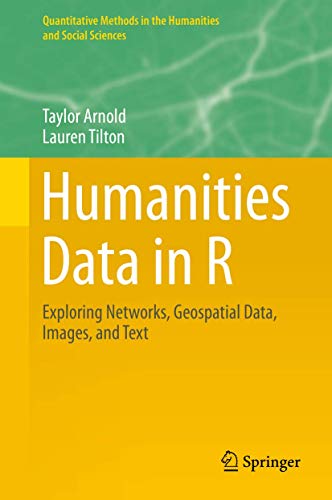
Humanities Data in R: Exploring Networks, Geospatial Data, Images, and Text (Quantitative Methods in the Humanities and Social Sciences)
Buch 18 von 18: Quantitative Methods in the Humanities and Social SciencesAnbieter: Majestic Books, Hounslow, Vereinigtes Königreich
Verkäuferbewertung 4 von 5 Sternen

EUR 85,21
EUR 7,40 shipping
Versand von Vereinigtes Königreich nach USAAnzahl: 1 verfügbar
In den WarenkorbZustand: New.
-

Humanities Data in R : Exploring Networks, Geospatial Data, Images, and Text
Buch 3 von 18: Quantitative Methods in the Humanities and Social SciencesSprache: Englisch
Verlag: Springer International Publishing, Springer International Publishing, 2016
ISBN 10: 3319366718 ISBN 13: 9783319366715
Anbieter: AHA-BUCH GmbH, Einbeck, Deutschland
Verkäuferbewertung 5 von 5 Sternen

Taschenbuch. Zustand: Neu. Druck auf Anfrage Neuware - Printed after ordering - This pioneering book teaches readers to use R within four core analytical areas applicable to the Humanities: networks, text, geospatial data, and images. This book is also designed to be a bridge: between quantitative and qualitative methods, individual and collaborative work, and the humanities and social sciences. Humanities Data with R does not presuppose background programming experience. Early chapters take readers from R set-up to exploratory data analysis (continuous and categorical data, multivariate analysis, and advanced graphics with emphasis on aesthetics and facility). Following this, networks, geospatial data, image data, natural language processing and text analysis each have a dedicated chapter. Each chapter is grounded in examples to move readers beyond the intimidation of adding new tools to their research. Everything is hands-on: networks are explained using U.S. Supreme Court opinions, and low-level NLP methods are applied to short stories by Sir Arthur Conan Doyle. After working through these examples with the provided data, code and book website, readers are prepared to apply new methods to their own work. The open source R programming language, with its myriad packages and popularity within the sciences and social sciences, is particularly well-suited to working with humanities data. R packages are also highlighted in an appendix. This book uses an expanded conception of the forms data may take and the information it represents. The methodology will have wide application in classrooms and self-study for the humanities, but also for use in linguistics, anthropology, and political science. Outside the classroom, this intersection of humanities and computing is particularly relevant for research and new modes of dissemination across archives, museums and libraries.
-
Humanities Data in R: Exploring Networks, Geospatial Data, Images, and Text
Buch 18 von 18: Quantitative Methods in the Humanities and Social SciencesSprache: Englisch
Verlag: Springer-Nature New York Inc, 2024
ISBN 10: 303162565X ISBN 13: 9783031625657
Anbieter: Revaluation Books, Exeter, Vereinigtes Königreich
Verkäuferbewertung 5 von 5 Sternen
EUR 139,63
EUR 14,24 shipping
Versand von Vereinigtes Königreich nach USAAnzahl: 2 verfügbar
In den WarenkorbHardcover. Zustand: Brand New. 2nd edition. 298 pages. 9.25x6.10x9.21 inches. In Stock.
-

Humanities Data in R : Exploring Networks, Geospatial Data, Images, and Text
Buch 18 von 18: Quantitative Methods in the Humanities and Social SciencesSprache: Englisch
Verlag: Springer International Publishing, 2024
ISBN 10: 303162565X ISBN 13: 9783031625657
Anbieter: AHA-BUCH GmbH, Einbeck, Deutschland
Verkäuferbewertung 5 von 5 Sternen
Buch. Zustand: Neu. Druck auf Anfrage Neuware - Printed after ordering - This book teaches readers to integrate data analysis techniques into humanities research practices using the R programming language. Methods for general-purpose visualization and analysis are introduced first, followed by domain-specific techniques for working with networks, text, geospatial data, temporal data, and images. The book is designed to be a bridge between quantitative and qualitative methods, individual and collaborative work, and the humanities and social sciences. The second edition of the text is a significant revision, with almost every aspect of the text rewritten in some way. The most notable difference is the incorporation of new R packages such as ggplot2 and dplyr that center broad data-science concepts.This 2nd edition of Humanities Data with Rdoes not presuppose backgroundprogramming experience. Early chapters take readers from R set-up to exploratory data analysis, with one chapter dedicated to each stage of the data-science pipeline (data collection, visualization, manipulation, and relational joins). Following this, text analysis, networks, temporal data, geospatial data, and image analysis each have a dedicated chapter. These are grounded in examples to move readers beyond the intimidation of adding new tools to their research.The final section of the book extends the core material with additional computer science techniques for processing large datasets.Everything is hands-on: image analysis is explained using digitized photographs from the 1930s, and networks are applied to page links on Wikipedia. After working through these examples with the provided data, code and book website, readers are prepared to apply new methods to their own work. The open source R programming language, with its myriad packages and popularity within the sciences and social sciences, is particularly well-suited to working with humanities data. R packages are also highlighted in an appendix.The methodology will have wide application in classrooms and self-study for the humanities, but also for use in linguistics, anthropology, and political science. Outside the classroom, this intersection of humanities and computing is particularly relevant for research and new modes of dissemination across archives, museums and libraries.

