
Gesamtpreis (1 Artikel Artikel):
Versandziel:

historian archivist (12 Ergebnisse)
Direkt zu den wichtigsten Suchergebnissen
Suchfilter
Produktart
- Alle Product Types
- Bücher (10)
- Magazine & Zeitschriften (Keine weiteren Ergebnisse entsprechen dieser Verfeinerung)
- Comics (Keine weiteren Ergebnisse entsprechen dieser Verfeinerung)
- Noten (Keine weiteren Ergebnisse entsprechen dieser Verfeinerung)
- Kunst, Grafik & Poster (1)
- Fotografien (Keine weiteren Ergebnisse entsprechen dieser Verfeinerung)
- Karten (Keine weiteren Ergebnisse entsprechen dieser Verfeinerung)
- Manuskripte & Papierantiquitäten (1)
Zustand Mehr dazu
- Neu (7)
- Wie Neu, Sehr Gut oder Gut Bis Sehr Gut (1)
- Gut oder Befriedigend (1)
- Ausreichend oder Schlecht (Keine weiteren Ergebnisse entsprechen dieser Verfeinerung)
- Wie beschrieben (3)
Einband
Weitere Eigenschaften
- Erstausgabe (Keine weiteren Ergebnisse entsprechen dieser Verfeinerung)
- Signiert (1)
- Schutzumschlag (Keine weiteren Ergebnisse entsprechen dieser Verfeinerung)
- Angebotsfoto (4)
Sprache (2)
Gratisversand
Land des Verkäufers
Verkäuferbewertung
-
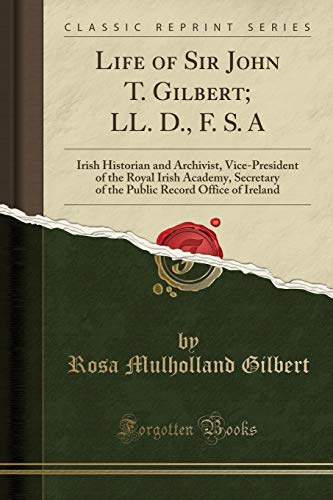
Life of Sir John T Gilbert LL D, F S A Irish Historian and Archivist, VicePresident of the Royal Irish Academy, Secretary of the Public Record Office of Ireland Classic Reprint
Anbieter: PBShop.store US, Wood Dale, IL, USA
Verkäuferbewertung 5 von 5 Sternen

PAP. Zustand: New. New Book. Shipped from UK. Established seller since 2000.
-
Life of Sir John T Gilbert LL D, F S A Irish Historian and Archivist, VicePresident of the Royal Irish Academy, Secretary of the Public Record Office of Ireland Classic Reprint
Anbieter: PBShop.store UK, Fairford, GLOS, Vereinigtes Königreich
Verkäuferbewertung 5 von 5 Sternen
EUR 21,73
EUR 6,70 für den Versand von Vereinigtes Königreich nach USAAnzahl: 15 verfügbar
In den WarenkorbPAP. Zustand: New. New Book. Shipped from UK. Established seller since 2000.
-

Life of Sir John T. Gilbert; LL. D., F. S. A: Irish Historian and Archivist, Vice-President of the Royal Irish Academy, Secretary of the Public Record Office of Ireland (Classic Reprint)
Anbieter: PBShop.store US, Wood Dale, IL, USA
Verkäuferbewertung 5 von 5 Sternen
HRD. Zustand: New. New Book. Shipped from UK. Established seller since 2000.
-
Life of Sir John T. Gilbert; LL. D., F. S. A: Irish Historian and Archivist, Vice-President of the Royal Irish Academy, Secretary of the Public Record Office of Ireland (Classic Reprint)
Anbieter: PBShop.store UK, Fairford, GLOS, Vereinigtes Königreich
Verkäuferbewertung 5 von 5 Sternen
EUR 26,35
EUR 6,70 für den Versand von Vereinigtes Königreich nach USAAnzahl: 15 verfügbar
In den WarenkorbHRD. Zustand: New. New Book. Shipped from UK. Established seller since 2000.
-

THE HISTORIAN AS AN ARCHIVIST (HB 1999)
Verlag: Distributed by Seagull Books, 1999
ISBN 10: 8170461707 ISBN 13: 9788170461708
Sprache: Englisch
Anbieter: Romtrade Corp., STERLING HEIGHTS, MI, USA
Verkäuferbewertung 5 von 5 Sternen
Zustand: New. This is a Brand-new US Edition. This Item may be shipped from US or any other country as we have multiple locations worldwide.
-

[Henry Hobhouse, historian and archivist] Autograph Signature on fragment of letter.
Verlag: No date; Basseterre Guadaloupe
Anbieter: Richard M. Ford Ltd, London, Vereinigtes Königreich
Verkäuferbewertung 5 von 5 Sternen
Signiert
EUR 23,51
EUR 5,14 für den Versand von Vereinigtes Königreich nach USAAnzahl: 1 verfügbar
In den WarenkorbEnglish historian and archivist (1776-1854; DNB) who superintended the publication of the 'State Papers of Henry VIII'. Fragment of letter, 2 inches by four, in good condition, on laid paper signed 'H. Hobhouse' beneath part of salutation 'Yr obed. Sert.' with 'Basseterre | Guadaloupe' beneath.
-

EUR 44,77
EUR 48,99 für den Versand von Deutschland nach USAAnzahl: Mehr als 20 verfügbar
In den WarenkorbGebunden. Zustand: New.
-
Zustand: Sehr gut. Zustand: Sehr gut | Seiten: 488 | Sprache: Englisch | Produktart: Bücher.
-

Life of Sir John T. Gilbert, Ll.D., F.S.a.: Irish Historian and Archivist, Vice-President of the Royal Irish Academy, Secretary of the Public Record O
Verlag: Touchladybirdlucky Studios Mai 2016, 2016
ISBN 10: 1357838123 ISBN 13: 9781357838126
Sprache: Englisch
Anbieter: AHA-BUCH GmbH, Einbeck, Deutschland
Verkäuferbewertung 5 von 5 Sternen
Buch. Zustand: Neu. Neuware - This work has been selected by scholars as being culturally important, and is part of the knowledge base of civilization as we know it. This work was reproduced from the original artifact, and remains as true to the original work as possible. Therefore, you will see the original copyright references, library stamps (as most of these works have been housed in our most important libraries around the world), and other notations in the work.This work is in the public domain in the United States of America, and possibly other nations. Within the United States, you may freely copy and distribute this work, as no entity (individual or corporate) has a copyright on the body of the work.As a reproduction of a historical artifact, this work may contain missing or blurred pages, poor pictures, errant marks, etc. Scholars believe, and we concur, that this work is important enough to be preserved, reproduced, and made generally available to the public. We appreciate your support of the preservation process, and thank you for being an important part of keeping this knowledge alive and relevant.
-
[Sir Francis Palgrave [born Francis Ephraim Cohen], archivist and historian.] Autograph Letter Signed ('Francis Palgrave'), regarding a statement which the recipient may wish to make to 'the Speaker' [of the House of Commons].
Verlag: Commission for Historic Manuscripts London. No date on paper with watermarked date, 1832
Anbieter: Richard M. Ford Ltd, London, Vereinigtes Königreich
Verkäuferbewertung 5 von 5 Sternen
Manuskript / Papierantiquität
EUR 58,77
EUR 5,14 für den Versand von Vereinigtes Königreich nach USAAnzahl: 1 verfügbar
In den Warenkorb1p, 12mo. In fair condition, lightly aged and worn. From the celebrated manuscript collection of Richard Monckton Milnes (Lord Houghton). The recipient is not named. Reads: 'My dear Sir/ | I have no doubt but that any statement which you may make to the Speaker will be in strict accordance with the facts; and I shall be always ready to bear testimony to your services during your connection with me - but for that very reason, I should not wish to impute [last word underlined three times] any document which you may have to present to him. Yrs ever faithfully | Francis Palgrave'. Postscript: 'I shall be here 'till 2 oClock & glad to see you.' In red ink, in a circle at head of page: '164'.
-

Portrait of Gerhard Dumbar (Dutch archivist of Deventer, book collector, civil servant, historian, 1680-1744).
Verlag: [Holland: Dutch Publisher, circa 1740]., 1740
Anbieter: Wittenborn Art Books, San Francisco, CA, USA
Verkäuferbewertung 5 von 5 Sternen
Kunst / Grafik / Poster
Zustand: Good. Stipple and line engraving. 28 x 21.5 cm. (sheet). Very Good. Sheet trimmed to or within the plate mark.
-

James Bonwick, colonial historian and archivist : cut signature, with a brief inscription.
Anbieter: Douglas Stewart Fine Books, Armadale, VIC, Australien
Verkäuferbewertung 4 von 5 Sternen

[undated, but after 1865]. Autograph signature in ink, on piece (42 x 180 mm): 'Yours truly, James Bonwick'; cut from the foot of a letter, the last part of which reads: '. Secretary & Assistant Secretary for the honour conf[erred] .', and with a postscript which reads: 'In my little leisure, I am working up a subject of early Colonial History'; laid down on section cut from a nineteenth-century album page, inscribed by the album's compiler in pencil: 'James Bonwick FRGS'; toned. Provenance: Autograph album compiled by Jane Emma Murphy (Balcombe) (1854-1924), "The Briars," Mornington, Victoria (Australia); àBeckett family, Melbourne (by descent). From the ADB: 'James Bonwick (1817-1906), teacher, author, historian and archivist, was born on 8 July 1817 at Lingfield, Surrey, England, eldest son of James Bonwick, carpenter, and his second wife Mary, née Preston. Soon after James's birth the family moved to Southwark, London, where he was educated at the Borough Road School in 1823-32. He began his teaching career in 1833 and had charge of several primary schools. While at Liverpool in 1837 he was influenced by a Baptist clergyman who converted Bonwick to Nonconformity and pledged him to the temperance cause. He returned to schools in London in 1838 and in May 1841 he and his wife were selected to manage the proposed normal school in Hobart Town, the chief school ofSir John Franklin's new Board of Education. Bonwick arrived in Hobart on 10 October 1841 and took charge of the school next January. He resigned two years later because of the poor conditions and established his own boarding school in Hobart, moving it to Glenorchy in June 1847. At this time he produced the first of his many valuable school textbooks. Bonwick also associated withGeorge Washington Walkerin the formation of the Hobart Town Total Abstinence Society in 1842 and the Van Diemen's Land Total Abstinence Society in 1846, serving as secretary to both. Through Walker's influence he also became interested in the study of the Aboriginals. No less influential was his association withHenry Melville, who captivated Bonwick with his knowledge of Freemasonry and mysticism. Thereafter Bonwick inclined towards religious eclecticism even to the extent of a brief contact in London with the mystic, Madame Blavatsky. In mid-1849 he unsuccessfully applied for the inspectorship of schools won byThomas Arnoldand, when an attempt to re-establish his school in Hobart in September failed, Bonwick left in February 1850 for Adelaide. There he opened a private school and identified himself with the cultural life of the city as a lecturer, secretary of the first Australian branch of the Young Men's Christian Association, and a founder of one of the earliest Australian teachers' associations. Heavily in debt for building expenses, Bonwick left for the Victorian goldfields in February 1852. After a brief stay at the diggings he returned to Melbourne and worked as a lecturer and then proprietor of theAustralian Gold Digger's Monthly Magazine, and Colonial Family Visitor. When publication ceased in May 1853 he opened a land agency, in conjunction with which he toured the diggings for a time as a lecturer for the Colonial Reform Association, a radical body pledged to 'unlocking the lands'. At the same time he helped to found the Victorian Liquor Law League which aimed to introduce prohibitory legislation. The land agency proved a failure and in January 1855 Bonwick opened a boarding school near Kew, but early next year had to close it because of poor health. For a time he lived by his writing, and publishedDiscovery and Settlement of Port Phillip(1856) and other works. In June 1856 he was appointed an inspector for the Denominational Schools Board and for the next three years was engaged in this arduous work, which included two extensive horseback tours of western Victoria. He retired after a serious coaching accident in September 1859, received £300 in compensation and in November left for England. Bonwick returned to Melbourne in July 1862 and at St Kilda opened another school which became very prosperous, having an enrolment of over 150 boys. He continued historical and anthropological work in his spare time, publishingJohn Batman(1867),Curious Facts of Old Colonial Days(1870),Daily Life and Origin of the Tasmanians(1870) andThe Last of the Tasmanians(1870). In 1869 Bonwick made another visit to England, leaving the school in charge of his son William. The school was mismanaged and Bonwick had to return and arrange a lease in September 1871. He journeyed to England by way of New Zealand and the United States, and briefly visited Melbourne in August 1875 to arrange the final sale of his St Kilda property. Through the influence ofRichard Daintreehe was appointed an immigration agent to lecture in England for the Queensland government in June 1874; the appointment was repudiated in March 1875. He visited Australia in 1881 and while in Brisbane was again appointed a lecturer by the Queensland government; he toured England from January 1882 to April 1883. Meanwhile he began searching in London for early Australian source material;First Twenty Years of Australia(1882) andPort Phillip Settlement(1883) embodied this research. The wealth of material Bonwick discovered suggested to him the possibility of transcribing it for use in the colonies, similar to a scheme adopted by the Canadian government. Bonwick's first offer to transcribe was made to the Queensland government, and he was appointed in June 1883 to do this work for a year. Small batches of transcripts were then made for South Australia in 1885 and the Melbourne Public Library in 1886. From January 1887 to 1893 he transcribed for Tasmania and from April 1887 to 1902 for New South Wales. These latter transcripts were used as the basis of the two-volumeHistory of New South Wales from the Records(1889-94), and many of the transcripts themselves were printed in the eight volumes of theHistorical Record.


