
Gesamtpreis (1 Artikel Artikel):
Versandziel:

foundations logic mathematics von carnap rudolf (6 Ergebnisse)
Direkt zu den wichtigsten Suchergebnissen
Suchfilter
Produktart
- Alle Product Types
- Bücher (6)
- Magazine & Zeitschriften (Keine weiteren Ergebnisse entsprechen dieser Verfeinerung)
- Comics (Keine weiteren Ergebnisse entsprechen dieser Verfeinerung)
- Noten (Keine weiteren Ergebnisse entsprechen dieser Verfeinerung)
- Kunst, Grafik & Poster (Keine weiteren Ergebnisse entsprechen dieser Verfeinerung)
- Fotografien (Keine weiteren Ergebnisse entsprechen dieser Verfeinerung)
- Karten (Keine weiteren Ergebnisse entsprechen dieser Verfeinerung)
- Manuskripte & Papierantiquitäten (Keine weiteren Ergebnisse entsprechen dieser Verfeinerung)
Zustand Mehr dazu
- Neu (Keine weiteren Ergebnisse entsprechen dieser Verfeinerung)
- Wie Neu, Sehr Gut oder Gut Bis Sehr Gut (Keine weiteren Ergebnisse entsprechen dieser Verfeinerung)
- Gut oder Befriedigend (3)
- Ausreichend oder Schlecht (Keine weiteren Ergebnisse entsprechen dieser Verfeinerung)
- Wie beschrieben (3)
Einband
- alle Einbände
- Hardcover (Keine weiteren Ergebnisse entsprechen dieser Verfeinerung)
- Softcover (6)
Weitere Eigenschaften
- Erstausgabe (1)
- Signiert (Keine weiteren Ergebnisse entsprechen dieser Verfeinerung)
- Schutzumschlag (Keine weiteren Ergebnisse entsprechen dieser Verfeinerung)
- Angebotsfoto (2)
Sprache (2)
Preis
- Beliebiger Preis
- Weniger als EUR 20 (Keine weiteren Ergebnisse entsprechen dieser Verfeinerung)
- EUR 20 bis EUR 45
- Mehr als EUR 45
Gratisversand
Land des Verkäufers
Verkäuferbewertung
-
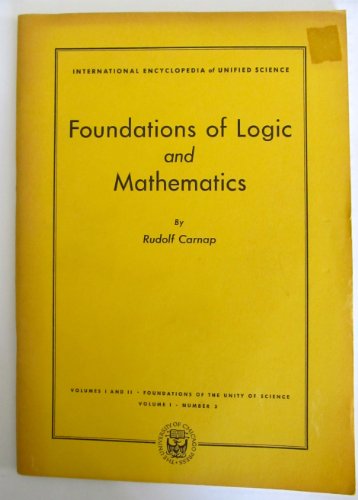
Foundations of Logic and Mathematics
Anbieter: ThriftBooks-Atlanta, AUSTELL, GA, USA
Verkäuferbewertung 5 von 5 Sternen

Paperback. Zustand: Good. No Jacket. Pages can have notes/highlighting. Spine may show signs of wear. ~ ThriftBooks: Read More, Spend Less 0.6.
-

FOUNDATIONS OF LOGIC AND MATHEMATICS International Encyclopedia of Unified Sciences, Volume 1, Number 3
Verlag: University of Chicago Press, 1949
Anbieter: Singing Saw Books, Portland, OR, USA
Verkäuferbewertung 5 von 5 Sternen
Paperback. Zustand: Good. Paperback. 1949 printing. Worn head and tail, name stamped on front wrap, bumped corners.
-

International Encyclopedia of United Science: Volume I and II: Foundations of the Unity of Science; Volume 1, Number 3: Foundations of Logic and Mathematics
Verlag: The University Of Chicago Press, 1949
Sprache: Englisch
Anbieter: Tilly's Bookshop (Eleven30 Group Ltd), Haydock, MER, Vereinigtes Königreich
Verkäuferbewertung 5 von 5 Sternen
EUR 47,23
EUR 22,93 shipping
Ships from Vereinigtes Königreich to USAAnzahl: 1 verfügbar
In den WarenkorbSoft cover. Zustand: Very Good. No Jacket. 5th or later Edition. The book has soft covers with black lettering on the front cover. The covers are in a very good condition, apart from a small amount of tanning on the front and back of the covers. There are minimal bumps and scuffing. There is no jacket with this book. The pages are in a very good condition, with neat pen marking on the inside front end paper. The overall condition of this book is very good.
-
Foundations of Logic and Mathematics.
Anbieter: Herman H. J. Lynge & Søn ILAB-ABF, Copenhagen, Dänemark
Verkäuferbewertung 4 von 5 Sternen

(Chicago, 1965). 8vo. Orig. yellow wrappers. A bit of soiling. IV, 71 pp. 11. impression of this important work in the development of mathematical logic. Originanlly published in 1939. From the International Encycloppedia of Unified Science.
-
Foundations of Logic and Mathematics.
Anbieter: Herman H. J. Lynge & Søn ILAB-ABF, Copenhagen, Dänemark
Verkäuferbewertung 4 von 5 Sternen
Chicago, The University of Chicago Press, (1953). 8vo. In the original blue printed wrappers. Light miscolouring and wear to extremities. Paper label pasted on to verso of back wrapper. Otherwise a fine and clean copy. VIII, 71 pp. Seventh impression of Carnap's seminal publication of his semantical period. Here Carnap presents a clear and detailed account of the application of logic and mathematics in empirical science and the central importance of the analytic/synthetic distinction herein.Carnap thought that the logic of science could be fruitfully applied to the problems of quantum theory as well. In particular, the final sections of Foundations of Logic and Mathematics (1939, §§24, 25) suggest that the vexed question of the "interpretation" of the wave-function can be resolved by appreciating that theories of modern mathematical physics operate with "abstract" terms which are implicitly defined, in the manner of Hilbert, in an axiomatic system (and thus require no "intuitive" or "visualizable" meaning) but which still relate to empirical phenomena (experimental measurements) indirectly. (Cambridge Companion to Carnap).These thoughts anticipate Carnap's later conception of the "partial interpretation" of theoretical terms.Rudolf Carnap (born 1891 in Ronsdorf, Germany, died 1970 in Santa Monica, California) was an immensely influential analytic philosopher, who has contributed decisively to the fields of logic, epistemology, semantics, philosophy of science, and philosophy of language. He was one of the leading figures of the Vienna Circle, and a prominent logical positivist. He studied philosophy, physics and mathematics at the universities of Berlin and Freiburg, and worked at the universities of Jena, Vienna and Prague until 1935, when he, due to the war, emigrated to the U.S., where he became an American citizen in 1941. In America he became professor of the University of Chicago.
-

Foundations of Logic and Mathematics.
Anbieter: Herman H. J. Lynge & Søn ILAB-ABF, Copenhagen, Dänemark
Verkäuferbewertung 4 von 5 Sternen
Erstausgabe
Chicago, The University of Chicago Press, (1939). 8vo. In the original blue printed wrappers. A very nice and clean copy - near mint. VIII, 71 pp. First printing of Carnap's seminal publication of his semantical period. Here Carnap presents a clear and detailed account of the application of logic and mathematics in empirical science and the central importance of the analytic/synthetic distinction herein.Carnap thought that the logic of science could be fruitfully applied to the problems of quantum theory as well. In particular, the final sections of Foundations of Logic and Mathematics (1939, §§24, 25) suggest that the vexed question of the "interpretation" of the wave-function can be resolved by appreciating that theories of modern mathematical physics operate with "abstract" terms which are implicitly defined, in the manner of Hilbert, in an axiomatic system (and thus require no "intuitive" or "visualizable" meaning) but which still relate to empirical phenomena (experimental measurements) indirectly. (Cambridge Companion to Carnap).These thoughts anticipate Carnap's later conception of the "partial interpretation" of theoretical terms.Rudolf Carnap (born 1891 in Ronsdorf, Germany, died 1970 in Santa Monica, California) was an immensely influential analytic philosopher, who has contributed decisively to the fields of logic, epistemology, semantics, philosophy of science, and philosophy of language. He was one of the leading figures of the Vienna Circle, and a prominent logical positivist. He studied philosophy, physics and mathematics at the universities of Berlin and Freiburg, and worked at the universities of Jena, Vienna and Prague until 1935, when he, due to the war, emigrated to the U.S., where he became an American citizen in 1941. In America he became professor of the University of Chicago.


