

Gesamtpreis (1 Artikel Artikel):
Versandziel:

estimating impact handbook computational (3 Ergebnisse)
Direkt zu den wichtigsten Suchergebnissen
Suchfilter
Produktart
- Alle Product Types
- Bücher (3)
- Magazine & Zeitschriften (Keine weiteren Ergebnisse entsprechen dieser Verfeinerung)
- Comics (Keine weiteren Ergebnisse entsprechen dieser Verfeinerung)
- Noten (Keine weiteren Ergebnisse entsprechen dieser Verfeinerung)
- Kunst, Grafik & Poster (Keine weiteren Ergebnisse entsprechen dieser Verfeinerung)
- Fotografien (Keine weiteren Ergebnisse entsprechen dieser Verfeinerung)
- Karten (Keine weiteren Ergebnisse entsprechen dieser Verfeinerung)
- Manuskripte & Papierantiquitäten (Keine weiteren Ergebnisse entsprechen dieser Verfeinerung)
Zustand Mehr dazu
- Neu (3)
- Wie Neu, Sehr Gut oder Gut Bis Sehr Gut (Keine weiteren Ergebnisse entsprechen dieser Verfeinerung)
- Gut oder Befriedigend (Keine weiteren Ergebnisse entsprechen dieser Verfeinerung)
- Ausreichend oder Schlecht (Keine weiteren Ergebnisse entsprechen dieser Verfeinerung)
- Wie beschrieben (Keine weiteren Ergebnisse entsprechen dieser Verfeinerung)
Einband
Weitere Eigenschaften
- Erstausgabe (Keine weiteren Ergebnisse entsprechen dieser Verfeinerung)
- Signiert (Keine weiteren Ergebnisse entsprechen dieser Verfeinerung)
- Schutzumschlag (Keine weiteren Ergebnisse entsprechen dieser Verfeinerung)
- Angebotsfoto (3)
Sprache (1)
Preis
- Beliebiger Preis
- Weniger als EUR 20 (Keine weiteren Ergebnisse entsprechen dieser Verfeinerung)
- EUR 20 bis EUR 45 (Keine weiteren Ergebnisse entsprechen dieser Verfeinerung)
- Mehr als EUR 45
Gratisversand
- Kostenloser Versand nach USA (Keine weiteren Ergebnisse entsprechen dieser Verfeinerung)
Land des Verkäufers
Verkäuferbewertung
-
Taschenbuch. Zustand: Neu. Estimating Impact | A Handbook of Computational Methods and Models for Anticipating Economic, Social, Political and Security Effects in International Interventions | Gary Citrenbaum (u. a.) | Taschenbuch | xviii | Englisch | 2014 | Humana | EAN 9781489987273 | Verantwortliche Person für die EU: Springer Verlag GmbH, Tiergartenstr. 17, 69121 Heidelberg, juergen[dot]hartmann[at]springer[dot]com | Anbieter: preigu.
-
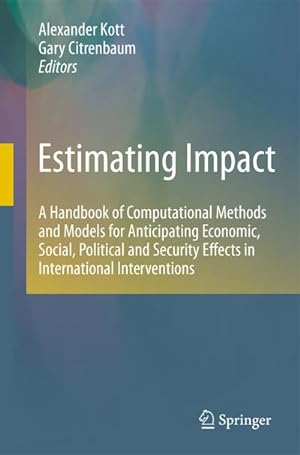
Estimating Impact : A Handbook of Computational Methods and Models for Anticipating Economic, Social, Political and Security Effects in International Interventions
Sprache: Englisch
Verlag: Springer US, Springer New York, 2014
ISBN 10: 1489987274 ISBN 13: 9781489987273
Anbieter: AHA-BUCH GmbH, Einbeck, Deutschland
Verkäuferbewertung 5 von 5 Sternen

Taschenbuch. Zustand: Neu. Druck auf Anfrage Neuware - Printed after ordering - Sociological theories of crime include: theories of strain blame crime on personal stressors; theories of social learning blame crime on its social rewards, and see crime more as an institution in conflict with other institutions rather than as in- vidual deviance; and theories of control look at crime as natural and rewarding, and explore the formation of institutions that control crime. Theorists of corruption generally agree that corruption is an expression of the Patron-Client relationship in which a person with access to resources trades resources with kin and members of the community in exchange for loyalty. Some approaches to modeling crime and corruption do not involve an explicit simulation: rule based systems; Bayesian networks; game theoretic approaches, often based on rational choice theory; and Neoclassical Econometrics, a rational choice-based approach. Simulation-based approaches take into account greater complexities of interacting parts of social phenomena. These include fuzzy cognitive maps and fuzzy rule sets that may incorporate feedback; and agent-based simulation, which can go a step farther by computing new social structures not previously identified in theory. The latter include cognitive agent models, in which agents learn how to perceive their en- ronment and act upon the perceptions of their individual experiences; and reactive agent simulation, which, while less capable than cognitive-agent simulation, is adequate for testing a policy's effects with existing societal structures. For example, NNL is a cognitive agent model based on the REPAST Simphony toolkit.
-
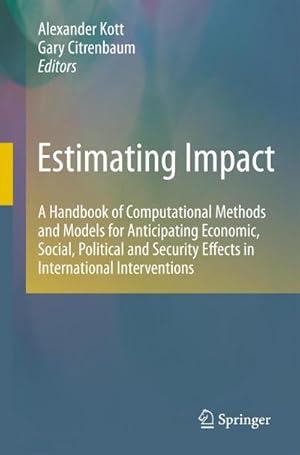
Estimating Impact : A Handbook of Computational Methods and Models for Anticipating Economic, Social, Political and Security Effects in International Interventions
Anbieter: AHA-BUCH GmbH, Einbeck, Deutschland
Verkäuferbewertung 5 von 5 Sternen
Buch. Zustand: Neu. Druck auf Anfrage Neuware - Printed after ordering - Sociological theories of crime include: theories of strain blame crime on personal stressors; theories of social learning blame crime on its social rewards, and see crime more as an institution in conflict with other institutions rather than as in- vidual deviance; and theories of control look at crime as natural and rewarding, and explore the formation of institutions that control crime. Theorists of corruption generally agree that corruption is an expression of the Patron-Client relationship in which a person with access to resources trades resources with kin and members of the community in exchange for loyalty. Some approaches to modeling crime and corruption do not involve an explicit simulation: rule based systems; Bayesian networks; game theoretic approaches, often based on rational choice theory; and Neoclassical Econometrics, a rational choice-based approach. Simulation-based approaches take into account greater complexities of interacting parts of social phenomena. These include fuzzy cognitive maps and fuzzy rule sets that may incorporate feedback; and agent-based simulation, which can go a step farther by computing new social structures not previously identified in theory. The latter include cognitive agent models, in which agents learn how to perceive their en- ronment and act upon the perceptions of their individual experiences; and reactive agent simulation, which, while less capable than cognitive-agent simulation, is adequate for testing a policy's effects with existing societal structures. For example, NNL is a cognitive agent model based on the REPAST Simphony toolkit.

