Gesamtpreis (1 Artikel Artikel):
Versandziel:

elements queueing theory palm von baccelli francois (4 Ergebnisse)
Direkt zu den wichtigsten Suchergebnissen
Suchfilter
Produktart
- Alle Product Types
- Bücher (4)
- Magazine & Zeitschriften (Keine weiteren Ergebnisse entsprechen dieser Verfeinerung)
- Comics (Keine weiteren Ergebnisse entsprechen dieser Verfeinerung)
- Noten (Keine weiteren Ergebnisse entsprechen dieser Verfeinerung)
- Kunst, Grafik & Poster (Keine weiteren Ergebnisse entsprechen dieser Verfeinerung)
- Fotografien (Keine weiteren Ergebnisse entsprechen dieser Verfeinerung)
- Karten (Keine weiteren Ergebnisse entsprechen dieser Verfeinerung)
- Manuskripte & Papierantiquitäten (Keine weiteren Ergebnisse entsprechen dieser Verfeinerung)
Zustand Mehr dazu
- Neu (2)
- Wie Neu, Sehr Gut oder Gut Bis Sehr Gut (1)
- Gut oder Befriedigend (Keine weiteren Ergebnisse entsprechen dieser Verfeinerung)
- Ausreichend oder Schlecht (Keine weiteren Ergebnisse entsprechen dieser Verfeinerung)
- Wie beschrieben (1)
Einband
Weitere Eigenschaften
- Erstausgabe (Keine weiteren Ergebnisse entsprechen dieser Verfeinerung)
- Signiert (Keine weiteren Ergebnisse entsprechen dieser Verfeinerung)
- Schutzumschlag (Keine weiteren Ergebnisse entsprechen dieser Verfeinerung)
- Angebotsfoto (3)
Sprache (1)
Gratisversand
- Kostenloser Versand nach USA (Keine weiteren Ergebnisse entsprechen dieser Verfeinerung)
Land des Verkäufers
Verkäuferbewertung
-

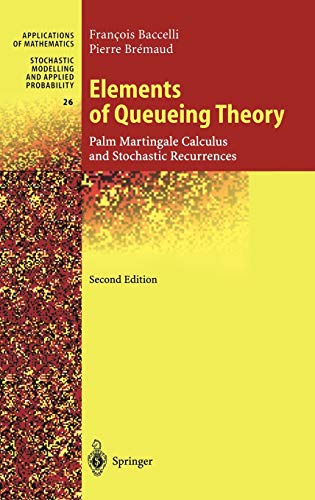
Elements of queueing theory Palm-Martingale calculus and stochastic recurrences François Baccelli, Pierre Brémaud. Applications of mathematics 26.
Anbieter: Antiquariat Bookfarm, Löbnitz, Deutschland
Verkäuferbewertung 5 von 5 Sternen

Hardcover. Ex-library with stamp and library-signature. GOOD condition, some traces of use. Ancien Exemplaire de bibliothèque avec signature et cachet. BON état, quelques traces d'usure. Ehem. Bibliotheksexemplar mit Signatur und Stempel. GUTER Zustand, ein paar Gebrauchsspuren. 60 BAC 9783540533474 Sprache: Englisch Gewicht in Gramm: 1150.
-
Sonderangebot
EUR 35,23
EUR 105,00 shipping
Versand von Deutschland nach USAAnzahl: 1 verfügbar
In den WarenkorbZustand: Sehr gut. Zustand: Sehr gut | Seiten: 334 | Sprache: Englisch | Produktart: Bücher | Keine Beschreibung verfügbar.
-
Taschenbuch. Zustand: Neu. Elements of Queueing Theory | Palm Martingale Calculus and Stochastic Recurrences | Francois Baccelli (u. a.) | Taschenbuch | xiv | Englisch | 2010 | Springer | EAN 9783642085376 | Verantwortliche Person für die EU: Springer Verlag GmbH, Tiergartenstr. 17, 69121 Heidelberg, juergen[dot]hartmann[at]springer[dot]com | Anbieter: preigu.
-

Elements of Queueing Theory : Palm Martingale Calculus and Stochastic Recurrences
Sprache: Englisch
Verlag: Springer, Berlin, Springer Berlin Heidelberg, Springer, 2002
ISBN 10: 3540660887 ISBN 13: 9783540660880
Anbieter: AHA-BUCH GmbH, Einbeck, Deutschland
Verkäuferbewertung 5 von 5 Sternen
Buch. Zustand: Neu. Neuware - Queueing theory is a fascinating subject in Applied Probability for two con tradictory reasons: it sometimes requires the most sophisticated tools of stochastic processes, and it often leads to simple and explicit answers. More over its interest has been steadily growing since the pioneering work of Erlang in 1917 on the blocking of telephone calls, to the more recent applications on the design of broadband communication networks and on the performance evaluation of computer architectures. All this led to a huge literature, articles and books, at various levels of mathematical rigor. Concerning the mathematical approach, most of the explicit results have been obtained when specific assumptions (Markov, re newal) are made. The aim of the present book is in no way to give a systematic account of the formulas of queueing theory and their applications, but rather to give a general framework in which these results are best understood and most easily derived. What knowledge of this vast literature is needed to read the book As the title of the book suggests, we believe that it can be read without prior knowledge of queueing theory at all, although the unifying nature of the proposed framework will of course be more meaningful to readers who already studied the classical Markovian approach.