
Gesamtpreis (1 Artikel Artikel):
Versandziel:

dynamics crowd minds patterns irrationality von adamatzky andrew (6 Ergebnisse)
Direkt zu den wichtigsten Suchergebnissen
Suchfilter
Produktart
- Alle Product Types
- Bücher (6)
- Magazine & Zeitschriften (Keine weiteren Ergebnisse entsprechen dieser Verfeinerung)
- Comics (Keine weiteren Ergebnisse entsprechen dieser Verfeinerung)
- Noten (Keine weiteren Ergebnisse entsprechen dieser Verfeinerung)
- Kunst, Grafik & Poster (Keine weiteren Ergebnisse entsprechen dieser Verfeinerung)
- Fotografien (Keine weiteren Ergebnisse entsprechen dieser Verfeinerung)
- Karten (Keine weiteren Ergebnisse entsprechen dieser Verfeinerung)
- Manuskripte & Papierantiquitäten (Keine weiteren Ergebnisse entsprechen dieser Verfeinerung)
Zustand Mehr dazu
- Neu (4)
- Wie Neu, Sehr Gut oder Gut Bis Sehr Gut (Keine weiteren Ergebnisse entsprechen dieser Verfeinerung)
- Gut oder Befriedigend (1)
- Ausreichend oder Schlecht (Keine weiteren Ergebnisse entsprechen dieser Verfeinerung)
- Wie beschrieben (1)
Einband
- alle Einbände
- Hardcover (6)
- Softcover (Keine weiteren Ergebnisse entsprechen dieser Verfeinerung)
Weitere Eigenschaften
- Erstausgabe (Keine weiteren Ergebnisse entsprechen dieser Verfeinerung)
- Signiert (Keine weiteren Ergebnisse entsprechen dieser Verfeinerung)
- Schutzumschlag (1)
- Angebotsfoto (3)
Sprache (1)
Preis
- Beliebiger Preis
- Weniger als EUR 20 (Keine weiteren Ergebnisse entsprechen dieser Verfeinerung)
- EUR 20 bis EUR 45
- Mehr als EUR 45
Gratisversand
Land des Verkäufers
Verkäuferbewertung
-

Dynamics of Crowd-Minds. Patterns of Irrationality in Emotions, Beliefs and Actions.
Verlag: New Jersey, London u.a., World Scientific Publishing,, 2005
Sprache: Englisch
Anbieter: Antiquariat Bader Tübingen, Tübingen, Deutschland
Verkäuferbewertung 5 von 5 Sternen

XII, 251 Seiten mit Abbildungen. Gutes Exemplar. Sprache: Englisch Gewicht in Gramm: 800 Gr.-8vo. Hardcover mit Schutzumschlag. - (= World Sc ientific Series on Nonlinear Science, Series A, Vol. 54).
-
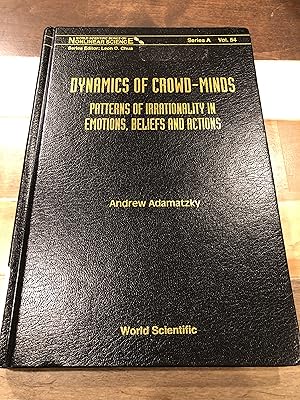
Dynamics of Crowd-Minds: Patterns of Irrationality in Emotions, Beliefs and Actions (World Scientific Nonlinear Science Series a)
Verlag: World Scientific Publishing Company, 2005
ISBN 10: 9812562869 ISBN 13: 9789812562869
Sprache: Englisch
Anbieter: Rosario Beach Rare Books, Lake Stevens, WA, USA
Verbandsmitglied: CBA ESA IOBA
Verkäuferbewertung 5 von 5 Sternen
Hardcover. Zustand: Very Good. No Jacket. Note: (2) pages in the preface with lines of highlighting; former library book with minimal markings; NO DUST JACKET.; otherwise the text is clean, the book is like new.
-

Dynamics of Crowd-Minds: Patterns of Irrationality in Emotions, Beliefs and Actions
Verlag: World Scientific Publishing Company, 2005
ISBN 10: 9812562869 ISBN 13: 9789812562869
Sprache: Englisch
Anbieter: Romtrade Corp., STERLING HEIGHTS, MI, USA
Verkäuferbewertung 5 von 5 Sternen
Zustand: New. This is a Brand-new US Edition. This Item may be shipped from US or any other country as we have multiple locations worldwide.
-
Dynamics of Crowd-minds: Patterns of Irrationality in Emotions, Beliefs And Actions
Verlag: World Scientific Pub Co Inc, 2005
ISBN 10: 9812562869 ISBN 13: 9789812562869
Sprache: Englisch
Anbieter: Revaluation Books, Exeter, Vereinigtes Königreich
Verkäuferbewertung 5 von 5 Sternen
EUR 112,67
EUR 14,31 shipping
Ships from Vereinigtes Königreich to USAAnzahl: 1 verfügbar
In den WarenkorbHardcover. Zustand: Brand New. new title edition. 264 pages. 9.00x6.00x0.75 inches. In Stock.
-

Dynamics Of Crowd-minds: Patterns Of Irrationality In Emotions, Beliefs And Actions
Verlag: WORLD SCIENTIFIC PUB CO INC, 2005
ISBN 10: 9812562869 ISBN 13: 9789812562869
Sprache: Englisch
Gebunden. Zustand: New. InhaltsverzeichnisCrowding Minds Patterns of Affect Doxastic Dynamics Normative Worlds Dynamically Non-Trivial Logics Morphology of IrrationalityKlappentextrnrnA crowd-mind emerges when formation of a crowd cause.
-

Dynamics of Crowd-Minds: Patterns of Irrationality in Emotions, Beliefs and Actions
Verlag: World Scientific Publishing Company Mai 2005, 2005
ISBN 10: 9812562869 ISBN 13: 9789812562869
Sprache: Englisch
Anbieter: AHA-BUCH GmbH, Einbeck, Deutschland
Verkäuferbewertung 5 von 5 Sternen
Buch. Zustand: Neu. Neuware - A crowd-mind emerges when formation of a crowd causes fusion of individual minds into one collective mind. Members of the crowd lose their individuality. The deindividuation leads to derationalization: emotional, impulsive and irrational behavior, self-catalytic activities, memory impairment, perceptual distortion, hyper-responsiveness, and distortion of traditional forms and structures. This book presents unique results of computational studies on cognitive and affective space-time processes in large-scale collectives of abstract agents being far from mental equilibrium. Computational experiments demonstrate that the irrational and nonsensical behavior of individual entities of crowd-mind results in complex, rich and non-trivial spatio-temporal dynamics of the agent collectives. Mathematical methods employ theory and techniques of cellular-automata and lattice swarms, applied algebra, theory of finite automata and Markov chains, and elementary differential equations.


