
Gesamtpreis (1 Artikel Artikel):
Versandziel:

dimensions space shape scale architecture von moore charles gerald allen (5 Ergebnisse)
Direkt zu den wichtigsten Suchergebnissen
Suchfilter
Produktart
- Alle Product Types
- Bücher (5)
- Magazine & Zeitschriften (Keine weiteren Ergebnisse entsprechen dieser Verfeinerung)
- Comics (Keine weiteren Ergebnisse entsprechen dieser Verfeinerung)
- Noten (Keine weiteren Ergebnisse entsprechen dieser Verfeinerung)
- Kunst, Grafik & Poster (Keine weiteren Ergebnisse entsprechen dieser Verfeinerung)
- Fotografien (Keine weiteren Ergebnisse entsprechen dieser Verfeinerung)
- Karten (Keine weiteren Ergebnisse entsprechen dieser Verfeinerung)
- Manuskripte & Papierantiquitäten (Keine weiteren Ergebnisse entsprechen dieser Verfeinerung)
Zustand Mehr dazu
- Neu (Keine weiteren Ergebnisse entsprechen dieser Verfeinerung)
- Wie Neu, Sehr Gut oder Gut Bis Sehr Gut (Keine weiteren Ergebnisse entsprechen dieser Verfeinerung)
- Gut oder Befriedigend (5)
- Ausreichend oder Schlecht (Keine weiteren Ergebnisse entsprechen dieser Verfeinerung)
- Wie beschrieben (Keine weiteren Ergebnisse entsprechen dieser Verfeinerung)
Einband
- alle Einbände
- Hardcover (5)
- Softcover (Keine weiteren Ergebnisse entsprechen dieser Verfeinerung)
Weitere Eigenschaften
- Erstausgabe (Keine weiteren Ergebnisse entsprechen dieser Verfeinerung)
- Signiert (Keine weiteren Ergebnisse entsprechen dieser Verfeinerung)
- Schutzumschlag (3)
- Angebotsfoto (Keine weiteren Ergebnisse entsprechen dieser Verfeinerung)
Sprache (1)
Gratisversand
Land des Verkäufers
Verkäuferbewertung
-
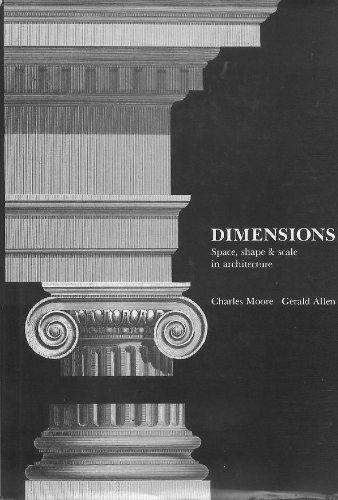
Dimensions : Space, Scale and Shape in Architecture
Sprache: Englisch
Verlag: McGraw-Hill Companies, The, 1976
ISBN 10: 0070023360 ISBN 13: 9780070023369
Anbieter: Better World Books: West, Reno, NV, USA
Verkäuferbewertung 5 von 5 Sternen

Zustand: Very Good. 0th Edition. Former library book; may include library markings. Used book that is in excellent condition. May show signs of wear or have minor defects.
-
Dimensions : Space, Scale and Shape in Architecture
Sprache: Englisch
Verlag: McGraw-Hill Companies, The, 1976
ISBN 10: 0070023360 ISBN 13: 9780070023369
Anbieter: Better World Books, Mishawaka, IN, USA
Verkäuferbewertung 5 von 5 Sternen
Zustand: Good. 0th Edition. Used book that is in clean, average condition without any missing pages.
-
Dimensions. Space, shape & scale in architecture.
Sprache: Englisch
Verlag: Architectural Record Books, 1976
ISBN 10: 0070023360 ISBN 13: 9780070023369
Anbieter: Books From California, Simi Valley, CA, USA
Verkäuferbewertung 5 von 5 Sternen
Hardcover. Zustand: Good. Zustand des Schutzumschlags: Includes dust jacket. mild amount of wear on the dust jacket (creasing, fading, light ripping), light amount of wear along the edges of the cover of the book.
-

Dimensions. Space, shape & scale in architecture.
Sprache: Englisch
Verlag: New York, McGraw Hill Book Co., 1976
Anbieter: Antiquariat Thomas Haker GmbH & Co. KG, Berlin, Deutschland
Verbandsmitglied: GIAQ
Verkäuferbewertung 5 von 5 Sternen
Zustand: Gut. 4th printing. 183 S. Good condition. Numerous ill. Sprache: Englisch Gewicht in Gramm: 510 Hardcover/Pappeinband with dust jacket.
-
Dimensions; Space, Shape & Scale in Architecture
Sprache: Englisch
Verlag: Architectural Record Books, New York, 1976
ISBN 10: 0070023360 ISBN 13: 9780070023369
Anbieter: Ground Zero Books, Ltd., Silver Spring, MD, USA
Verkäuferbewertung 4 von 5 Sternen

Hardcover. Zustand: Very good. Zustand des Schutzumschlags: Very good. Robert Hazzon (Author photograph) (illustrator). Fourth printing [stated]. viii, 183, [1] pages. Frontispiece. Illustrations (drawings, maps, photographs). Reference Notes. Index. Charles Willard Moore (October 31, 1925 - December 16, 1993) was an American architect, educator, writer, Fellow of the American Institute of Architects, and winner of the AIA Gold Medal in 1991. He is often labeled as the father of postmodernism. His work as an educator was important to a generation of American architects who read his books or studied with him at one of the several universities where he taught. Design features (historical detail, ornament, fictional treatments, ironic significations) made Moore one of the chief proponents of postmodern architecture, along with Robert Venturi, Michael Graves, Stanley Tigerman, and Charles Jencks. Gerald Pitman Allen, 73, of Spring Lake, NC, died on Sunday, November 1, 2015, from heart failure. Mr. Allen attended Episcopal High School in Alexandria, VA, and Yale University. After studying English at Cambridge University in England and returning to Yale to study architecture, he worked in New York for Philip Johnson and Architectural Record before starting his own firm, Gerald Allen & Associates. Gerald Allen (in later life) Mr. Allen's architectural career spanned a broad scope of work. He wrote several books with Charles Moore and taught in various universities, including Yale, Harvard, North Carolina State University, and Carnegie Mellon. He also designed sets for the Santa Fe Opera. In 1982, he and Kent Bloomer designed the lights currently in Central Park, and he designed the restoration of the Bethesda Fountain, both projects as part of an effort to revitalize the park. Later in his career, his work focused on church design and renovation and included projects in Manhattan at St. Thomas Episcopal Church, the Church of the Heavenly Rest, and Riverside Church, as well as projects in Larchmont and Oyster Bay and Wilson, NC. Dimensions and their architectural products - space, shape and scale - are essential concepts, the basic stuff of everyday design. Architect-authors Charles Moore and Gerald Allen feel that these terms are basically misunderstood among architects and laymen alike, and have written this book not only for architects who design new buildings, but also for all who want to learn to appreciate architecture and who must live their lives with what architects have built. Dimensions, the authors show, are not just the familiar ones of height, width, and depth which designers so often focus on, but in fact include any variable which can be changed without affecting any of he others. thus the temperature in a room , or the amount of sunlight, or the color, or the psychic pleasure that they all create are all dimensions, too--and all of them must be the necessary concern of architecture.


