

Gesamtpreis (1 Artikel Artikel):
Versandziel:

databases information systems peer to peer (12 Ergebnisse)
Direkt zu den wichtigsten Suchergebnissen
Suchfilter
Produktart
- Alle Product Types
- Bücher (12)
- Magazine & Zeitschriften (Keine weiteren Ergebnisse entsprechen dieser Verfeinerung)
- Comics (Keine weiteren Ergebnisse entsprechen dieser Verfeinerung)
- Noten (Keine weiteren Ergebnisse entsprechen dieser Verfeinerung)
- Kunst, Grafik & Poster (Keine weiteren Ergebnisse entsprechen dieser Verfeinerung)
- Fotografien (Keine weiteren Ergebnisse entsprechen dieser Verfeinerung)
- Karten (Keine weiteren Ergebnisse entsprechen dieser Verfeinerung)
- Manuskripte & Papierantiquitäten (Keine weiteren Ergebnisse entsprechen dieser Verfeinerung)
Zustand Mehr dazu
- Neu (10)
- Wie Neu, Sehr Gut oder Gut Bis Sehr Gut (1)
- Gut oder Befriedigend (1)
- Ausreichend oder Schlecht (Keine weiteren Ergebnisse entsprechen dieser Verfeinerung)
- Wie beschrieben (Keine weiteren Ergebnisse entsprechen dieser Verfeinerung)
Einband
- alle Einbände
- Hardcover (Keine weiteren Ergebnisse entsprechen dieser Verfeinerung)
- Softcover (12)
Weitere Eigenschaften
- Erstausgabe (Keine weiteren Ergebnisse entsprechen dieser Verfeinerung)
- Signiert (Keine weiteren Ergebnisse entsprechen dieser Verfeinerung)
- Schutzumschlag (Keine weiteren Ergebnisse entsprechen dieser Verfeinerung)
- Angebotsfoto (9)
Sprache (1)
Preis
- Beliebiger Preis
- Weniger als EUR 20 (Keine weiteren Ergebnisse entsprechen dieser Verfeinerung)
- EUR 20 bis EUR 45
- Mehr als EUR 45
Gratisversand
- Kostenloser Versand nach USA (Keine weiteren Ergebnisse entsprechen dieser Verfeinerung)
Land des Verkäufers
Verkäuferbewertung
-
Soft Cover. Zustand: Good. LNCS 4125. Usual ex-library features. The interior is clean and tight. Binding is good. Cover shows slight wear. 418 pages. Ex-Library.
-

Databases, Information Systems, and Peer-to-Peer Computing: First International Workshop, DBISP2P, Berlin Germany, September 7-8, 2003, Revised Papers (Lecture Notes in Computer Science)
Anbieter: Ria Christie Collections, Uxbridge, Vereinigtes Königreich
Verkäuferbewertung 5 von 5 Sternen

EUR 76,14
EUR 13,71 Versand
Versand von Vereinigtes Königreich nach USAAnzahl: Mehr als 20 verfügbar
In den WarenkorbZustand: New. In.
-

Databases, Information Systems, and Peer-to-Peer Computing
Sprache: Englisch
Verlag: Springer Berlin Heidelberg, Springer Berlin Heidelberg Apr 2007, 2007
ISBN 10: 3540716602 ISBN 13: 9783540716600
Anbieter: buchversandmimpf2000, Emtmannsberg, BAYE, Deutschland
Verkäuferbewertung 5 von 5 Sternen
Taschenbuch. Zustand: Neu. Neuware -The aim of the International Workshop on Databases, Information Systems and P2P Computing was to explore the promise of P2P to o er exciting new p- sibilities in distributed information processing and database technologies. The realization of this promise lies fundamentally in the availability of enhanced services such as structured ways for classifying and registering shared infor- tion, veri cation and certi cation of information, content distributed schemes and quality of content, security features, information discovery and accessib- ity, interoperation and composition of active information services, and nally market-based mechanisms to allow cooperative and noncooperative information exchanges. The P2P paradigm lends itself to constructing large-scale, complex, adaptive, autonomous and heterogeneous database and information systems, endowed with clearly speci ed and di erential capabilities to negotiate, bargain, coordinate and self-organize the information exchanges in large-scale networks. This vision will have a radical impact on the structure of complex organizations (business, sci- ti c or otherwise) and on the emergence and the formation of social communities, and on how the information is organized and processed. The P2P information paradigm naturally encompasses static and wireless connectivity and static and mobile architectures. Wireless connectivity combined with the increasingly small and powerful mobile devices and sensors poses new challenges as well as opp- tunities to the database community. Information becomes ubiquitous, highly distributed and accessible anywhere and at any time over highly dynamic, - stable networks with very severe constraints on the information management and processing capabilities.Springer Verlag GmbH, Tiergartenstr. 17, 69121 Heidelberg 440 pp. Englisch.
-

Databases, Information Systems, and Peer-to-Peer Computing
Sprache: Englisch
Verlag: Springer Berlin Heidelberg, Springer Berlin Heidelberg Jan 2004, 2004
ISBN 10: 3540209689 ISBN 13: 9783540209683
Anbieter: buchversandmimpf2000, Emtmannsberg, BAYE, Deutschland
Verkäuferbewertung 5 von 5 Sternen
Buch. Zustand: Neu. Neuware -Peer-to-peer(P2P)computingiscurrentlyattractingenormousmediaattention, spurred by the popularity of le sharing systems such as Napster, Gnutella and Morpheus. In P2P systems a very large number of autonomous computing nodes (the peers) pool together their resources and rely on each other for data and services. The wealth of business opportunities promised by P2P networks has gene- ted much industrial interest recently, and has resulted in the creation of various industrial projects, startup companies, and special interest groups. Researchers from distributed computing, networks, agents and databases have also become excited about the P2P vision, and papers tackling open problems in this area have started appearing in high-quality conferences and workshops. Much of the recent research on P2P systems seems to be carried out by - search groups with a primary interest in distributed computation and networks. This workshop concentrated on the impact that current database research can have on P2P computing and vice versa. Although researchers in distributed data structures and databases have been working on related issues for a long time, the developed techniques are simply not adequate for the new paradigm. 264 pp. Englisch.
-

Databases, Information Systems, and Peer-to-Peer Computing : Second International Workshop, DBISP2P 2004, Toronto, Canada, August 29-30, 2004, Revised Selected Papers
Sprache: Englisch
Verlag: Springer Berlin Heidelberg, 2005
ISBN 10: 3540252339 ISBN 13: 9783540252337
Anbieter: AHA-BUCH GmbH, Einbeck, Deutschland
Verkäuferbewertung 5 von 5 Sternen
Taschenbuch. Zustand: Neu. Druck auf Anfrage Neuware - Printed after ordering - Peer-to-peer (P2P) computing promises to o er exciting new possibilities in d- tributed information processing and database technologies. The realization of this promise lies fundamentally in the availability of enhanced services such as structured ways for classifying and registering shared information, veri cation and certi cation of information, content-distributed schemes and quality of c- tent, security features, information discovery and accessibility, interoperation and composition of active information services, and nally market-based me- anisms to allow cooperative and non-cooperative information exchanges. The P2P paradigm lends itself to constructing large-scale complex, adaptive, - tonomous and heterogeneous database and information systems, endowed with clearly speci ed and di erential capabilities to negotiate, bargain, coordinate, and self-organize the information exchanges in large-scale networks. This vision will have a radical impact on the structure of complex organizations (business, scienti c, or otherwise) and on the emergence and the formation of social c- munities, and on how the information is organized and processed. The P2P information paradigm naturally encompasses static and wireless connectivity, and static and mobile architectures. Wireless connectivity c- bined with the increasingly small and powerful mobile devices and sensors pose new challenges to as well as opportunities for the database community. Inf- mation becomes ubiquitous, highly distributed and accessible anywhere and at any time over highly dynamic, unstable networks with very severe constraints on the information management and processing capabilities.
-

Databases, Information Systems, and Peer-to-Peer Computing : First International Workshop, DBISP2P, Berlin Germany, September 7-8, 2003, Revised Papers
Anbieter: AHA-BUCH GmbH, Einbeck, Deutschland
Verkäuferbewertung 5 von 5 Sternen
Buch. Zustand: Neu. Druck auf Anfrage Neuware - Printed after ordering - Peer-to-peer(P2P)computingiscurrentlyattractingenormousmediaattenti on, spurred by the popularity of le sharing systems such as Napster, Gnutella and Morpheus. In P2P systems a very large number of autonomous computing nodes (the peers) pool together their resources and rely on each other for data and services. The wealth of business opportunities promised by P2P networks has gene- ted much industrial interest recently, and has resulted in the creation of various industrial projects, startup companies, and special interest groups. Researchers from distributed computing, networks, agents and databases have also become excited about the P2P vision, and papers tackling open problems in this area have started appearing in high-quality conferences and workshops. Much of the recent research on P2P systems seems to be carried out by - search groups with a primary interest in distributed computation and networks. This workshop concentrated on the impact that current database research can have on P2P computing and vice versa. Although researchers in distributed data structures and databases have been working on related issues for a long time, the developed techniques are simply not adequate for the new paradigm.
-

Databases, Information Systems, and Peer-to-Peer Computing : International Workshops, DBISP2P 2005/2006, Trondheim, Norway, August 28-29, 2006, Revised Selected Papers
Anbieter: AHA-BUCH GmbH, Einbeck, Deutschland
Verkäuferbewertung 5 von 5 Sternen
Taschenbuch. Zustand: Neu. Druck auf Anfrage Neuware - Printed after ordering - The aim of the International Workshop on Databases, Information Systems and P2P Computing was to explore the promise of P2P to o er exciting new p- sibilities in distributed information processing and database technologies. The realization of this promise lies fundamentally in the availability of enhanced services such as structured ways for classifying and registering shared infor- tion, veri cation and certi cation of information, content distributed schemes and quality of content, security features, information discovery and accessib- ity, interoperation and composition of active information services, and nally market-based mechanisms to allow cooperative and noncooperative information exchanges. The P2P paradigm lends itself to constructing large-scale, complex, adaptive, autonomous and heterogeneous database and information systems, endowed with clearly speci ed and di erential capabilities to negotiate, bargain, coordinate and self-organize the information exchanges in large-scale networks. This vision will have a radical impact on the structure of complex organizations (business, sci- ti c or otherwise) and on the emergence and the formation of social communities, and on how the information is organized and processed. The P2P information paradigm naturally encompasses static and wireless connectivity and static and mobile architectures. Wireless connectivity combined with the increasingly small and powerful mobile devices and sensors poses new challenges as well as opp- tunities to the database community. Information becomes ubiquitous, highly distributed and accessible anywhere and at any time over highly dynamic, - stable networks with very severe constraints on the information management and processing capabilities.
-
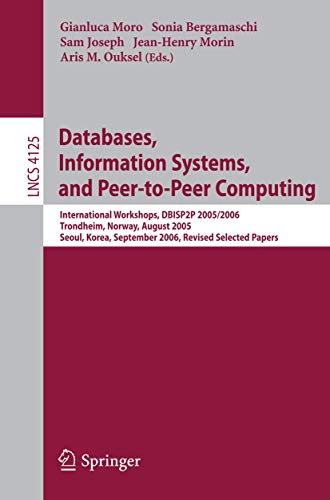
Taschenbuch. Zustand: Neu. Databases, Information Systems, and Peer-to-Peer Computing | International Workshops, DBISP2P 2005/2006, Trondheim, Norway, August 28-29, 2006, Revised Selected Papers | Gianluca Moro (u. a.) | Taschenbuch | xvi | Englisch | 2007 | Springer | EAN 9783540716600 | Verantwortliche Person für die EU: Springer Verlag GmbH, Tiergartenstr. 17, 69121 Heidelberg, juergen[dot]hartmann[at]springer[dot]com | Anbieter: preigu.
-
Taschenbuch. Zustand: Neu. Databases, Information Systems, and Peer-to-Peer Computing | Second International Workshop, DBISP2P 2004, Toronto, Canada, August 29-30, 2004, Revised Selected Papers | Wee Siong Ng (u. a.) | Taschenbuch | x | Englisch | 2005 | Springer | EAN 9783540252337 | Verantwortliche Person für die EU: Springer Verlag GmbH, Tiergartenstr. 17, 69121 Heidelberg, juergen[dot]hartmann[at]springer[dot]com | Anbieter: preigu.
-

Databases, Information Systems, and Peer-to-Peer Computing : First International Workshop, DBISP2P, Berlin Germany, September 7-8, 2003, Revised Papers
Sprache: Englisch
Verlag: Springer Berlin Heidelberg, 2010
ISBN 10: 364205899X ISBN 13: 9783642058998
Anbieter: AHA-BUCH GmbH, Einbeck, Deutschland
Verkäuferbewertung 5 von 5 Sternen
Taschenbuch. Zustand: Neu. Druck auf Anfrage Neuware - Printed after ordering - Peer-to-peer(P2P)computingiscurrentlyattractingenormousmediaattenti on, spurred by the popularity of le sharing systems such as Napster, Gnutella and Morpheus. In P2P systems a very large number of autonomous computing nodes (the peers) pool together their resources and rely on each other for data and services. The wealth of business opportunities promised by P2P networks has gene- ted much industrial interest recently, and has resulted in the creation of various industrial projects, startup companies, and special interest groups. Researchers from distributed computing, networks, agents and databases have also become excited about the P2P vision, and papers tackling open problems in this area have started appearing in high-quality conferences and workshops. Much of the recent research on P2P systems seems to be carried out by - search groups with a primary interest in distributed computation and networks. This workshop concentrated on the impact that current database research can have on P2P computing and vice versa. Although researchers in distributed data structures and databases have been working on related issues for a long time, the developed techniques are simply not adequate for the new paradigm.
-
Taschenbuch. Zustand: Neu. Databases, Information Systems, and Peer-to-Peer Computing | First International Workshop, DBISP2P, Berlin Germany, September 7-8, 2003, Revised Papers | Karl Aberer (u. a.) | Taschenbuch | x | Englisch | 2010 | Springer | EAN 9783642058998 | Verantwortliche Person für die EU: Springer Verlag GmbH, Tiergartenstr. 17, 69121 Heidelberg, juergen[dot]hartmann[at]springer[dot]com | Anbieter: preigu.
-

Zustand: Sehr gut. Zustand: Sehr gut | Sprache: Englisch | Produktart: Bücher | Peer-to-peer (P2P) computing promises to o?er exciting new possibilities in d- tributed information processing and database technologies. The realization of this promise lies fundamentally in the availability of enhanced services such as structured ways for classifying and registering shared information, veri?cation and certi?cation of information, content-distributed schemes and quality of c- tent, security features, information discovery and accessibility, interoperation and composition of active information services, and ?nally market-based me- anisms to allow cooperative and non-cooperative information exchanges. The P2P paradigm lends itself to constructing large-scale complex, adaptive, - tonomous and heterogeneous database and information systems, endowed with clearly speci?ed and di?erential capabilities to negotiate, bargain, coordinate, and self-organize the information exchanges in large-scale networks. This vision will have a radical impact on the structure of complex organizations (business, scienti?c, or otherwise) and on the emergence and the formation of social c- munities, and on how the information is organized and processed. The P2P information paradigm naturally encompasses static and wireless connectivity, and static and mobile architectures. Wireless connectivity c- bined with the increasingly small and powerful mobile devices and sensors pose new challenges to as well as opportunities for the database community. Inf- mation becomes ubiquitous, highly distributed and accessible anywhere and at any time over highly dynamic, unstable networks with very severe constraints on the information management and processing capabilities.


