

Gesamtpreis (1 Artikel Artikel):
Versandziel:

computational methods sensor material (5 Ergebnisse)
Direkt zu den wichtigsten Suchergebnissen
Suchfilter
Produktart
- Alle Product Types
- Bücher (5)
- Magazine & Zeitschriften (Keine weiteren Ergebnisse entsprechen dieser Verfeinerung)
- Comics (Keine weiteren Ergebnisse entsprechen dieser Verfeinerung)
- Noten (Keine weiteren Ergebnisse entsprechen dieser Verfeinerung)
- Kunst, Grafik & Poster (Keine weiteren Ergebnisse entsprechen dieser Verfeinerung)
- Fotografien (Keine weiteren Ergebnisse entsprechen dieser Verfeinerung)
- Karten (Keine weiteren Ergebnisse entsprechen dieser Verfeinerung)
- Manuskripte & Papierantiquitäten (Keine weiteren Ergebnisse entsprechen dieser Verfeinerung)
Zustand Mehr dazu
- Neu (3)
- Wie Neu, Sehr Gut oder Gut Bis Sehr Gut (1)
- Gut oder Befriedigend (1)
- Ausreichend oder Schlecht (Keine weiteren Ergebnisse entsprechen dieser Verfeinerung)
- Wie beschrieben (Keine weiteren Ergebnisse entsprechen dieser Verfeinerung)
Einband
Weitere Eigenschaften
- Erstausgabe (Keine weiteren Ergebnisse entsprechen dieser Verfeinerung)
- Signiert (Keine weiteren Ergebnisse entsprechen dieser Verfeinerung)
- Schutzumschlag (Keine weiteren Ergebnisse entsprechen dieser Verfeinerung)
- Angebotsfoto (3)
Sprache (1)
Gratisversand
- Kostenloser Versand nach USA (Keine weiteren Ergebnisse entsprechen dieser Verfeinerung)
Land des Verkäufers
Verkäuferbewertung
-

Computational Methods for Sensor Material Selection (Integrated Analytical Systems)
Buch 6 von 15: Integrated Analytical SystemsAnbieter: Books From California, Simi Valley, CA, USA
Verkäuferbewertung 4 von 5 Sternen

Hardcover. Zustand: Good. Ex library copy with usual markings.
-
Sonderangebot
EUR 39,38
EUR 105,00 Versand
Versand von Deutschland nach USAAnzahl: 1 verfügbar
In den WarenkorbZustand: Sehr gut. Zustand: Sehr gut | Seiten: 319 | Sprache: Englisch | Produktart: Bücher | In Computational Methods for Sensor Material Selection, experts discuss the design and selection of active sensing surfaces for chemical sensors, particularly sensors used in vapor sensing arrays or electronic noses.Part I covers first principles.Part II focuses on identifying and evaluating candidate sensing materials and covers such topics as calculations of sensor-analyte interactions, statistical and semi-empirical methods based on characteristics of sensing material and analyte, and new experimental methods.Part III advises on selecting materials for inclusion in arrays by use of statistical methods and algorithm-based methods for evaluating the array response to target analytes.This book will appeal to researchers in academia and industry involved in chemical vapor sensing and monitoring. Also, it will be of special interest to those who are developing devices based on chemical sensing arrays.
-
Taschenbuch. Zustand: Neu. Computational Methods for Sensor Material Selection | Margaret A. Ryan (u. a.) | Taschenbuch | xv | Englisch | 2014 | Springer US | EAN 9781489984166 | Verantwortliche Person für die EU: Springer Verlag GmbH, Tiergartenstr. 17, 69121 Heidelberg, juergen[dot]hartmann[at]springer[dot]com | Anbieter: preigu.
-
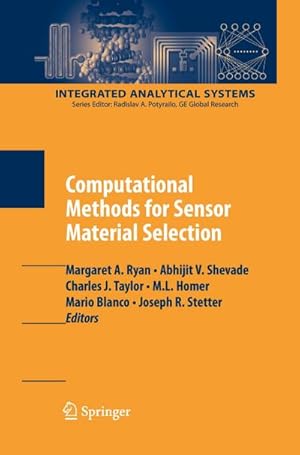
Computational Methods for Sensor Material Selection
Buch 6 von 15: Integrated Analytical SystemsAnbieter: AHA-BUCH GmbH, Einbeck, Deutschland
Verkäuferbewertung 5 von 5 Sternen

Taschenbuch. Zustand: Neu. Druck auf Anfrage Neuware - Printed after ordering - Chemical vapor sensing arrays have grown in popularity over the past two decades, finding applications for tasks such as process control, environmental monitoring, and medical diagnosis. This is the first in-depth analysis of the process of choosing materials and components for these 'electronic noses', with special emphasis on computational methods. For a view of component selection with an experimental perspective, readers may refer to the complementary volume of Integrated Microanalytical Systems entitled 'Combinatorial Methodologies for Sensor Materials.'.
-

Computational Methods for Sensor Material Selection
Buch 6 von 15: Integrated Analytical SystemsAnbieter: AHA-BUCH GmbH, Einbeck, Deutschland
Verkäuferbewertung 5 von 5 Sternen
Buch. Zustand: Neu. Druck auf Anfrage Neuware - Printed after ordering - Chemical vapor sensing arrays have grown in popularity over the past two decades, finding applications for tasks such as process control, environmental monitoring, and medical diagnosis. This is the first in-depth analysis of the process of choosing materials and components for these 'electronic noses', with special emphasis on computational methods. For a view of component selection with an experimental perspective, readers may refer to the complementary volume of Integrated Microanalytical Systems entitled 'Combinatorial Methodologies for Sensor Materials.'.


