

Gesamtpreis (1 Artikel Artikel):
Versandziel:

collision spectroscopy (9 Ergebnisse)
Direkt zu den wichtigsten Suchergebnissen
Suchfilter
Produktart
- Alle Product Types
- Bücher (9)
- Magazine & Zeitschriften (Keine weiteren Ergebnisse entsprechen dieser Verfeinerung)
- Comics (Keine weiteren Ergebnisse entsprechen dieser Verfeinerung)
- Noten (Keine weiteren Ergebnisse entsprechen dieser Verfeinerung)
- Kunst, Grafik & Poster (Keine weiteren Ergebnisse entsprechen dieser Verfeinerung)
- Fotografien (Keine weiteren Ergebnisse entsprechen dieser Verfeinerung)
- Karten (Keine weiteren Ergebnisse entsprechen dieser Verfeinerung)
- Manuskripte & Papierantiquitäten (Keine weiteren Ergebnisse entsprechen dieser Verfeinerung)
Zustand Mehr dazu
- Neu (5)
- Wie Neu, Sehr Gut oder Gut Bis Sehr Gut (1)
- Gut oder Befriedigend (2)
- Ausreichend oder Schlecht (Keine weiteren Ergebnisse entsprechen dieser Verfeinerung)
- Wie beschrieben (1)
Einband
Weitere Eigenschaften
- Erstausgabe (Keine weiteren Ergebnisse entsprechen dieser Verfeinerung)
- Signiert (Keine weiteren Ergebnisse entsprechen dieser Verfeinerung)
- Schutzumschlag (Keine weiteren Ergebnisse entsprechen dieser Verfeinerung)
- Angebotsfoto (5)
Sprache (2)
Gratisversand
Land des Verkäufers
Verkäuferbewertung
-

Collision Spectroscopy
Anbieter: Better World Books, Mishawaka, IN, USA
Verkäuferbewertung 5 von 5 Sternen

Zustand: Good. Former library copy. Pages intact with minimal writing/highlighting. The binding may be loose and creased. Dust jackets/supplements are not included. Includes library markings. Stock photo provided. Product includes identifying sticker. Better World Books: Buy Books. Do Good.
-
Sonderangebot
EUR 5,84
EUR 20,50 Versand
Versand von Frankreich nach USAAnzahl: 1 verfügbar
In den WarenkorbHardcover. Zustand: Bon. Ancien livre de bibliothèque. Légères traces d'usure sur la couverture. Salissures sur la tranche. Traces d'humidité sur les pages. Jaquette abîmée. Edition 1978. Ammareal reverse jusqu'à 15% du prix net de cet article à des organisations caritatives. ENGLISH DESCRIPTION Book Condition: Used, Good. Former library book. Slight signs of wear on the cover. Stains on the edge. Traces of humidity on the pages. Damaged dust jacket. Edition 1978. Ammareal gives back up to 15% of this item's net price to charity organizations.
-

Rotationally Cooled Hot Band Spectroscopy through Collision Mediated Double Resonance Techniques
Verlag: z.n. 1996, 1996
Anbieter: Antiquariaat Schot, Hendrik-Ido-Ambacht, Niederlande
Verkäuferbewertung 5 von 5 Sternen
130 p. Paperback.
-
Collision Spectroscopy / Applied Atomic Spectroscopy. Modern Analytic Chemistry.
Sprache: Englisch
Verlag: New York / London, Plenum Press., 1978
Anbieter: Antiquariat Thomas Haker GmbH & Co. KG, Berlin, Deutschland
Verbandsmitglied: GIAQ
Verkäuferbewertung 5 von 5 Sternen
Hardcover. Zustand: Gut. 458, 472 S., with numerous figures, Guter Zustand / good condition. Bibl.-Ex. / Ex.-library. Edges slightly soiled. Sprache: Englisch Gewicht in Gramm: 1640.
-

Taschenbuch. Zustand: Neu. Collision Spectroscopy | R. Cooks | Taschenbuch | xiv | Englisch | 2011 | Humana | EAN 9781461339571 | Verantwortliche Person für die EU: Springer Verlag GmbH, Tiergartenstr. 17, 69121 Heidelberg, juergen[dot]hartmann[at]springer[dot]com | Anbieter: preigu.
-
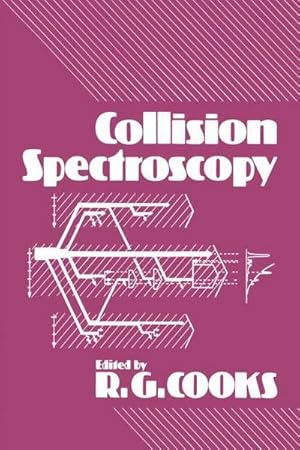
Collision Spectroscopy
Anbieter: AHA-BUCH GmbH, Einbeck, Deutschland
Verkäuferbewertung 5 von 5 Sternen
Taschenbuch. Zustand: Neu. Druck auf Anfrage Neuware - Printed after ordering - R. G. Cooks This introduction has three purposes: (a) to summarize some of the chief features of energy spectrometry of ions and to sketch in a little of the background to this subject, (b) to present some simple facts about collision processes which one skilled in, say, mass spectrometry but innocent of any knowledge of bimolecular collisions might find of value, and (c) to indicate the scope and content of the volume. 1. The Subject This book takes as its subject, ion-molecule and ion-atom reactions occurring at high energies. It emphasizes the study of inelastic reactions at high energy through measurements of translational energy. The investiga tion of these reactions using other procedures has been important in the cases of the simpler systems. In particular, the emitted radiation has been investigated and this subject is therefore discussed where appropriate. For more complex species, however, there is little information available other than from energy spectra. The defining characteristic of the energy range of interest is that momentum transfer to the neutral target is negligible for small scattering angles. The result of this apparently bland condition is a welcome simplicity in the interpretation of the results of what appears to be developing into a R. G. Cooks - Department of Chemistry, Purdue University, West Lafayette, Indiana 47907. 2 Introduction unique form of spectroscopy. The names ion kinetic-energy spectrometry, translational energy spectrometry, collision spectroscopy, and energy-loss spectrometry have all been used to describe this subject (d. Section 5).
-
Taschenbuch. Zustand: Neu. Collision- and Interaction-Induced Spectroscopy | Murray N. Neuman (u. a.) | Taschenbuch | xiii | Englisch | 2012 | Springer Netherland | EAN 9789401040822 | Verantwortliche Person für die EU: Springer Verlag GmbH, Tiergartenstr. 17, 69121 Heidelberg, juergen[dot]hartmann[at]springer[dot]com | Anbieter: preigu.
-

Collision- and Interaction-Induced Spectroscopy
Sprache: Englisch
Verlag: Springer Netherlands, Springer Netherlands, 2012
ISBN 10: 9401040826 ISBN 13: 9789401040822
Anbieter: AHA-BUCH GmbH, Einbeck, Deutschland
Verkäuferbewertung 5 von 5 Sternen
Taschenbuch. Zustand: Neu. Druck auf Anfrage Neuware - Printed after ordering - Collision-or interaction-induced spectroscopy refers to radiative transitions, which are forbidden in free atoms or molecules, but which occur in clusters of interacting atoms or molecules. The most common phenomena are induced absorption, in the infrared region, and induced light scattering, which involves inelastic scattering of visible laser light. The particle interactions giving rise to the necessary induced dipole moments and polarizabilities are modelled at long range by multipole expansions; at short range, electron overlap and exchange mechanisms come into play. Information on atomic and molecular interactions and dynamics in dense media on a picosecond timescale may be drawn from the spectra. Collision-induced absorption in the infrared was discovered at the University of Toronto in 1949 by Crawford, Welsh and Locke who studied liquid O and N. Through the 1950s and 1960s, 2 2 experimental elucidation of the phenomenon, particularly in gases, continued and theoretical underpinnings were established. In the late 1960s, the related phenomenon of collision-induced light scattering was first observed in compressed inert gases. In 1978, an 'Enrico Fermi' Summer School was held at Varenna, Italy, under the directorship of J. Van Kranendonk. The lectures, there, reviewed activity from the previous two decades, during which the approach to the subject had not changed greatly. In 1983, a highly successful NATO Advanced Research Workshop was held at Bonas, France, under the directorship of G. Birnbaum. An important outcome of that meeting was the demonstration of the maturity and sophistication of current experimental and theoretical techniques.
-

Collision- and Interaction-Induced Spectroscopy
Sprache: Englisch
Verlag: Springer Netherlands, Springer Netherlands, 1995
ISBN 10: 0792332520 ISBN 13: 9780792332527
Anbieter: AHA-BUCH GmbH, Einbeck, Deutschland
Verkäuferbewertung 5 von 5 Sternen
Buch. Zustand: Neu. Druck auf Anfrage Neuware - Printed after ordering - Collision-or interaction-induced spectroscopy refers to radiative transitions, which are forbidden in free atoms or molecules, but which occur in clusters of interacting atoms or molecules. The most common phenomena are induced absorption, in the infrared region, and induced light scattering, which involves inelastic scattering of visible laser light. The particle interactions giving rise to the necessary induced dipole moments and polarizabilities are modelled at long range by multipole expansions; at short range, electron overlap and exchange mechanisms come into play. Information on atomic and molecular interactions and dynamics in dense media on a picosecond timescale may be drawn from the spectra. Collision-induced absorption in the infrared was discovered at the University of Toronto in 1949 by Crawford, Welsh and Locke who studied liquid O and N. Through the 1950s and 1960s, 2 2 experimental elucidation of the phenomenon, particularly in gases, continued and theoretical underpinnings were established. In the late 1960s, the related phenomenon of collision-induced light scattering was first observed in compressed inert gases. In 1978, an 'Enrico Fermi' Summer School was held at Varenna, Italy, under the directorship of J. Van Kranendonk. The lectures, there, reviewed activity from the previous two decades, during which the approach to the subject had not changed greatly. In 1983, a highly successful NATO Advanced Research Workshop was held at Bonas, France, under the directorship of G. Birnbaum. An important outcome of that meeting was the demonstration of the maturity and sophistication of current experimental and theoretical techniques.


