

Gesamtpreis (1 Artikel Artikel):
Versandziel:

clause effect prolog programming von clocksin william (6 Ergebnisse)
Direkt zu den wichtigsten Suchergebnissen
Suchfilter
Produktart
- Alle Product Types
- Bücher (6)
- Magazine & Zeitschriften (Keine weiteren Ergebnisse entsprechen dieser Verfeinerung)
- Comics (Keine weiteren Ergebnisse entsprechen dieser Verfeinerung)
- Noten (Keine weiteren Ergebnisse entsprechen dieser Verfeinerung)
- Kunst, Grafik & Poster (Keine weiteren Ergebnisse entsprechen dieser Verfeinerung)
- Fotografien (Keine weiteren Ergebnisse entsprechen dieser Verfeinerung)
- Karten (Keine weiteren Ergebnisse entsprechen dieser Verfeinerung)
- Manuskripte & Papierantiquitäten (Keine weiteren Ergebnisse entsprechen dieser Verfeinerung)
Zustand Mehr dazu
- Neu (2)
- Wie Neu, Sehr Gut oder Gut Bis Sehr Gut (1)
- Gut oder Befriedigend (3)
- Ausreichend oder Schlecht (Keine weiteren Ergebnisse entsprechen dieser Verfeinerung)
- Wie beschrieben (Keine weiteren Ergebnisse entsprechen dieser Verfeinerung)
Einband
- alle Einbände
- Hardcover (Keine weiteren Ergebnisse entsprechen dieser Verfeinerung)
- Softcover (6)
Weitere Eigenschaften
- Erstausgabe (Keine weiteren Ergebnisse entsprechen dieser Verfeinerung)
- Signiert (Keine weiteren Ergebnisse entsprechen dieser Verfeinerung)
- Schutzumschlag (Keine weiteren Ergebnisse entsprechen dieser Verfeinerung)
- Angebotsfoto (3)
Sprache (1)
Preis
- Beliebiger Preis
- Weniger als EUR 20 (Keine weiteren Ergebnisse entsprechen dieser Verfeinerung)
- EUR 20 bis EUR 45
- Mehr als EUR 45
Gratisversand
Land des Verkäufers
Verkäuferbewertung
-

Clause and Effect: Prolog Programming for the Working Programmer
Anbieter: Dream Books Co., Denver, CO, USA
Verkäuferbewertung 5 von 5 Sternen

Zustand: good. Gently used with minimal wear on the corners and cover. A few pages may contain light highlighting or writing, but the text remains fully legible. Dust jacket may be missing, and supplemental materials like CDs or codes may not be included. May be ex-library with library markings. Ships promptly!
-

Clause and Effect : Prolog Programming for the Working Programmer
Sprache: Englisch
Verlag: Springer Berlin / Heidelberg, 1997
ISBN 10: 3540629718 ISBN 13: 9783540629719
Anbieter: Better World Books Ltd, Dunfermline, Vereinigtes Königreich
Verkäuferbewertung 5 von 5 Sternen
EUR 33,23
EUR 5,75 Versand
Versand von Vereinigtes Königreich nach USAAnzahl: 1 verfügbar
In den WarenkorbZustand: Good. Former library copy. Pages intact with minimal writing/highlighting. The binding may be loose and creased. Dust jackets/supplements are not included. Includes library markings. Stock photo provided. Product includes identifying sticker. Better World Books: Buy Books. Do Good.
-
Clause and Effect: Prolog Programming for the Working Programmer
Anbieter: Anybook.com, Lincoln, Vereinigtes Königreich
Verkäuferbewertung 5 von 5 Sternen
EUR 57,20
EUR 15,40 Versand
Versand von Vereinigtes Königreich nach USAAnzahl: 1 verfügbar
In den WarenkorbZustand: Good. This is an ex-library book and may have the usual library/used-book markings inside.This book has soft covers. In good all round condition. Please note the Image in this listing is a stock photo and may not match the covers of the actual item,350grams, ISBN:9783540629719.
-
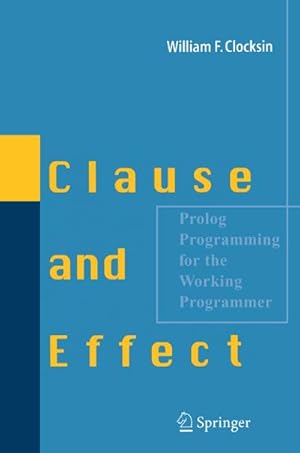
Clause and Effect : Prolog Programming for the Working Programmer
Anbieter: AHA-BUCH GmbH, Einbeck, Deutschland
Verkäuferbewertung 5 von 5 Sternen
Taschenbuch. Zustand: Neu. Druck auf Anfrage Neuware - Printed after ordering - This book is for people who have done some programming, either in Prolog or in a language other than Prolog, and who can find their way around a reference manual. The emphasis of this book is on a simplified and disciplined methodology for discerning the mathematical structures related to a problem, and then turning these structures into Prolog programs. This book is therefore not concerned about the particular features of the language nor about Prolog programming skills or techniques in general. A relatively pure subset of Prolog is used, which includes the 'cut', but no input/output, no assert/retract, no syntactic extensions such as if then-else and grammar rules, and hardly any built-in predicates apart from arithmetic operations. I trust that practitioners of Prolog program ming who have a particular interest in the finer details of syntactic style and language features will understand my purposes in not discussing these matters. The presentation, which I believe is novel for a Prolog programming text, is in terms of an outline of basic concepts interleaved with worksheets. The idea is that worksheets are rather like musical exercises. Carefully graduated in scope, each worksheet introduces only a limited number of new ideas, and gives some guidance for practising them. The principles introduced in the worksheets are then applied to extended examples in the form of case studies.
-
Taschenbuch. Zustand: Neu. Clause and Effect | Prolog Programming for the Working Programmer | William F. Clocksin | Taschenbuch | ix | Englisch | 1997 | Springer | EAN 9783540629719 | Verantwortliche Person für die EU: Springer Verlag GmbH, Tiergartenstr. 17, 69121 Heidelberg, juergen[dot]hartmann[at]springer[dot]com | Anbieter: preigu.
-
Sonderangebot
EUR 38,75
EUR 105,00 Versand
Versand von Deutschland nach USAAnzahl: 1 verfügbar
In den WarenkorbZustand: Sehr gut. Zustand: Sehr gut | Sprache: Englisch | Produktart: Bücher | This book is for people who have done some programming, either in Prolog or in a language other than Prolog, and who can find their way around a reference manual. The emphasis of this book is on a simplified and disciplined methodology for discerning the mathematical structures related to a problem, and then turning these structures into Prolog programs. This book is therefore not concerned about the particular features of the language nor about Prolog programming skills or techniques in general. A relatively pure subset of Prolog is used, which includes the 'cut', but no input/output, no assert/retract, no syntactic extensions such as if then-else and grammar rules, and hardly any built-in predicates apart from arithmetic operations. I trust that practitioners of Prolog program ming who have a particular interest in the finer details of syntactic style and language features will understand my purposes in not discussing these matters. The presentation, which I believe is novel for a Prolog programming text, is in terms of an outline of basic concepts interleaved with worksheets. The idea is that worksheets are rather like musical exercises. Carefully graduated in scope, each worksheet introduces only a limited number of new ideas, and gives some guidance for practising them. The principles introduced in the worksheets are then applied to extended examples in the form of case studies.

