Gesamtpreis (1 Artikel Artikel):
Versandziel:

ceramique orientale (22 Ergebnisse)
Direkt zu den wichtigsten Suchergebnissen
Suchfilter
Produktart
- Alle Product Types
- Bücher (22)
- Magazine & Zeitschriften (Keine weiteren Ergebnisse entsprechen dieser Verfeinerung)
- Comics (Keine weiteren Ergebnisse entsprechen dieser Verfeinerung)
- Noten (Keine weiteren Ergebnisse entsprechen dieser Verfeinerung)
- Kunst, Grafik & Poster (Keine weiteren Ergebnisse entsprechen dieser Verfeinerung)
- Fotografien (Keine weiteren Ergebnisse entsprechen dieser Verfeinerung)
- Karten (Keine weiteren Ergebnisse entsprechen dieser Verfeinerung)
- Manuskripte & Papierantiquitäten (Keine weiteren Ergebnisse entsprechen dieser Verfeinerung)
Zustand Mehr dazu
Weitere Eigenschaften
- Erstausgabe (7)
- Signiert (Keine weiteren Ergebnisse entsprechen dieser Verfeinerung)
- Schutzumschlag (1)
- Angebotsfoto (10)
Sprache (3)
Gratisversand
- Kostenloser Versand nach USA (Keine weiteren Ergebnisse entsprechen dieser Verfeinerung)
Land des Verkäufers
Verkäuferbewertung
-

Ceramique Orientale
Sprache: Französisch
Verlag: Paris, 1927
Anbieter: Samuel Lasenby Bookseller, Corona del Mar, CA, USA
Verkäuferbewertung 4 von 5 Sternen

Erstausgabe
Buckram. Zustand: Very Good. No Jacket. First Edition. Blue boards. Gitl title on spine. Unpag One page introduction. One page Table des Matieres. Followed by 40 color plates laid down on brown paper. Introduction by Rene Grandjean. French Text. No publication date. Tp pulled but present. Gilt LPH at tail. Probably ex-library but no marks except paper loss section on brown paste-down and white paper remnants on rear paste-down and cep.World cat states 1927 date.
-

La Céramique Chinoise. Porcelaine Orientale, Date de Sa Découverte: Explication Des Sujets de Décor, Les Usages Divers, Classification (French Edition)
Anbieter: Ria Christie Collections, Uxbridge, Vereinigtes Königreich
Verkäuferbewertung 5 von 5 Sternen

EUR 28,81
EUR 13,85 Versand
Versand von Vereinigtes Königreich nach USAAnzahl: Mehr als 20 verfügbar
In den WarenkorbZustand: New. In.
-
Motifs et symboles du IVe millénaire dans la céramique orientale [Syria. Tome 16 fascicule 4, 1935]
Sprache: Französisch
Verlag: Paul Geuthner, Paris, 1935
Anbieter: Joseph Burridge Books, Dagenham, Vereinigtes Königreich
Verkäuferbewertung 5 von 5 Sternen
EUR 26,20
EUR 26,59 Versand
Versand von Vereinigtes Königreich nach USAAnzahl: 1 verfügbar
In den WarenkorbSoft cover. Zustand: Very Good. pp. 375-39, illustrations : 28 cm.
-
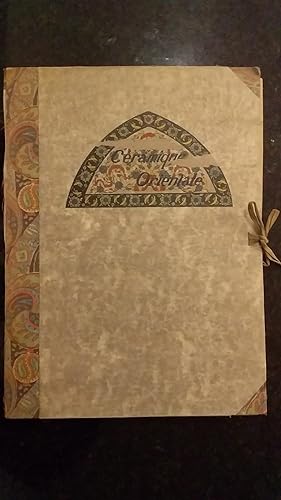
Ceramique Orientale.
Sprache: Englisch
Verlag: Henri Ernst, Paris, 1920
Anbieter: Tinakori Books, Lower Hutt, Neuseeland
Verkäuferbewertung 5 von 5 Sternen
Erstausgabe
Hardcover. Zustand: Good. First Edition. No publication date, ca. 1920. Portfolio of 40 beautiful colour plates laid down on brown boards. Some foxing to the 6 preliminary leaves but plates are all in fine condition. Spine strip detached but present, some wear on covers. Beautiful examples of Islamic, Arabic and Persian tiles and pottery.
-

EUR 29,91
EUR 48,99 Versand
Versand von Deutschland nach USAAnzahl: Mehr als 20 verfügbar
In den WarenkorbZustand: New.
-
Terres D'Islam: Les Collections de Ceramique Moyen-Orientale du Musee Ariana a Geneve
Sprache: Englisch
Verlag: 5 Continents Editions, Milan, Italy, 2014
ISBN 10: 8874395345 ISBN 13: 9788874395347
Anbieter: Jorge Welsh Books, Lisboa, Portugal
Verkäuferbewertung 5 von 5 Sternen
Erstausgabe
Soft cover. Zustand: Good. No Jacket. 1st Edition. French text with English summaries at the end.; Paperback.;25.5 x 24.5 cm.; 1.9 kg.; 344 pages with colour illustrations.; Used with signs of wear on the exterior, namely edge wear, a few scuffs and scratches on the front cover, spine and back cover. Interior in very good condition.; Catalogue from the exhibition"Terres d'Islam : L'Ariana sort de ses reserves II," held at the Musee Ariana, Geneva, from February 28-August 31, 2014.; The Arina Museum Islamic collection comprises pieces from the 9th to the 19th century from Transoxiana, Persia, Turkey, Syria, Egypt and Spain.
-
Céramique Orientale
Verlag: Ernst Henri, Paris, 1925
Anbieter: ERIC CHAIM KLINE, BOOKSELLER (ABAA ILAB), Santa Monica, CA, USA
Verkäuferbewertung 4 von 5 Sternen
Erstausgabe
Hardcover. Zustand: fair. First edition. Folio. [6]pp (text), 39 loose plates (of 40). Original decorative 3/4 cloth over paper covered boards, with paste-down on front cover. Remarkable collection of fine Oriental ceramics from the 13th to the 18th century reproduced in color collotypes and tipped onto heavy mounts. 1 plate missing (#40). Heavy edge wear on portfolio with front board detached but present. Spine split open and frayed. String ties missing. Text pages age-toned along margin. Left margin of introduction page creased and partly torn (not affecting text). Minor sunning along margin of plates (not affecting images). Text in French. Portfolio in poor, text pages in fair, plates in good+, images in very good condition.
-
Zustand: Sehr gut. Zustand: Sehr gut | Seiten: 338 | Sprache: Französisch | Produktart: Bücher | Keine Beschreibung verfügbar.
-

Terres d'Islam: Les collections de céramique moyen-orientale du Musée Ariana à Genève
Anbieter: Joseph Burridge Books, Dagenham, Vereinigtes Königreich
Verkäuferbewertung 5 von 5 Sternen
Erstausgabe
EUR 119,09
EUR 26,59 Versand
Versand von Vereinigtes Königreich nach USAAnzahl: 1 verfügbar
In den WarenkorbSoft cover. Zustand: Very Good. 1st Edition. 343 pages : colour illustrations ; 26 cm. Text in French; summaries in English. Published in conjunction with an exhibition entitled "Terres d'Islam : L'Ariana sort de ses reserves II," held at the Musee Ariana, Geneva, February 28-August 31, 2014.
-
Ceramique Orientale
Verlag: Ernst Henri, Paris, 1922
Anbieter: Rooke Books PBFA, Bath, Vereinigtes Königreich
Verbandsmitglied: PBFA
Verkäuferbewertung 5 von 5 Sternen
EUR 89,32
EUR 23,11 Versand
Versand von Vereinigtes Königreich nach USAAnzahl: 1 verfügbar
In den WarenkorbCloth. Zustand: Good Only. Not Stated (illustrator). A French portfolio highlighting the beauty of the ceramic pattern designs commonly seen in Islamic, Arabic, and Persian pottery. In French.Illustrated with thirty-eight hand-coloured plates.Bound without title page and introduction, and two plates, plates 31 and 33.A beautiful portfolio volume showing lovely examples of Islamic, Arabic, and Persian pottery and tiles.The plates show the beauty of Islamic, Arabic, and Persian patterns for ceramics, each plate hand-coloured with vivid colours.Introduction by Rene Grandjean.Undated, dated from Jisc from a copy held at the University of Edinburgh Libraries. In a half cloth portfolio with paper to the boards, with ribbon ties. Externally, boards are detached from one another, backstrip is attached to the rear board but mostly torn and may detach. Some fraying to the edges of the cloth, and lifting of cloth to the extremities. A little discolouration and some marks to the boards. Label to the front paste down. Internally, unbound, as issued. Pages are a little age-toned with some light marks. Light edge wear to the first few plates. Small ink mark to a couple of plates. Lacking plates 31 and 33. Good Only. book.
-
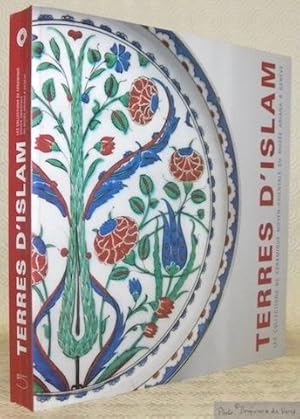
Terre d'Islam. Les collections de céramique moyen-orientale du Musée Ariana à Genève.
Verlag: 5 Continents Editions, Milan,, 2014
Anbieter: Bouquinerie du Varis, Russy, FR, Schweiz
Verkäuferbewertung 5 von 5 Sternen
broché. 255x240mm, 343pages, photos couleurs, Couverture à rabats. Exemplaire à l'état de neuf. En cas de problème de commande, veuillez nous contacter via notre page d'accueil / If there is a problem with the order, please contact us via our homepage.
-
Céramique Orientale
Verlag: Ernst Henri, Paris, 1920
Anbieter: ERIC CHAIM KLINE, BOOKSELLER (ABAA ILAB), Santa Monica, CA, USA
Verkäuferbewertung 4 von 5 Sternen
Hardcover. Zustand: fair. Portfolio. 4 pp. introduction. 3/4 paisley cloth over decorated boards. With original tie. With 40 collotype plates with pochoir elements. Portfolio showcases turkish, early iranian and mediterranean ceramic tiles and pottery. Binding split. Plates browned and chipped at edges. Beautifully colored plates. Overall, in fair/good condition.
-
Céramique Orientale (Oriental Ceramics)
Verlag: Henri Ernst, Éditeur, Paris, 1922
Anbieter: ERIC CHAIM KLINE, BOOKSELLER (ABAA ILAB), Santa Monica, CA, USA
Verkäuferbewertung 4 von 5 Sternen
Erstausgabe
Loose leaf. Zustand: Good+ to very good+ condition. First edition. Small Elephant Folio. [6]pp. (text), 40 plates. Original decorative three quarter cloth over textured gray paper covered boards, with decorative color and lettering on paste-down on front cover. Remarkable collection of fine Oriental ceramics from the 10th to the 16h century, reproduced in color collotypes with pochoir elements and tipped onto heavy mounts. Attempt to provide an overview of the production of the best-known centers while respecting the chronological order. Includes products of the Rakka workshop (Euphrates), a series likely originating in Egypt, several from Rhages or Bajes (Persia), mosque decorations from Koniek, and wall coverings, dishes and plates from Asia Minor, Damascus, and Rhodes, Text in French. Portfolio lightly sunned with circular water stain on front cover. Title and text pages with light chipping at edges; title page with editor's name penciled to top left. Plates in very good+ condition.
-
La Ceramique Chinoise: Porcelaine Orientale : Date de sa Decouverte Explication des Sujets de Decor. - Les Usages Divers Classification
Verlag: Librairie de Firmin-Didot et Cie, 1894
Anbieter: Anybook.com, Lincoln, Vereinigtes Königreich
Verkäuferbewertung 5 von 5 Sternen
EUR 327,51
EUR 42,46 Versand
Versand von Vereinigtes Königreich nach USAAnzahl: 1 verfügbar
In den WarenkorbZustand: Fair. This is an ex-library book and may have the usual library/used-book markings inside.This book has soft covers. In fair condition, suitable as a study copy. Folio. Grubby soft covers with lettering on front cover. Bumped and creased corners. Age-toned pages. Marks on covers. Contains plates protected by tissue guards. Very loose binding. Please note the Image in this listing is a stock photo and may not match the covers of the actual item,3100grams, ISBN:
-
La céramique chinoise. Porcelaine orientale: Date de sa découverte. - Explication des sujets de décor. - Les usages divers. - Classification. Héliogravures par Dujardin reproduisant cent vingt-quatre pièces de la collection de l'auteur.
Verlag: Librairie de Firmin-Didot et Cie, Paris, 1894
Anbieter: Emile Kerssemakers ILAB, Heerlen, Niederlande
Verkäuferbewertung 5 von 5 Sternen
Large 4to (34,5x26 cm). Wrappers renewed with contemporary thick paper, with copied title-label ("couverture d'attente"). Uncut and unopened. (iv),(ii),232 pp. With 42 plates, printed on silk-like tissue paper and tipped in on thick handmade paper. Representing 124 items of the author's collection. With protecting tissues: the tissues more or less browned. 10 tissues affecting the plates with brown spots. - Standard work in good condition. 3500g.
-
Céramique Orientale. Introduction de René Grandjean.
Verlag: Ernst Henri, (1922)., Paris,, 1922
Anbieter: Llibreria Antiquària Els Gnoms, Sedó, L, Spanien
Verkäuferbewertung 4 von 5 Sternen
Contiene 40 láminas en color montadas en cartulina con docenas de objetos reproducidos. 3hh. de texto.
-
La céramique chinoise, porcelaine orientale : Date de sa découverte, explication des sujets de décor, les usages divers, classification. First edition. Signed presentation copy.
Verlag: Paris: Librairie de Firmin-Didot et Cie., 1894
Anbieter: Wittenborn Art Books, San Francisco, CA, USA
Verkäuferbewertung 5 von 5 Sternen
Zustand: Good. Large 4to. 24.7 x 33cm. Contemporary half shagreen. (II-232 p.-XLII p. de pl.). OCLC Number 959015205. Grandidier's collecting practice was not just driven by the charm of exoticism?it was an academic, conscientious, and long-term focus. The more than 200-page La céramique chinoise published the year of his installation at the Louvre best records and testifies to the time and effort he devoted to the collection. Using pieces from his collection as examples and illustrations, the publication offered the public one of the most extensive textual introductions to Chinese porcelain available, covering such topics as origins, kilns, textures, colours, subject matters, decoration, and reigns (Grandidier, 1894). Having a great sense of the contents and limitations of other existing collections in France, Britain, and the United States, Grandidier expressed in his book his intention to form the best collection in Europe for France in terms of 'completeness and quality', which he regarded as the two most important collecting criteria (ibid., pp. 4-6). For completeness, he advanced an eclectic policy: the collecting of 'all genres, all types, and all times' (ibid., p. 5.). In terms of quality, on the other hand, he favoured porcelains made for local consumption rather than export pieces which he thought were 'less instructive and less beautiful' (ibid., p. 6). According to Raymond Koechlin (1860-1931), collector, politician, and general secretary of the Friends of the Louvre, Grandidier sold his family property in Corbeil in exchange for porcelains and was said to have continued collecting after his donation to the Louvre and even while dying on his sickbed (Koechlin, 1914, p. 12).Choosing the Louvre, the national museum of highest reputation, as the repository of his great collection was not random (Fig. 2). Unlike collectors such as the couple Adolphe d'Ennery (1811-99) and Clémence d'Ennery (1823-98) and Henri Cernuschi (1821-96), Grandidier chose not to display the porcelains in his home. That choice positioned his collection in a spectrum between a display of French imperialism and the open cultural appreciation of another nation. Indeed, the expansion of the Louvre's collection in the 19th century from European to Eastern culture coincided with the expansionist actions of successive French governments, from the founding of the Egyptian collection following the expedition of Napoleon to the formation of the Salle d'Orient (Orient Room) for Muslim art correspondent to France's intervention in the Near East during the reign of Napoleon III (Koechlin, 1914, pp. 3-5).In 1894, instead of being integrated into a smaller collection of Chinese artefacts primarily collected by military generals and diplomats under the maritime museum at the Louvre, Grandidier's collection was installed in a new space established in the Denon Wing?under the name the Musée d'Extrême-Orient (Museum of the Far East). It occupied the long rectangular space on the entresol on the ground floor (Fig. 3) below the famous grand gallery for Italian School paintings. The promising area matched with the ambitions of both Gaston Migeon (1861-1930), curator of the department of objects d'art, and Grandidier, newly appointed curator of the Musée de l'Extrême-Orient, to expand and 'complete' the collection as well as provide a pleasurable visual experience to the visitor (Musée du Louvre, 1897, p. 24; Guide Joanne, 1912, p. 63). To enhance visual attention to the artistic value of the porcelains, the space was specially designed. The entresol, which featured more rooms (eleven, plus two long galleries) than other spaces in the Denon Wing, created visual divisions favourable for allowing the visitor to concentrate on the details of the porcelain works. The vitrines, according to Koechlin, were in monochrome and simple rectangular form so as not to divert the audience's attention, as in the galleries of western ceramics (Koechlin, 1914, p. 11). Light was sufficiently provided.
-
Céramique orientale.
Anbieter: Antiquariaat A. Kok & Zn. B.V., Amsterdam, Niederlande
Verkäuferbewertung 5 von 5 Sternen
Paris, Henri Ernst, n.d. [1920/30s]. 2 pp. text. 40 col.plts. H.cloth portfolio, spine damaged.
-
Céramique orientale.
Anbieter: Antiquariaat A. Kok & Zn. B.V., Amsterdam, Niederlande
Verkäuferbewertung 5 von 5 Sternen
Paris, Henri Ernst, n.d. [1920/30s]. 2 pp. text. 40 col.plts. H.cloth portfolio.
-
Céramique orientale.
Anbieter: Babel Librairie, PERIGUEUX, Frankreich
Verbandsmitglied: ILAB
Verkäuferbewertung 5 von 5 Sternen
Erstausgabe
Paris, Ernst Henri Editeur, s.d. [circa 1910]. Un vol. au format in-folio (387 x 287 mm) de 3 ff. n.fol. et 40 planches. Reliure d'édition de plein cartonnage marbré souple, dos et coins de tissu multicolore, fermeture à lacet. Edition originale. Soigneuse publication, elle recèle 40 (sur 40) superbes planches délicieusement rehaussées au pochoir. ''Nos reproductions sont faites sans ordre, le plus exactement possible, avec le seul souci de présenter un ouvrage encore plus utile au décorateur qu'à l'archéologue''. Rares rousseurs affectant les feuillets de texte. Du reste, très belle condition.
-
La céramique chinoise. Porcelaine orientale: Date de sa découverte - Explication des sujets de décor - Les usages divers classification.
Anbieter: Antiquariaat A. Kok & Zn. B.V., Amsterdam, Niederlande
Verkäuferbewertung 5 von 5 Sternen
Paris, Firmin-Didot, 1894. 232 pp. 42 plts. In contemp. simple brown wrappers (as issued by the publisher) with title printed on frontcover, wrapper damaged.
-
CÉRAMIQUE ORIENTALE.
Verlag: Introducción de René Grandjean. Ed. Ernst Henri. París, s.a. (c. 1920, 1920
Anbieter: FARRÉ Libreria Anticuaria, Barcelona, B, Spanien
Verkäuferbewertung 5 von 5 Sternen
). 38 cm. 3 h. y 40 lám. en color, sobrepuestas. En rama, presentado en carpeta en media tela, puntas. Leves rozaduras en el plano posterior. Señal de óxido en las hojas de texto. Ex libris de anterior poseedor. Arte. Cerámica oriental.