
Bounded queries recursion theory von levine william (8 Ergebnisse)
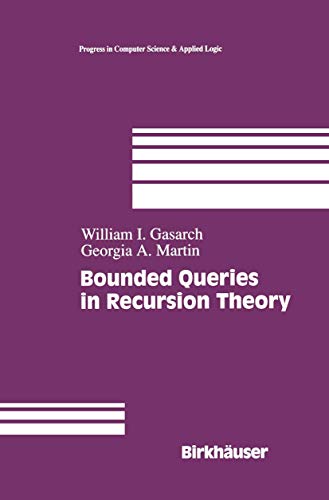
- Hardcover
Anbieter: Majestic Books, Hounslow, Vereinigtes KönigreichMajestic Books
Verkäufer/-in kontaktierenVerkäufer/-in mit 4 SternenZustand: Neu
EUR 47,72
EUR 7,51 VersandVersand von Vereinigtes Königreich nach USAAnzahl: 1 verfügbar
Zustand: New. pp. 376 52:B&W 6.14 x 9.21in or 234 x 156mm (Royal 8vo) Case Laminate on White w/Gloss Lam.
- Hardcover
Anbieter: Ria Christie Collections, Uxbridge, Vereinigtes KönigreichRia Christie Collections
Verkäufer/-in kontaktierenVerkäufer/-in mit 5 SternenZustand: Neu
EUR 114,38
EUR 13,84 VersandVersand von Vereinigtes Königreich nach USAAnzahl: Mehr als 20 verfügbar
Zustand: New. In.

- Softcover
Anbieter: Ria Christie Collections, Uxbridge, Vereinigtes KönigreichRia Christie Collections
Verkäufer/-in kontaktierenVerkäufer/-in mit 5 SternenZustand: Neu
EUR 114,38
EUR 13,84 VersandVersand von Vereinigtes Königreich nach USAAnzahl: Mehr als 20 verfügbar
Zustand: New. In.

- Softcover
Anbieter: moluna, Greven, Deutschlandmoluna
Verkäufer/-in kontaktierenVerkäufer/-in mit 4 SternenZustand: Neu
EUR 92,27
EUR 48,99 VersandVersand von Deutschland nach USAAnzahl: Mehr als 20 verfügbar
Zustand: New.
 Weitere Bilder
- Softcover
Anbieter: preigu, Osnabrück, Deutschlandpreigu
Verkäufer/-in kontaktierenVerkäufer/-in mit 5 SternenZustand: Neu
EUR 95,15
EUR 70,00 VersandVersand von Deutschland nach USAAnzahl: 5 verfügbar
Taschenbuch. Zustand: Neu. Bounded Queries in Recursion Theory | William Levine (u. a.) | Taschenbuch | Progress in Computer Science and Applied Logic | xiii | Englisch | 2013 | Birkhäuser | EAN 9781461268482 | Verantwortliche Person für die EU: Springer Basel AG in Springer Science + Business Media, Heidelberger Platz 3, 14197…Berlin, juergen[dot]hartmann[at]springer[dot]com | Anbieter: preigu.

- Hardcover
Anbieter: moluna, Greven, Deutschlandmoluna
Verkäufer/-in kontaktierenVerkäufer/-in mit 5 SternenZustand: Neu
EUR 124,02
EUR 48,99 VersandVersand von Deutschland nach USAAnzahl: Mehr als 20 verfügbar
Gebunden. Zustand: New.

- Softcover
Anbieter: AHA-BUCH GmbH, Einbeck, DeutschlandAHA-BUCH GmbH
Verkäufer/-in kontaktierenVerkäufer/-in mit 5 SternenZustand: Neu
EUR 114,36
EUR 62,82 VersandVersand von Deutschland nach USAAnzahl: 1 verfügbar
Taschenbuch. Zustand: Neu. Druck auf Anfrage Neuware - Printed after ordering - One of the major concerns of theoretical computer science is the classifi cation of problems in terms of how hard they are. The natural measure of difficulty of a function is the amount of time needed to compute it (as a function of the length of the… input). Other resources, such as space, have also been considered. In recursion theory, by contrast, a function is considered to be easy to compute if there exists some algorithm that computes it. We wish to classify functions that are hard, i.e., not computable, in a quantitative way. We cannot use time or space, since the functions are not even computable. We cannot use Turing degree, since this notion is not quantitative. Hence we need a new notion of complexity-much like time or spac~that is quantitative and yet in some way captures the level of difficulty (such as the Turing degree) of a function.

- Hardcover
Anbieter: AHA-BUCH GmbH, Einbeck, DeutschlandAHA-BUCH GmbH
Verkäufer/-in kontaktierenVerkäufer/-in mit 5 SternenZustand: Neu
EUR 153,14
EUR 63,62 VersandVersand von Deutschland nach USAAnzahl: 1 verfügbar
Buch. Zustand: Neu. Neuware - One of the major concerns of theoretical computer science is the classifi cation of problems in terms of how hard they are. The natural measure of difficulty of a function is the amount of time needed to compute it (as a function of the length of the input). Other resources, such as space, have also… been considered. In recursion theory, by contrast, a function is considered to be easy to compute if there exists some algorithm that computes it. We wish to classify functions that are hard, i.e., not computable, in a quantitative way. We cannot use time or space, since the functions are not even computable. We cannot use Turing degree, since this notion is not quantitative. Hence we need a new notion of complexity-much like time or spac~that is quantitative and yet in some way captures the level of difficulty (such as the Turing degree) of a function.


