Gesamtpreis (1 Artikel Artikel):
Versandziel:

big typescript 213 von wittgenstein ludwig (11 Ergebnisse)
Direkt zu den wichtigsten Suchergebnissen
Suchfilter
Produktart
- Alle Product Types
- Bücher (11)
- Magazine & Zeitschriften (Keine weiteren Ergebnisse entsprechen dieser Verfeinerung)
- Comics (Keine weiteren Ergebnisse entsprechen dieser Verfeinerung)
- Noten (Keine weiteren Ergebnisse entsprechen dieser Verfeinerung)
- Kunst, Grafik & Poster (Keine weiteren Ergebnisse entsprechen dieser Verfeinerung)
- Fotografien (Keine weiteren Ergebnisse entsprechen dieser Verfeinerung)
- Karten (Keine weiteren Ergebnisse entsprechen dieser Verfeinerung)
- Manuskripte & Papierantiquitäten (Keine weiteren Ergebnisse entsprechen dieser Verfeinerung)
Zustand Mehr dazu
- Neu (7)
- Wie Neu, Sehr Gut oder Gut Bis Sehr Gut (2)
- Gut oder Befriedigend (1)
- Ausreichend oder Schlecht (Keine weiteren Ergebnisse entsprechen dieser Verfeinerung)
- Wie beschrieben (1)
Einband
Weitere Eigenschaften
- Erstausgabe (2)
- Signiert (Keine weiteren Ergebnisse entsprechen dieser Verfeinerung)
- Schutzumschlag (2)
- Angebotsfoto (7)
Sprache (3)
Preis
- Beliebiger Preis
- Weniger als EUR 20 (Keine weiteren Ergebnisse entsprechen dieser Verfeinerung)
- EUR 20 bis EUR 45
- Mehr als EUR 45
Gratisversand
- Kostenloser Versand nach USA (Keine weiteren Ergebnisse entsprechen dieser Verfeinerung)
Land des Verkäufers
Verkäuferbewertung
-

The Big Typescript: TS 213
Anbieter: Black Gull Books (P.B.F.A.), St Leonard's on Sea, Vereinigtes Königreich
Verbandsmitglied: PBFA
Verkäuferbewertung 5 von 5 Sternen

EUR 35,30
EUR 14,85 shipping
Versand von Vereinigtes Königreich nach USAAnzahl: 1 verfügbar
In den Warenkorbpaperback. Zustand: Very Good.
-

The Big Typescript : Ts 213
Anbieter: AHA-BUCH GmbH, Einbeck, Deutschland
Verkäuferbewertung 5 von 5 Sternen
Buch. Zustand: Neu. Neuware - In 1933, Wittgenstein set out to dictate a collection of his recent writings to a typist in the form of a book. Even as he was dictating he began revising the text extensively, so that the surviving typewritten manuscript contains numerous corrections, additions, deletions, alternative words and phrasings, suggestions for moves within the text, and marginal comments in both handwritten and typed form.
-
The Big Typescript: TS 213: German-English Scholars' Edition
Anbieter: Revaluation Books, Exeter, Vereinigtes Königreich
Verkäuferbewertung 5 von 5 Sternen
EUR 82,63
EUR 17,14 shipping
Versand von Vereinigtes Königreich nach USAAnzahl: 2 verfügbar
In den WarenkorbPaperback. Zustand: Brand New. blg rep edition. 516 pages. 9.50x6.75x2.00 inches. In Stock.
-
![Beispielbild für Escrito a máquina : [The big typescript] [TS 213] zum Verkauf von Librería Pérez Galdós](https://pictures.abebooks.com/isbn/9788498795592-de-300.jpg)
Escrito a máquina : [The big typescript] [TS 213]
Sprache: Spanisch
Verlag: Editorial Trotta, S.A., Madrid, 2014
ISBN 10: 8498795591 ISBN 13: 9788498795592
Anbieter: Librería Pérez Galdós, Madrid, M, Spanien
Verkäuferbewertung 5 von 5 Sternen
cart. . . Estado de conservación: new. 696 p. páginas.
-

The Big Typescript : Ts 213
Anbieter: AHA-BUCH GmbH, Einbeck, Deutschland
Verkäuferbewertung 5 von 5 Sternen
Taschenbuch. Zustand: Neu. Neuware - Long awaited by the scholarly community, Wittgenstein's so-called Big Typescript (von Wright Catalog # TS 213) is presented here in an en face English-German scholar's edition.\* Presents scholar's edition of important material from 1933, Wittgenstein's first efforts to set out his new thoughts after the publication of the Tractatus Logico Philosophicus\* Includes indications to help the reader identify Wittgenstein's numerous corrections, additions, deletions, alternative words and phrasings, suggestions for moves within the text, and marginal comments.
-
![Bild des Verkäufers für Escrito a máquina: [The big typescript] [TS 213] zum Verkauf von AG Library](https://pictures.abebooks.com/inventory/md/md17660904028.jpg)
Zustand: New. Idioma/Language: Español. A partir de 1929, Ludwig Wittgenstein trabaja en lo que en reiteradas ocasiones denomina «mi libro» y cuyo resultado será el escrito a máquina que lleva la signatura TS 213 en el archivo de la Universidad de Cambridge y que data de 1933. Los albaceas de su obra pusieron a este texto mecanografiado, redactado en alemán, el título The Big Typescript, literalmente, «el gran escrito a máquina» o «gran mecanoscrito». El propio Wittgenstein se refería a él como Maschinenschrift o Typescript. Este texto inicia la etapa que podría denominarse de madurez en la obra de Ludwig Wittgenstein. No se puede comprender el Tractatus logico-philosophicus sin la lectura de The Big Typescript. Ningún trabajo relevante sobre la obra temprana de Wittgenstein puede prescindir de consultar los argumentos esbozados en este texto. Pero, sobre todo, no se puede entender gran parte de las posteriores Investigaciones filosóficas sin conocerlo. En este texto se condensan, por un lado, las críticas, conjeturas y argumentos más importantes del autor contra su obra temprana; por otro lado, hay que considerarlo el origen, el taller, por así decir, en el que se forma su obra tardía. Constituye, en definitiva, el primer intento serio en el que Wittgenstein sistematiza su pensamiento filosófico tras volver a Cambridge. *** Nota: Los envíos a España peninsular, Baleares y Canarias se realizan a través de mensajería urgente. No aceptamos pedidos con destino a Ceuta y Melilla.
-

The Big Typescript: TS 213: German-English Scholars' Edition
Anbieter: Revaluation Books, Exeter, Vereinigtes Königreich
Verkäuferbewertung 5 von 5 Sternen
EUR 327,24
EUR 17,14 shipping
Versand von Vereinigtes Königreich nach USAAnzahl: 2 verfügbar
In den WarenkorbHardcover. Zustand: Brand New. bilingual edition. 516 pages. German language. 10.00x7.25x2.50 inches. In Stock.
-
![Bild des Verkäufers für Escrito a máquina : [The big typescript] [TS 213] zum Verkauf von moluna](https://pictures.abebooks.com/inventory/md/md32206217930.jpg)
Zustand: New.
-
![Bild des Verkäufers für Escrito a máquina : [The big typescript] [TS 213] zum Verkauf von AHA-BUCH GmbH](https://pictures.abebooks.com/inventory/md/md32214019793.jpg)
Escrito a máquina : [The big typescript] [TS 213]
Sprache: Spanisch
Verlag: Editorial Trotta, S.A. Dez 2014, 2014
ISBN 10: 8498795591 ISBN 13: 9788498795592
Anbieter: AHA-BUCH GmbH, Einbeck, Deutschland
Verkäuferbewertung 5 von 5 Sternen
Taschenbuch. Zustand: Neu. Neuware - A partir de 1929, Ludwig Wittgenstein trabaja en lo que en reiteradas ocasiones denomina 'mi libro' y cuyo resultado será el escrito a máquina que lleva la signatura TS 213 en el archivo de la Universidad de Cambridge y que data de 1933. Los albaceas de su obra pusieron a este texto mecanografiado, redactado en alemán, el título The Big Typescript, literalmente, 'el gran escrito a máquina' o 'gran mecanoscrito'. El propio Wittgenstein se refería a él como Maschinenschrift o Typescript.Este texto inicia la etapa que podría denominarse de madurez en la obra de Ludwig Wittgenstein. No se puede comprender el Tractatus logico-philosophicus sin la lectura de The Big Typescript. Ningún trabajo relevante sobre la obra temprana de Wittgenstein puede prescindir de consultar los argumentos esbozados en este texto. Pero, sobre todo, no se puede entender gran parte de las posteriores Investigaciones filosóficas sin conocerlo. En este texto se condensan, por un lado, las críticas, conjeturas y argumentos más importantes del autor contra su obra temprana; por otro lado, hay que considerarlo el origen, el taller, por así decir, en el que se forma su obra tardía. Constituye, en definitiva, el primer intento serio en el que Wittgenstein sistematiza su pensamiento filosófico tras volver a Cambridge.
-
The Big Typescript: TS 213
Verlag: Blackwell Publishing Ltd, Malden, Massachusetts and Oxford, England, 2005
Anbieter: Swan's Fine Books, ABAA, ILAB, IOBA, Walnut Creek, CA, USA
Verbandsmitglied: ABAA ILAB IOBA
Verkäuferbewertung 5 von 5 Sternen
Erstausgabe
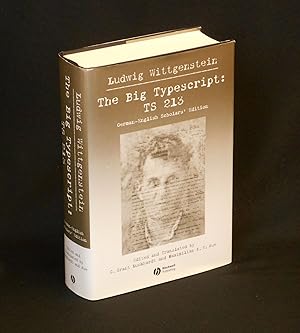
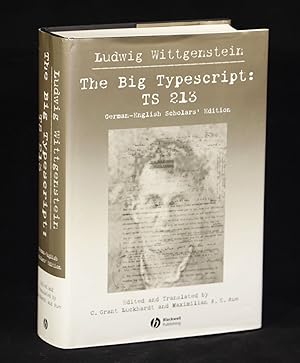
Hardcover. Zustand: Fine. Zustand des Schutzumschlags: near fine. First Edition. First printing, quarto size, 516 pp. (but over 1000 including both German and English pp., see below). The philosophy of Ludwig Wittgenstein (1889-1951) has been vastly influential to artists and thinkers alike; despite having only one book published during his lifetime, Wittgenstein was a prolific writer and many of his manuscripts were published posthumously. This the first printing of his "Big Typescript": a collection of his writings dictated to a typist which Wittengenstein began revising even as he was dictating, "here set out in an en-face German-English scholars' edition, complete with clear indications to help the reader identify the various leverls of Wittgenstein's edition" (n.b., info and quote from jacket flap). ___DESCRIPTION: Bound in full black cloth over boards, silver lettering stamped onto the spine, black endpapers, the German-language pages on the left (versos) and the English-language pages facing those, on the right (rectos); quarto size (9 7/8" by 6 7/8"), pagination: [i-v, preliminary pages] vi-xviiie [2] 1-506e (note that the publisher numbered the English pages with the same page number as the German with the letter 'e" appended), 507-512 ("Register") 513-516 ("Index"). The dust jacket is unclipped (albeit unpriced), on the front panel an image of Wittgenstein overlaid with a facimile of the annotated typescript, review blurbs on the back panel, short summary of work on the front flap, short bios of the editors/translators on the back flap. ___CONDITION: Volume fine overall, with clean boards, straight corners without rubbing, a strong, square text block with solid hinges, the interior is clean and bright, and entirely free of prior owner markings; a minute spot at the top of the front joint, a very shallow ding to the bottom edge of the front board, else fine. The unclipped dust jacket near fine, clean with light overall edgewear and a few shallow unintended creases at the head of the spine and the top of the back panel. ___POSTAGE: Please note that this is an unusually large and heavy volume (as the actual page count is over 1000, including the German and English pages) and additional postage may apply; please inquire for details. ___Swan's Fine Books is pleased to be a member of the ABAA, ILAB, and IOBA and we stand behind every book we sell. Please contact us with any questions you may have, we are here to help.
-
The Big Typescript TS 213; German-English Scholars' Edition
Verlag: Blackwell Publishing (2005), [London], 2005
Anbieter: Evening Star Books, ABAA/ILAB, Madison, WI, USA
Verbandsmitglied: ABAA ILAB IOBA
Verkäuferbewertung 5 von 5 Sternen
Erstausgabe
Hardcover. Zustand: Near Fine. Zustand des Schutzumschlags: Very Good+. First edition. Large 8vo. [5], vi-xviiie, [2], 1-507, [12] pp. Black cloth with silver lettering on the spine. Black endpapers and pastedowns. Edited and translated by C. Grant Luckhardt and Maximilian A.E. Aue. German text on the left, English on the right. With a few in-text diagrams. A fascinating look at Wittgenstein's later philosophy, a manuscript with numerous amendments and edits done by Wittgenstein himself. The philosopher began this project in 1933, and it appears here for the first time as a trade edition. A small push to the top textblock; jacket has a few creases.