

Gesamtpreis (1 Artikel Artikel):
Versandziel:

algorithmic learning random world (11 Ergebnisse)
Direkt zu den wichtigsten Suchergebnissen
Suchfilter
Produktart
- Alle Product Types
- Bücher (11)
- Magazine & Zeitschriften (Keine weiteren Ergebnisse entsprechen dieser Verfeinerung)
- Comics (Keine weiteren Ergebnisse entsprechen dieser Verfeinerung)
- Noten (Keine weiteren Ergebnisse entsprechen dieser Verfeinerung)
- Kunst, Grafik & Poster (Keine weiteren Ergebnisse entsprechen dieser Verfeinerung)
- Fotografien (Keine weiteren Ergebnisse entsprechen dieser Verfeinerung)
- Karten (Keine weiteren Ergebnisse entsprechen dieser Verfeinerung)
- Manuskripte & Papierantiquitäten (Keine weiteren Ergebnisse entsprechen dieser Verfeinerung)
Zustand Mehr dazu
- Neu (7)
- Wie Neu, Sehr Gut oder Gut Bis Sehr Gut (1)
- Gut oder Befriedigend (3)
- Ausreichend oder Schlecht (Keine weiteren Ergebnisse entsprechen dieser Verfeinerung)
- Wie beschrieben (Keine weiteren Ergebnisse entsprechen dieser Verfeinerung)
Einband
Weitere Eigenschaften
- Erstausgabe (Keine weiteren Ergebnisse entsprechen dieser Verfeinerung)
- Signiert (Keine weiteren Ergebnisse entsprechen dieser Verfeinerung)
- Schutzumschlag (Keine weiteren Ergebnisse entsprechen dieser Verfeinerung)
- Angebotsfoto (3)
Sprache (1)
Preis
- Beliebiger Preis
- Weniger als EUR 20 (Keine weiteren Ergebnisse entsprechen dieser Verfeinerung)
- EUR 20 bis EUR 40 (Keine weiteren Ergebnisse entsprechen dieser Verfeinerung)
- Mehr als EUR 40
Gratisversand
Land des Verkäufers
Verkäuferbewertung
-

Algorithmic Learning in a Random World
Anbieter: ThriftBooks-Dallas, Dallas, TX, USA
Verkäuferbewertung 5 von 5 Sternen

Hardcover. Zustand: Very Good. No Jacket. May have limited writing in cover pages. Pages are unmarked. ~ ThriftBooks: Read More, Spend Less.
-
Algorithmic Learning in a Random World
Anbieter: Better World Books, Mishawaka, IN, USA
Verkäuferbewertung 5 von 5 Sternen
Zustand: Very Good. Former library copy. Pages intact with possible writing/highlighting. Binding strong with minor wear. Dust jackets/supplements may not be included. Includes library markings. Stock photo provided. Product includes identifying sticker. Better World Books: Buy Books. Do Good.
-
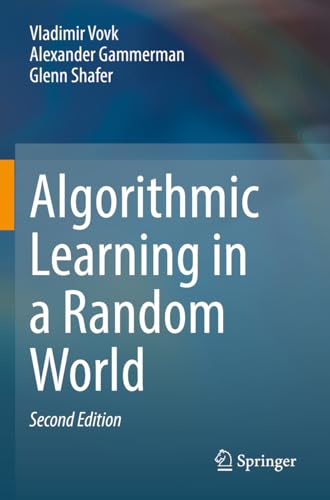
Algorithmic Learning in a Random World
Anbieter: Books From California, Simi Valley, CA, USA
Verkäuferbewertung 4 von 5 Sternen

paperback. Zustand: Fine.
-
Algorithmic Learning in a Random World
Anbieter: Buchkanzlei, Bremen, Deutschland
Verkäuferbewertung 5 von 5 Sternen
Hardcover. Zustand: Gut. 340 pp. Cover discolored at the spine, otherwise well preserved copy 350 Sprache: Englisch Gewicht in Gramm: 808.
-

Algorithmic Learning in a Random World
Anbieter: Revaluation Books, Exeter, Vereinigtes Königreich
Verkäuferbewertung 5 von 5 Sternen
EUR 183,92
EUR 14,34 Versand
Versand von Vereinigtes Königreich nach USAAnzahl: 1 verfügbar
In den WarenkorbPaperback. Zustand: Brand New. 344 pages. 9.25x6.10x0.77 inches. In Stock.
-

Algorithmic Learning in a Random World
Sprache: Englisch
Verlag: Springer International Publishing, 2023
ISBN 10: 3031066510 ISBN 13: 9783031066511
Anbieter: AHA-BUCH GmbH, Einbeck, Deutschland
Verkäuferbewertung 5 von 5 Sternen
Taschenbuch. Zustand: Neu. Druck auf Anfrage Neuware - Printed after ordering - This book is about conformal prediction, an approach to prediction that originated in machine learning in the late 1990s. The main feature of conformal prediction is the principled treatment of the reliability of predictions. The prediction algorithms described-conformal predictors-are provably valid in the sense that they evaluate the reliability of their own predictions in a way that is neither over-pessimistic nor over-optimistic (the latter being especially dangerous). The approach is still flexible enough to incorporate most of the existing powerful methods of machine learning. The book covers both key conformal predictors and the mathematical analysis of their properties.Algorithmic Learning in a Random Worldcontains, in addition to proofs of validity, results about the efficiency of conformal predictors. The only assumption required for validity is that of 'randomness' (the prediction algorithm is presented with independent and identically distributed examples); in later chapters, even the assumption of randomness is significantly relaxed. Interesting results about efficiency are established both under randomness and under stronger assumptions.Since publication of the First Edition in 2005 conformal prediction has found numerous applications in medicine and industry, and is becoming a popular machine-learning technique. This Second Edition contains three new chapters. One is about conformal predictive distributions, which are more informative than the set predictions produced by standard conformal predictors. Another is about the efficiency of ways of testing the assumption of randomness based on conformal prediction. The third new chapter harnesses conformal testing procedures for protecting machine-learning algorithms against changes in the distribution of the data. In addition, the existing chapters have been revised, updated, and expanded.
-
Algorithmic Learning in a Random World
Sprache: Englisch
Verlag: Springer International Publishing, 2022
ISBN 10: 3031066480 ISBN 13: 9783031066481
Anbieter: AHA-BUCH GmbH, Einbeck, Deutschland
Verkäuferbewertung 5 von 5 Sternen
Buch. Zustand: Neu. Druck auf Anfrage Neuware - Printed after ordering - This book is about conformal prediction, an approach to prediction that originated in machine learning in the late 1990s. The main feature of conformal prediction is the principled treatment of the reliability of predictions. The prediction algorithms described-conformal predictors-are provably valid in the sense that they evaluate the reliability of their own predictions in a way that is neither over-pessimistic nor over-optimistic (the latter being especially dangerous). The approach is still flexible enough to incorporate most of the existing powerful methods of machine learning. The book covers both key conformal predictors and the mathematical analysis of their properties.Algorithmic Learning in a Random Worldcontains, in addition to proofs of validity, results about the efficiency of conformal predictors. The only assumption required for validity is that of 'randomness' (the prediction algorithm is presented with independent and identically distributed examples); in later chapters, even the assumption of randomness is significantly relaxed. Interesting results about efficiency are established both under randomness and under stronger assumptions.Since publication of the First Edition in 2005 conformal prediction has found numerous applications in medicine and industry, and is becoming a popular machine-learning technique. This Second Edition contains three new chapters. One is about conformal predictive distributions, which are more informative than the set predictions produced by standard conformal predictors. Another is about the efficiency of ways of testing the assumption of randomness based on conformal prediction. The third new chapter harnesses conformal testing procedures for protecting machine-learning algorithms against changes in the distribution of the data. In addition, the existing chapters have been revised, updated, and expanded.
-
Algorithmic Learning in a Random World
Anbieter: Revaluation Books, Exeter, Vereinigtes Königreich
Verkäuferbewertung 5 von 5 Sternen
EUR 258,77
EUR 14,34 Versand
Versand von Vereinigtes Königreich nach USAAnzahl: 1 verfügbar
In den WarenkorbPaperback. Zustand: Brand New. 344 pages. 9.25x6.10x0.77 inches. In Stock.
-
Algorithmic Learning in a Random World
Sprache: Englisch
Verlag: Springer-Nature New York Inc, 2023
ISBN 10: 3031066510 ISBN 13: 9783031066511
Anbieter: Revaluation Books, Exeter, Vereinigtes Königreich
Verkäuferbewertung 5 von 5 Sternen
EUR 272,48
EUR 14,34 Versand
Versand von Vereinigtes Königreich nach USAAnzahl: 2 verfügbar
In den WarenkorbPaperback. Zustand: Brand New. 2nd edition. 502 pages. 9.25x6.10x1.01 inches. In Stock.
-
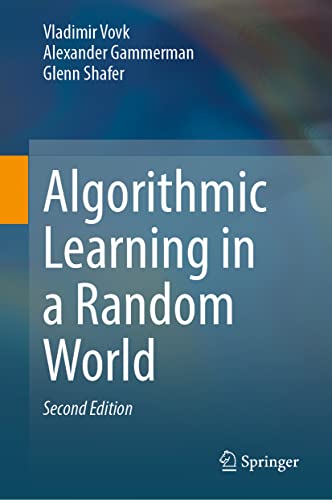
Algorithmic Learning in a Random World
Anbieter: Revaluation Books, Exeter, Vereinigtes Königreich
Verkäuferbewertung 5 von 5 Sternen
EUR 274,49
EUR 14,34 Versand
Versand von Vereinigtes Königreich nach USAAnzahl: 2 verfügbar
In den WarenkorbHardcover. Zustand: Brand New. 2nd edition. 502 pages. 9.25x6.10x1.34 inches. In Stock.
-
Algorithmic Learning In A Random World
Anbieter: Kennys Bookstore, Olney, MD, USA
Verkäuferbewertung 4 von 5 Sternen
Zustand: New.


