Gesamtpreis (1 Artikel Artikel):
Versandziel:

affine analysis image sequences von shapiro larry (4 Ergebnisse)
Direkt zu den wichtigsten Suchergebnissen
Suchfilter
Produktart
- Alle Product Types
- Bücher (4)
- Magazine & Zeitschriften (Keine weiteren Ergebnisse entsprechen dieser Verfeinerung)
- Comics (Keine weiteren Ergebnisse entsprechen dieser Verfeinerung)
- Noten (Keine weiteren Ergebnisse entsprechen dieser Verfeinerung)
- Kunst, Grafik & Poster (Keine weiteren Ergebnisse entsprechen dieser Verfeinerung)
- Fotografien (Keine weiteren Ergebnisse entsprechen dieser Verfeinerung)
- Karten (Keine weiteren Ergebnisse entsprechen dieser Verfeinerung)
- Manuskripte & Papierantiquitäten (Keine weiteren Ergebnisse entsprechen dieser Verfeinerung)
Zustand Mehr dazu
- Neu (1)
- Wie Neu, Sehr Gut oder Gut Bis Sehr Gut (1)
- Gut oder Befriedigend (2)
- Ausreichend oder Schlecht (Keine weiteren Ergebnisse entsprechen dieser Verfeinerung)
- Wie beschrieben (Keine weiteren Ergebnisse entsprechen dieser Verfeinerung)
Einband
Weitere Eigenschaften
- Erstausgabe (1)
- Signiert (Keine weiteren Ergebnisse entsprechen dieser Verfeinerung)
- Schutzumschlag (2)
- Angebotsfoto (2)
Sprache (1)
Gratisversand
Land des Verkäufers
Verkäuferbewertung
-

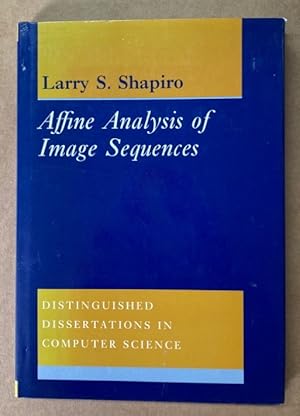
Affine Analysis of Image Sequences (Distinguished Dissertations in Computer Science, Series Number 10)
Verlag: Cambridge University Press, 1995
ISBN 10: 0521550637 ISBN 13: 9780521550635
Sprache: Englisch
Anbieter: Wonder Book, Frederick, MD, USA
Verkäuferbewertung 5 von 5 Sternen

Zustand: Very Good. Very Good condition. Good dust jacket. A copy that may have a few cosmetic defects. May also contain light spine creasing or a few markings such as an owner's name, short gifter's inscription or light stamp.
-
Affine Analysis of Image Sequences.
Verlag: Cambridge University Press, 1995
ISBN 10: 0521550637 ISBN 13: 9780521550635
Sprache: Englisch
Anbieter: Plurabelle Books Ltd, Cambridge, Vereinigtes Königreich
Verbandsmitglied: GIAQ
Verkäuferbewertung 5 von 5 Sternen
Erstausgabe
EUR 28,10
EUR 9,09 für den Versand von Vereinigtes Königreich nach USAAnzahl: 1 verfügbar
In den WarenkorbHardback. Zustand: As New. Series: Distinguished Dissertations in Computer Science. xi 210p large sturdy hardback, navy cloth with blue and yellow jacket, very good condition, minimal wear, jacket a bit sunned, pages clean and bright like new, numerous graphs and diagrams very clear and sharp, a very good copy without names or stamps Language: English Weight (g): 584.
-
Affine Analysis of Image Sequences (Distinguished Dissertations in Computer Science, Series Number 10)
Verlag: Cambridge University Press, 1995
ISBN 10: 0521550637 ISBN 13: 9780521550635
Sprache: Englisch
Anbieter: Anybook.com, Lincoln, Vereinigtes Königreich
Verkäuferbewertung 5 von 5 Sternen
EUR 31,37
EUR 14,71 für den Versand von Vereinigtes Königreich nach USAAnzahl: 1 verfügbar
In den WarenkorbZustand: Good. This is an ex-library book and may have the usual library/used-book markings inside.This book has hardback covers. In good all round condition. No dust jacket. Please note the Image in this listing is a stock photo and may not match the covers of the actual item,650grams, ISBN:0521550637.
-

Affine Analysis of Image Sequences
Verlag: Cambridge University Press, 2005
ISBN 10: 0521019788 ISBN 13: 9780521019781
Sprache: Englisch
Anbieter: AHA-BUCH GmbH, Einbeck, Deutschland
Verkäuferbewertung 5 von 5 Sternen
Taschenbuch. Zustand: Neu. Druck auf Anfrage Neuware - Printed after ordering - Computer vision is a rapidly growing field which aims to make computers 'see' as effectively as humans. In this book Dr Shapiro presents a new computer vision framework for interpreting time-varying imagery. This is an important task, since movement reveals valuable information about the environment. The fully-automated system operates on long, monocular image sequences containing multiple, independently-moving objects, and demonstrates the practical feasibility of recovering scene structure and motion in a bottom-up fashion. Real and synthetic examples are given throughout, with particular emphasis on image coding applications. Novel theory is derived in the context of the affine camera, a generalisation of the familiar scaled orthographic model. Analysis proceeds by tracking 'corner features' through successive frames and grouping the resulting trajectories into rigid objects using new clustering and outlier rejection techniques. The three-dimensional motion parameters are then computed via 'affine epipolar geometry', and 'affine structure' is used to generate alternative views of the object and fill in partial views. The use of all available features (over multiple frames) and the incorporation of statistical noise properties substantially improves existing algorithms, giving greater reliability and reduced noise sensitivity.