
Gesamtpreis (1 Artikel Artikel):
Versandziel:

advanced transaction models architectures (6 Ergebnisse)
Direkt zu den wichtigsten Suchergebnissen
Suchfilter
Produktart
- Alle Product Types
- Bücher (6)
- Magazine & Zeitschriften (Keine weiteren Ergebnisse entsprechen dieser Verfeinerung)
- Comics (Keine weiteren Ergebnisse entsprechen dieser Verfeinerung)
- Noten (Keine weiteren Ergebnisse entsprechen dieser Verfeinerung)
- Kunst, Grafik & Poster (Keine weiteren Ergebnisse entsprechen dieser Verfeinerung)
- Fotografien (Keine weiteren Ergebnisse entsprechen dieser Verfeinerung)
- Karten (Keine weiteren Ergebnisse entsprechen dieser Verfeinerung)
- Manuskripte & Papierantiquitäten (Keine weiteren Ergebnisse entsprechen dieser Verfeinerung)
Zustand Mehr dazu
- Neu (3)
- Wie Neu, Sehr Gut oder Gut Bis Sehr Gut (1)
- Gut oder Befriedigend (2)
- Ausreichend oder Schlecht (Keine weiteren Ergebnisse entsprechen dieser Verfeinerung)
- Wie beschrieben (Keine weiteren Ergebnisse entsprechen dieser Verfeinerung)
Einband
Weitere Eigenschaften
- Erstausgabe (Keine weiteren Ergebnisse entsprechen dieser Verfeinerung)
- Signiert (Keine weiteren Ergebnisse entsprechen dieser Verfeinerung)
- Schutzumschlag (Keine weiteren Ergebnisse entsprechen dieser Verfeinerung)
- Angebotsfoto (2)
Sprache (1)
Gratisversand
Land des Verkäufers
Verkäuferbewertung
-

Advanced Transaction Models and Architectures
Anbieter: Better World Books, Mishawaka, IN, USA
Verkäuferbewertung 5 von 5 Sternen

Zustand: Good. Former library book; may include library markings. Used book that is in clean, average condition without any missing pages.
-
Zustand: Sehr gut. Zustand: Sehr gut | Seiten: 404 | Sprache: Englisch | Produktart: Bücher | Motivation Modem enterprises rely on database management systems (DBMS) to collect, store and manage corporate data, which is considered a strategic corporate re source. Recently, with the proliferation of personal computers and departmen tal computing, the trend has been towards the decentralization and distribution of the computing infrastructure, with autonomy and responsibility for data now residing at the departmental and workgroup level of the organization. Users want their data delivered to their desktops, allowing them to incor porate data into their personal databases, spreadsheets, word processing doc uments, and most importantly, into their daily tasks and activities. They want to be able to share their information while retaining control over its access and distribution. There are also pressures from corporate leaders who wish to use information technology as a strategic resource in offering specialized value-added services to customers. Database technology is being used to manage the data associated with corporate processes and activities. Increasingly, the data being managed are not simply formatted tables in relational databases, but all types of ob jects, including unstructured text, images, audio, and video. Thus, the database management providers are being asked to extend the capabilities of DBMS to include object-relational models as well as full object-oriented database man agement systems.
-
Zustand: Gut. Zustand: Gut | Seiten: 404 | Sprache: Englisch | Produktart: Bücher | Motivation Modem enterprises rely on database management systems (DBMS) to collect, store and manage corporate data, which is considered a strategic corporate re source. Recently, with the proliferation of personal computers and departmen tal computing, the trend has been towards the decentralization and distribution of the computing infrastructure, with autonomy and responsibility for data now residing at the departmental and workgroup level of the organization. Users want their data delivered to their desktops, allowing them to incor porate data into their personal databases, spreadsheets, word processing doc uments, and most importantly, into their daily tasks and activities. They want to be able to share their information while retaining control over its access and distribution. There are also pressures from corporate leaders who wish to use information technology as a strategic resource in offering specialized value-added services to customers. Database technology is being used to manage the data associated with corporate processes and activities. Increasingly, the data being managed are not simply formatted tables in relational databases, but all types of ob jects, including unstructured text, images, audio, and video. Thus, the database management providers are being asked to extend the capabilities of DBMS to include object-relational models as well as full object-oriented database man agement systems.
-
Advanced Transaction Models And Architectures
Anbieter: Romtrade Corp., STERLING HEIGHTS, MI, USA
Verkäuferbewertung 5 von 5 Sternen
Zustand: New. This is a Brand-new US Edition. This Item may be shipped from US or any other country as we have multiple locations worldwide.
-

Advanced Transaction Models and Architectures
Anbieter: AHA-BUCH GmbH, Einbeck, Deutschland
Verkäuferbewertung 5 von 5 Sternen
Taschenbuch. Zustand: Neu. Druck auf Anfrage Neuware - Printed after ordering - Motivation Modem enterprises rely on database management systems (DBMS) to collect, store and manage corporate data, which is considered a strategic corporate re source. Recently, with the proliferation of personal computers and departmen tal computing, the trend has been towards the decentralization and distribution of the computing infrastructure, with autonomy and responsibility for data now residing at the departmental and workgroup level of the organization. Users want their data delivered to their desktops, allowing them to incor porate data into their personal databases, spreadsheets, word processing doc uments, and most importantly, into their daily tasks and activities. They want to be able to share their information while retaining control over its access and distribution. There are also pressures from corporate leaders who wish to use information technology as a strategic resource in offering specialized value-added services to customers. Database technology is being used to manage the data associated with corporate processes and activities. Increasingly, the data being managed are not simply formatted tables in relational databases, but all types of ob jects, including unstructured text, images, audio, and video. Thus, the database management providers are being asked to extend the capabilities of DBMS to include object-relational models as well as full object-oriented database man agement systems.
-
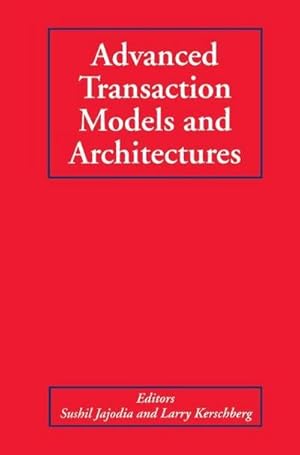
Advanced Transaction Models and Architectures
Sprache: Englisch
Verlag: Springer US, Springer New York, 1997
ISBN 10: 0792398807 ISBN 13: 9780792398806
Anbieter: AHA-BUCH GmbH, Einbeck, Deutschland
Verkäuferbewertung 5 von 5 Sternen
Buch. Zustand: Neu. Druck auf Anfrage Neuware - Printed after ordering - Motivation Modem enterprises rely on database management systems (DBMS) to collect, store and manage corporate data, which is considered a strategic corporate re source. Recently, with the proliferation of personal computers and departmen tal computing, the trend has been towards the decentralization and distribution of the computing infrastructure, with autonomy and responsibility for data now residing at the departmental and workgroup level of the organization. Users want their data delivered to their desktops, allowing them to incor porate data into their personal databases, spreadsheets, word processing doc uments, and most importantly, into their daily tasks and activities. They want to be able to share their information while retaining control over its access and distribution. There are also pressures from corporate leaders who wish to use information technology as a strategic resource in offering specialized value-added services to customers. Database technology is being used to manage the data associated with corporate processes and activities. Increasingly, the data being managed are not simply formatted tables in relational databases, but all types of ob jects, including unstructured text, images, audio, and video. Thus, the database management providers are being asked to extend the capabilities of DBMS to include object-relational models as well as full object-oriented database man agement systems.
