
Gesamtpreis (1 Artikel Artikel):
Versandziel:

active sensor planning multiview von chen shengyong (8 Ergebnisse)
Direkt zu den wichtigsten Suchergebnissen
Suchfilter
Produktart
- Alle Product Types
- Bücher (8)
- Magazine & Zeitschriften (Keine weiteren Ergebnisse entsprechen dieser Verfeinerung)
- Comics (Keine weiteren Ergebnisse entsprechen dieser Verfeinerung)
- Noten (Keine weiteren Ergebnisse entsprechen dieser Verfeinerung)
- Kunst, Grafik & Poster (Keine weiteren Ergebnisse entsprechen dieser Verfeinerung)
- Fotografien (Keine weiteren Ergebnisse entsprechen dieser Verfeinerung)
- Karten (Keine weiteren Ergebnisse entsprechen dieser Verfeinerung)
- Manuskripte & Papierantiquitäten (Keine weiteren Ergebnisse entsprechen dieser Verfeinerung)
Zustand Mehr dazu
- Neu (6)
- Wie Neu, Sehr Gut oder Gut Bis Sehr Gut (2)
- Gut oder Befriedigend (Keine weiteren Ergebnisse entsprechen dieser Verfeinerung)
- Ausreichend oder Schlecht (Keine weiteren Ergebnisse entsprechen dieser Verfeinerung)
- Wie beschrieben (Keine weiteren Ergebnisse entsprechen dieser Verfeinerung)
Einband
Weitere Eigenschaften
- Erstausgabe (Keine weiteren Ergebnisse entsprechen dieser Verfeinerung)
- Signiert (Keine weiteren Ergebnisse entsprechen dieser Verfeinerung)
- Schutzumschlag (Keine weiteren Ergebnisse entsprechen dieser Verfeinerung)
- Angebotsfoto (4)
Sprache (1)
Preis
- Beliebiger Preis
- Weniger als EUR 20 (Keine weiteren Ergebnisse entsprechen dieser Verfeinerung)
- EUR 20 bis EUR 45
- Mehr als EUR 45
Gratisversand
Land des Verkäufers
Verkäuferbewertung
-
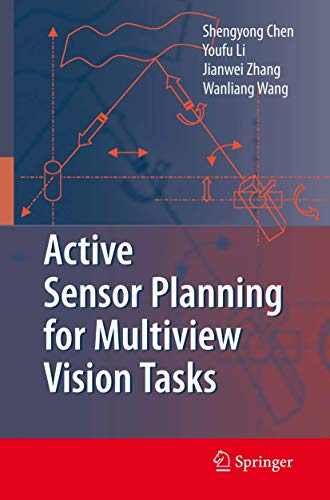
Active Sensor Planning for Multiview Vision Tasks
Anbieter: Majestic Books, Hounslow, Vereinigtes Königreich
Verkäuferbewertung 4 von 5 Sternen

EUR 51,54
EUR 7,44 shipping
Ships from Vereinigtes Königreich to USAAnzahl: 4 verfügbar
In den WarenkorbZustand: New. pp. xii + 266.
-
Active Sensor Planning For Multiview Vision Tasks (Hb)
Anbieter: Romtrade Corp., STERLING HEIGHTS, MI, USA
Verkäuferbewertung 5 von 5 Sternen

Zustand: New. This is a Brand-new US Edition. This Item may be shipped from US or any other country as we have multiple locations worldwide.
-
Sonderangebot
EUR 34,48
EUR 105,00 shipping
Ships from Deutschland to USAAnzahl: 1 verfügbar
In den WarenkorbZustand: Sehr gut. Zustand: Sehr gut | Seiten: 280 | Sprache: Englisch | Produktart: Bücher | An active robot system can change its visual parameters in an intentional manner and perform its sensing actions purposefully. A general vision task thus can be performed in an efficient way by means of strategic control of the perception process. The controllable processes include 3D active sensing, sensor configuration and recalibration, automatic sensor placement, and 3D sensing. This book explores these important issues in studying for active visual perception. Vision sensors have limited fields of views and can only "see" a portion of a scene from a single viewpoint. To make the entire object visible, the sensor has to be moved from one place to another around the object to observe all features of interest. The sensor planning presented in this book describes an effective strategy to generate a sequence of viewing poses and sensor settings for optimally completing a perception task. Several methods are proposed to solve the problems in both model-based and nonmodel-based vision tasks. For model-based applications, the method involves determination of the optimal sensor placements and a shortest path through these viewpoints for automatic generation of a perception plan. A topology of viewpoints is achieved by a genetic algorithm in which a min-max criterion is used for evaluation. A shortest path is also determined by graph algorithms. For nonmodel-based applications, the method involves determination of the best next view and sensor settings. The trend surface is proposed as the cue to predict the unknown portion of an object or environment. The 11 chapters in Active Vision Planning draw on recent work in robot vision over ten years, particularly in the use of new concepts of active sensing, reconfiguration, recalibration, sensor model, sensing constraints, sensing evaluation, viewpoint decision, sensor placement graph, model based planning, path planning, planning for robot in unknown environment, dynamic 3D construction,surface prediction, etc. Implementation examples are also provided with theoretical methods for testing in a real robot system. With these optimal sensor planning strategies, this book will give the robot vision system the adaptability needed in many practical applications.
-
Sonderangebot
EUR 34,48
EUR 105,00 shipping
Ships from Deutschland to USAAnzahl: 1 verfügbar
In den WarenkorbZustand: Sehr gut. Zustand: Sehr gut | Seiten: 280 | Sprache: Englisch | Produktart: Bücher | An active robot system can change its visual parameters in an intentional manner and perform its sensing actions purposefully. A general vision task thus can be performed in an efficient way by means of strategic control of the perception process. The controllable processes include 3D active sensing, sensor configuration and recalibration, automatic sensor placement, and 3D sensing. This book explores these important issues in studying for active visual perception. Vision sensors have limited fields of views and can only "see" a portion of a scene from a single viewpoint. To make the entire object visible, the sensor has to be moved from one place to another around the object to observe all features of interest. The sensor planning presented in this book describes an effective strategy to generate a sequence of viewing poses and sensor settings for optimally completing a perception task. Several methods are proposed to solve the problems in both model-based and nonmodel-based vision tasks. For model-based applications, the method involves determination of the optimal sensor placements and a shortest path through these viewpoints for automatic generation of a perception plan. A topology of viewpoints is achieved by a genetic algorithm in which a min-max criterion is used for evaluation. A shortest path is also determined by graph algorithms. For nonmodel-based applications, the method involves determination of the best next view and sensor settings. The trend surface is proposed as the cue to predict the unknown portion of an object or environment. The 11 chapters in Active Vision Planning draw on recent work in robot vision over ten years, particularly in the use of new concepts of active sensing, reconfiguration, recalibration, sensor model, sensing constraints, sensing evaluation, viewpoint decision, sensor placement graph, model based planning, path planning, planning for robot in unknown environment, dynamic 3D construction,surface prediction, etc. Implementation examples are also provided with theoretical methods for testing in a real robot system. With these optimal sensor planning strategies, this book will give the robot vision system the adaptability needed in many practical applications.
-

Active Sensor Planning for Multiview Vision Tasks
Verlag: Springer Berlin Heidelberg, Springer Berlin Heidelberg Nov 2014, 2014
ISBN 10: 3642437370 ISBN 13: 9783642437373
Sprache: Englisch
Anbieter: buchversandmimpf2000, Emtmannsberg, BAYE, Deutschland
Verkäuferbewertung 5 von 5 Sternen
Taschenbuch. Zustand: Neu. Neuware -An active robot system can change its visual parameters in an intentional manner and perform its sensing actions purposefully. A general vision task thus can be performed in an efficient way by means of strategic control of the perception process. The controllable processes include 3D active sensing, sensor configuration and recalibration, automatic sensor placement, and 3D sensing. This book explores these important issues in studying for active visual perception.Vision sensors have limited fields of views and can only 'see' a portion of a scene from a single viewpoint. To make the entire object visible, the sensor has to be moved from one place to another around the object to observe all features of interest. The sensor planning presented in this book describes an effective strategy to generate a sequence of viewing poses and sensor settings for optimally completing a perception task. Several methods are proposed to solve the problems in both model-based and nonmodel-based vision tasks. For model-based applications, the method involves determination of the optimal sensor placements and a shortest path through these viewpoints for automatic generation of a perception plan. A topology of viewpoints is achieved by a genetic algorithm in which a min-max criterion is used for evaluation. A shortest path is also determined by graph algorithms. For nonmodel-based applications, the method involves determination of the best next view and sensor settings. The trend surface is proposed as the cue to predict the unknown portion of an object or environment.The 11 chapters in Active Vision Planning draw on recent work in robot vision over ten years, particularly in the use of new concepts of active sensing, reconfiguration, recalibration, sensor model, sensing constraints, sensing evaluation, viewpoint decision, sensor placement graph, model based planning, path planning, planning for robot in unknown environment, dynamic 3D construction,surface prediction, etc. Implementation examples are also provided with theoretical methods for testing in a real robot system. With these optimal sensor planning strategies, this book will give the robot vision system the adaptability needed in many practical applications.Springer Verlag GmbH, Tiergartenstr. 17, 69121 Heidelberg 280 pp. Englisch.
-

Active Sensor Planning for Multiview Vision Tasks
Verlag: Springer Berlin Heidelberg, Springer Berlin Heidelberg Feb 2008, 2008
ISBN 10: 3540770712 ISBN 13: 9783540770718
Sprache: Englisch
Anbieter: buchversandmimpf2000, Emtmannsberg, BAYE, Deutschland
Verkäuferbewertung 5 von 5 Sternen
Buch. Zustand: Neu. Neuware -An active robot system can change its visual parameters in an intentional manner and perform its sensing actions purposefully. A general vision task thus can be performed in an efficient way by means of strategic control of the perception process. The controllable processes include 3D active sensing, sensor configuration and recalibration, automatic sensor placement, and 3D sensing. This book explores these important issues in studying for active visual perception.Vision sensors have limited fields of views and can only 'see' a portion of a scene from a single viewpoint. To make the entire object visible, the sensor has to be moved from one place to another around the object to observe all features of interest. The sensor planning presented in this book describes an effective strategy to generate a sequence of viewing poses and sensor settings for optimally completing a perception task. Several methods are proposed to solve the problems in both model-based and nonmodel-based vision tasks. For model-based applications, the method involves determination of the optimal sensor placements and a shortest path through these viewpoints for automatic generation of a perception plan. A topology of viewpoints is achieved by a genetic algorithm in which a min-max criterion is used for evaluation. A shortest path is also determined by graph algorithms. For nonmodel-based applications, the method involves determination of the best next view and sensor settings. The trend surface is proposed as the cue to predict the unknown portion of an object or environment.The 11 chapters in Active Vision Planning draw on recent work in robot vision over ten years, particularly in the use of new concepts of active sensing, reconfiguration, recalibration, sensor model, sensing constraints, sensing evaluation, viewpoint decision, sensor placement graph, model based planning, path planning, planning for robot in unknown environment, dynamic 3D construction,surface prediction, etc. Implementation examples are also provided with theoretical methods for testing in a real robot system. With these optimal sensor planning strategies, this book will give the robot vision system the adaptability needed in many practical applications.Springer Verlag GmbH, Tiergartenstr. 17, 69121 Heidelberg 280 pp. Englisch.
-

Active Sensor Planning for Multiview Vision Tasks
Verlag: Springer Berlin Heidelberg, Springer Berlin Heidelberg, 2014
ISBN 10: 3642437370 ISBN 13: 9783642437373
Sprache: Englisch
Anbieter: AHA-BUCH GmbH, Einbeck, Deutschland
Verkäuferbewertung 5 von 5 Sternen
Taschenbuch. Zustand: Neu. Druck auf Anfrage Neuware - Printed after ordering - An active robot system can change its visual parameters in an intentional manner and perform its sensing actions purposefully. A general vision task thus can be performed in an efficient way by means of strategic control of the perception process. The controllable processes include 3D active sensing, sensor configuration and recalibration, automatic sensor placement, and 3D sensing. This book explores these important issues in studying for active visual perception.Vision sensors have limited fields of views and can only 'see' a portion of a scene from a single viewpoint. To make the entire object visible, the sensor has to be moved from one place to another around the object to observe all features of interest. The sensor planning presented in this book describes an effective strategy to generate a sequence of viewing poses and sensor settings for optimally completing a perception task. Several methods are proposed to solve the problems in both model-based and nonmodel-based vision tasks. For model-based applications, the method involves determination of the optimal sensor placements and a shortest path through these viewpoints for automatic generation of a perception plan. A topology of viewpoints is achieved by a genetic algorithm in which a min-max criterion is used for evaluation. A shortest path is also determined by graph algorithms. For nonmodel-based applications, the method involves determination of the best next view and sensor settings. The trend surface is proposed as the cue to predict the unknown portion of an object or environment.The 11 chapters in Active Vision Planning draw on recent work in robot vision over ten years, particularly in the use of new concepts of active sensing, reconfiguration, recalibration, sensor model, sensing constraints, sensing evaluation, viewpoint decision, sensor placement graph, model based planning, path planning, planning for robot in unknown environment, dynamic 3D construction,surface prediction, etc. Implementation examples are also provided with theoretical methods for testing in a real robot system. With these optimal sensor planning strategies, this book will give the robot vision system the adaptability needed in many practical applications.
-

Active Sensor Planning for Multiview Vision Tasks
Verlag: Springer Berlin Heidelberg, 2008
ISBN 10: 3540770712 ISBN 13: 9783540770718
Sprache: Englisch
Anbieter: AHA-BUCH GmbH, Einbeck, Deutschland
Verkäuferbewertung 5 von 5 Sternen
Buch. Zustand: Neu. Druck auf Anfrage Neuware - Printed after ordering - An active robot system can change its visual parameters in an intentional manner and perform its sensing actions purposefully. A general vision task thus can be performed in an efficient way by means of strategic control of the perception process. The controllable processes include 3D active sensing, sensor configuration and recalibration, automatic sensor placement, and 3D sensing. This book explores these important issues in studying for active visual perception.Vision sensors have limited fields of views and can only 'see' a portion of a scene from a single viewpoint. To make the entire object visible, the sensor has to be moved from one place to another around the object to observe all features of interest. The sensor planning presented in this book describes an effective strategy to generate a sequence of viewing poses and sensor settings for optimally completing a perception task. Several methods are proposed to solve the problems in both model-based and nonmodel-based vision tasks. For model-based applications, the method involves determination of the optimal sensor placements and a shortest path through these viewpoints for automatic generation of a perception plan. A topology of viewpoints is achieved by a genetic algorithm in which a min-max criterion is used for evaluation. A shortest path is also determined by graph algorithms. For nonmodel-based applications, the method involves determination of the best next view and sensor settings. The trend surface is proposed as the cue to predict the unknown portion of an object or environment.The 11 chapters in Active Vision Planning draw on recent work in robot vision over ten years, particularly in the use of new concepts of active sensing, reconfiguration, recalibration, sensor model, sensing constraints, sensing evaluation, viewpoint decision, sensor placement graph, model based planning, path planning, planning for robot in unknown environment, dynamic 3D construction,surface prediction, etc. Implementation examples are also provided with theoretical methods for testing in a real robot system. With these optimal sensor planning strategies, this book will give the robot vision system the adaptability needed in many practical applications.

