Gesamtpreis (1 Artikel Artikel):
Versandziel:

falloppio (38 Ergebnisse)
Stichwörter:
falloppio
Mit der Detailsuche verfeinern
Direkt zu den wichtigsten Suchergebnissen
Suchfilter
Produktart
- Alle Product Types
- Bücher (38)
- Magazine & Zeitschriften (Keine weiteren Ergebnisse entsprechen dieser Verfeinerung)
- Comics (Keine weiteren Ergebnisse entsprechen dieser Verfeinerung)
- Noten (Keine weiteren Ergebnisse entsprechen dieser Verfeinerung)
- Kunst, Grafik & Poster (Keine weiteren Ergebnisse entsprechen dieser Verfeinerung)
- Fotografien (Keine weiteren Ergebnisse entsprechen dieser Verfeinerung)
- Karten (Keine weiteren Ergebnisse entsprechen dieser Verfeinerung)
- Manuskripte & Papierantiquitäten (Keine weiteren Ergebnisse entsprechen dieser Verfeinerung)
Zustand Mehr dazu
Weitere Eigenschaften
- Erstausgabe (14)
- Signiert (1)
- Schutzumschlag (Keine weiteren Ergebnisse entsprechen dieser Verfeinerung)
- Angebotsfoto (30)
Sprache (5)
Gratisversand
Land des Verkäufers
Verkäuferbewertung
-

Gabbrielis Falloppii Obseruationes anatomicae 1562
Anbieter: Majestic Books, Hounslow, Vereinigtes Königreich
Verkäuferbewertung 4 von 5 Sternen

EUR 15,26
EUR 7,44 Versand
Versand von Vereinigtes Königreich nach USAAnzahl: 4 verfügbar
In den WarenkorbZustand: New. pp. 270.
-

Gabrielis Falloppii Mutinensis, De Humani Corporis Anatome, Compendium (Classic Reprint)
Anbieter: PBShop.store US, Wood Dale, IL, USA
Verkäuferbewertung 5 von 5 Sternen

PAP. Zustand: New. New Book. Shipped from UK. Established seller since 2000.
-
Gabrielis Falloppii Mutinensis, De Humani Corporis Anatome, Compendium (Classic Reprint)
Anbieter: PBShop.store UK, Fairford, GLOS, Vereinigtes Königreich
Verkäuferbewertung 4 von 5 Sternen
EUR 22,43
EUR 4,76 Versand
Versand von Vereinigtes Königreich nach USAAnzahl: 15 verfügbar
In den WarenkorbPAP. Zustand: New. New Book. Shipped from UK. Established seller since 2000.
-

Gabrielis Falloppii Mutinensis, De Humani Corporis Anatome, Compendium (Classic Reprint)
Anbieter: PBShop.store US, Wood Dale, IL, USA
Verkäuferbewertung 5 von 5 Sternen
HRD. Zustand: New. New Book. Shipped from UK. Established seller since 2000.
-
Gabrielis Falloppii Mutinensis, De Humani Corporis Anatome, Compendium (Classic Reprint)
Anbieter: PBShop.store UK, Fairford, GLOS, Vereinigtes Königreich
Verkäuferbewertung 4 von 5 Sternen
EUR 28,22
EUR 4,76 Versand
Versand von Vereinigtes Königreich nach USAAnzahl: 15 verfügbar
In den WarenkorbHRD. Zustand: New. New Book. Shipped from UK. Established seller since 2000.
-

La Lombardia paese per paese vol. 3: Castro - Falloppio
Verlag: Bonechi, 1985
Anbieter: Librodifaccia, Alessandria, AL, Italien
Verkäuferbewertung 5 von 5 Sternen
Zustand: Buone. italiano Condizioni dell'esterno: sovracopertina leggermente strappata Condizioni dell'interno: Buone.
-
De medicatis aquis atque de fossilibus.
Verlag: Ludovico Avanzi,, 1569
Anbieter: Sokol Books Ltd. ABA ILAB, London, Vereinigtes Königreich
Verkäuferbewertung 5 von 5 Sternen
Erstausgabe
EUR 5.600,80
EUR 48,08 Versand
Versand von Vereinigtes Königreich nach USAAnzahl: 1 verfügbar
In den WarenkorbSoft cover. Zustand: Very Good. 1st Edition. MINERAL SPRING WATERS, GEOLOGY AND MEDICINE FIRST EDITION? 4to. 2 works in 1, continuous signatures and pagination, ff. [32], 176. Roman letter, little Italic. Woodcut printer's device to title, small ¼-page woodcut of distillation equipment, decorated initials and ornaments. Light age yellowing, occasional very minor marginal spotting and browning, marginal water stain to P1-2, 7-8, tear to margin of last leaf. A very good copy in contemporary limp vellum, lacking ties, early vellum reback (holed), early ms title to spine, a little chewing to fore- and lower edge of upper cover, c1600 ms 'Andreas Falco[ne?]' to upper cover, small vellum loss to lower. Modern bookplate and C17 pen trials to front pastedown, C17 Latin ms verse, old bookseller's ink stamp and C18 pen trials to ffep, ms autograph 'Jo[annes] Curt[ius?] mutuatus' (i.e., borrowed) to title, occasional early ms notes in Latin, C17 ms 'Il con(?) del (?) (?) è tondo' to verso of rear fep. A very good copy of probably the first edition of these important early works on therapeutic waters and fossils. Gabriele Falloppio (1523-62) was a major physician and anatomist, professor at Ferrara (where he taught Fabricius ab Aquapendente), Pisa and Padua. Several anatomical formations, of which he provided ground-breaking descriptions and studies, are still named after him, e.g., Fallopian tubes, 'aquaeductus Fallopii'. 'As with all of his publications except "Observationes anatomicae", this work was published posthumously. It consists of two lectures given at Padua in 1556 and 1557 respectively, [.] edited from lecture notes by Andreas Marcolini (fl. 1560), one of Fallopius' friends' (Heirs of Hippocrates). 'De medicatis aquis' is devoted to mineral spring waters and their therapeutic qualities. It introduces the names and nature of various spa waters, and proceeds to discuss why they emerge from the ground at very high temperatures (with a section on the rare instances in which they emerge cold), their metallic and mineral composition and how to investigate it (e.g., through sight and colour, smell, touch and taste), the 'lutus thermalis' (the therapeutic essence of spa waters), the application of mud, the medical characteristics of specific spa baths near Padua (e.g., Monte Ortone, San Pietro, Sant'Elena and Montegrotto, this last still in use and very popular, in an area named 'Terme Euganee') and in Emilia and Tuscany, and the benefits of spa waters for all kinds of conditions, head to foot. 'De medicatis aquis' is considered 'the most influential work on solution analysis' of the C16, for its discussion of the chemical composition of water (Debus, p.46). 'De metallis seu fossilibus' is concerned with geology and mineralogy. By 'fossils', like Agricola and Gesner, Falloppio meant 'everything dug out of the ground or extracted from rocks that showed a distinct form [.]. It included therefore, besides fossils in the modern sense [.], also crystals, stones, minerals and artifacts' (Etter, p.131). Falloppio focuses on stones and minerals to identify their medical properties, defining the types of soil, the nature and properties of stones, and the essence of metals (including less common substances like 'chrysocolla'). Two most interesting works by one of the medical authorities of the Renaissance. Another ed. appeared the same year, published by Avanzi with Giordano Ziletti - priority not established. USTC 828698; EDIT16 CNCE 18531; Wellcome I, 2149; Durling 1431; Heirs of Hippocrates 336; Osler 2563. A. Debus, Chemistry, Alchemy, and the New Philosophy, 1550-1700 (1987); W. Etter, 'Conrad Gessner and the Early History of Palaeontology', in Conrad Gessner (1516-1565), ed. U. Leu et al. (2019), pp.129-44.
-
In Hippocratis librum de vulneribus capitis.
Sprache: Latein
Verlag: Luca Bertello, Venice, 1566
Anbieter: Milestones of Science Books, Ritterhude, Deutschland
Verkäuferbewertung 5 von 5 Sternen
Erstausgabe
EUR 4.500,00
EUR 45,00 Versand
Versand von Deutschland nach USAAnzahl: 1 verfügbar
In den WarenkorbHardcover. Zustand: Very Good. 1st Edition. 4to (207 x 155 mm). 59, [1] leaves. Woodcut initials. Signatures: A-P4. Including final blank P4. Bound in 20th-century carta rustica. Text crisp and clean throughout, gutter of first and last gatherings reinforced with paper, a few blank corners clipped, few pages with light (finger-) soiling. Provenance: Il Polifilo (small sticker to front pastedown); a few contemporary marginal comments and marks. Very good copy. ---- FIRST EDITION, AND EXCEPTIONALLY RARE, of Falloppio's treatise on head wounds. This work, which like most of his writings was printed posthumously, is a transcript of lectures given by Falloppio in Padua, where he held the chair of anatomy. It was edited for publication by Giovanni Bonacci. It takes the form of an exposition and commentary on relevant passages from Hippocrates dealing with cranial anatomy and various diseases and their cures. Falloppio was the first to describe many physical characteristics of the brain and made an important contribution to cranial surgery with his work, although he himself was not a trained surgeon. The publication is dedicated to the great Venetian printer Vincenzo Valgrisi. This work is rare and absent from many standard medical bibliographies. RBH only records one other copy at auction (Jeschke can Vliet, Berlin 2011, lot no. 47). Bibliography: Adams F-142.; Bruni Celli 1334 (with incorrect citation of the printer and erroneous collation); not in Norman, Waller, or Wellcome. - Visit our website to see more images!
-
Tractatus de compositione medicamentorum dilucidissimus; nunc primum ad candidatorum medicinae utilitatem summa opera, ac cura castigatus, & in lucem editus [.].
Sprache: Latein
Verlag: Venedig, (Officina Gratiosi Perchacini für) Paolo u. Antonio Meietti, 1570., 1570
Anbieter: Versandantiquariat Wolfgang Friebes, Graz, Österreich
Verkäuferbewertung 4 von 5 Sternen
Erstausgabe
Zustand: 0. Erstausgabe. - This scarce and infrequently seen book contains two works by Fallopius. The first deals with the theoretical and practical aspects of formulating various therapeutic remedies [.]. The second work is Fallopius' tract on cautery in which he discusses its uses and concentrates on the various salves and caustics that may be employed with the procedure" (Eimas 339). - Der italienische Anatom und Chirurg Gabriele Falloppio (1523 -1562) gilt als Mitbegründer der modernen Anatomie und war einer der wichtigsten Ärzte des 16. Jahrhunderts. Falloppio empfahl mit Medikamenten und anorganischen Salzen getränkte Leinensäckchen gegen die sich ausbreitende Syphilis, weshalb er auch als Erfinder des Kondoms gehalten wird. - Titel m. altem Besitzvermerk u. etw. fingerfleckig. Durchg. etw. wasserrandig (dadurch der Farbschnitt tlw. leicht verlaufen). Min. gebräunt. - EDIT16, CNCE 18544; BM STC, Italian Books 243; Durling, 1453; Wellcome, I, 2159; nicht bei Adams. la Gewicht in Gramm: 500 4°. Mit Holzschn.-Titelvignette, Holzschn.-Druckermarke am Ende, zahlr. Holzschn.-Initialen u. einigen Holzschn.-Vignetten. 4 nn., 67 (recte 72) num., 12 nn. Bll., Mod. Ppbd.
-
Libelli duo, alter de ulceribus, alter de tumoribus praeter naturam, nunc recens in lucem editi.
Sprache: Latein
Verlag: Donato Bertelli, Venice, 1563
Anbieter: Milestones of Science Books, Ritterhude, Deutschland
Verkäuferbewertung 5 von 5 Sternen
Erstausgabe
EUR 4.500,00
EUR 45,00 Versand
Versand von Deutschland nach USAAnzahl: 1 verfügbar
In den WarenkorbHardcover. Zustand: Very Good. 1st Edition. 4to (222 x 154 mm). [3], 101, [1] leaves. Signatures: A3, A* (A-Z)4 Aa4 Bb6, with both, the cancel and cancelland leaf present. Title page with woodcut vignette, woodcut intials in text, errata on final leaf recto. 19th-century drab boards, spine with gilt-lettered paper label (rebacked with most of original spine preserved, corners scuffed, extremities rubbed, boards stained). Leaves untrimmed. Text only very little browned, faint minor spotting and soiling of outer margins, leaf E2 loose, two leaves with old paper repair to top blank margin. Provenance: Henri Aniere, Paris (sticker to front pastedown). A fine, crisp and wide-margined copy. ---- Eimas, Heirs of Hippocrates 333, Cushing F25; NLM/Durling 1438; Waller 2934; Wellcome I, 2156 (2nd edition only). EXCEPTIONALLY RARE FIRST EDITION. "Fallopius was a clinician as well as an anatomist, and this treatise on diseases of the skin (ulcers and tumors) is one of the most complete of its kind up to the time of its publication. An interesting bibliographical point in this copy is the canceling of leaf 1 with a substitute leaf, but the cancelland was not removed, thus leaving both the original leaf and its substitute in place." (Heirs of Hippocrates). This first edition is rare. Only one copy has appeared at auction in the past 80 years (the Virchow copy, Christie's 2016). - Visit our website for additional images and information.
-
Opuscula tria. I. Tractatus de vulneribus. II. Expositio in lib. Hipp. de vulneribus capitis. III. Tractatus de vulneribus oculorum, aliarumque partium corporis. . .
Sprache: Latein
Verlag: Paul Meietus, Venice, 1569
Anbieter: Milestones of Science Books, Ritterhude, Deutschland
Verkäuferbewertung 5 von 5 Sternen
Erstausgabe
EUR 3.000,00
EUR 45,00 Versand
Versand von Deutschland nach USAAnzahl: 1 verfügbar
In den WarenkorbSoft cover. Zustand: Very Good. 1st Edition. 3 parts in 1 volume. 4to (208 x 149 mm). [8], 223, [25] pp. Signatures: *4 A8 B-V4 X6 Y-Cc4 Dd2 a-c4. Separate title-page with woodcut device to each part, woodcut head-pieces and initials, including the blank leaf L4. Internally little browned, occasional minor foxing, some worming and light dampstaining to top margin of second part, one wormtrack to final leaves of index affecting a few letters, leaf Q4 torn in lower blank margin. Contemporary limp vellum, spine lettered in script (little staining and soiling, spine darkened). Provenance: Joannis Antony Farrelly(?) (signature to lower margin of title-page, dated 1744). A fine, wide-margined copy. ---- NLM/Durling 1429; Adams F136; Castiglioni 372; not in Wellcome, Waller or Bird. FIRST EDITION. Rare work of the famous surgeon and anatomist Gabriele Falloppio dealing with different types of injuries, their care and healing. - Visit our website to see more images!
-
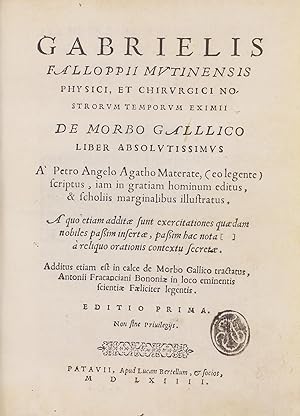
De morbo gallico liber absolutissimus. . .Additus etiam est in calce De morbo Gallico tractatus, Antonii Fracanciani Bononiae.
Sprache: Latein
Verlag: L. Bertelli, Padova, 1564
Anbieter: Milestones of Science Books, Ritterhude, Deutschland
Verkäuferbewertung 5 von 5 Sternen
Erstausgabe
EUR 4.800,00
EUR 45,00 Versand
Versand von Deutschland nach USAAnzahl: 1 verfügbar
In den WarenkorbHardcover. Zustand: Near Fine. 1st Edition. 2 parts in one volume. Padua: L. Bertelli, 1564 [part 2: C. Gryphius, 1563 (colophon 1564)]. 4to (220x170 mm). [4], 64, 16, [2] ff. Contemporary limp vellum, spine titled in manuscript (covers browned and little soiled), title page with old ex-libris stamp, text leaves expertly cleaned. A fine, crisp copy of this important work on syphilis.---- Eimas, Heirs of Hippocrates 334; Garrison-Morton 2370. Wellcome 2152; Waller 2928. RARE FIRST EDITION. In this classic work on "the French disease," Fallopius wrote more knowingly of the Europe-wide scourge of syphilis than previous authors on the subject and was one of the first to oppose the use of mercury in its treatment. Antonio Fracanzano (d. 1567), a teacher of Fallopius at Padua and later his colleague there, contributed a short tract to this work on syphilis published in the year after Fallopius' death. (Heirs of Hippocrates, p.123). "He distinguished between syphilitic and non-syphilitic condylomata" (Garrison-Morton). Exceedingly rare, only two copies have been auctioned in the past 25 years. - Visit our website for additional images.
-

Secreti diversi, et miracolosi raccolti dal Falopia, Et approbati da altri Medici di Gran Fama. NVOVAMENTE RISTAMPATI, E ?? commun beneficio di Ciascuno. DISTINTI IN TRE LIBRI. Nel Primo de' quali si contiene il modo di far Olij, Cerotti, Unguenti, Ontioni, Elettuarij, Pillole, & altri medicamenti. Nel Secondo, s'insegna ?? far diverse sorti di Vini, & Acque molto salutifere. Nel terzo si contengono importantissimi Secreti d'Alchimia, & altri dilettevoli & curiosi
Verlag: Appresso Giuseppe Tramontin, Venetia, 1687
Anbieter: Libreria Antiquaria Giulio Cesare di Daniele Corradi, Roma, RM, Italien
Verkäuferbewertung 2 von 5 Sternen

Piccola mancanza alla parte superiore del dorso XXIV + 358 p. 146x78 mm p.pelle cordonata coeva con tassello e fregi oro al dorso.
-
Observationes anatomicae
Verlag: Marco Antonio Ulmo and Gratioso Perchachino, Venice, 1561
Anbieter: SOPHIA RARE BOOKS, Koebenhavn V, Dänemark
Verkäuferbewertung 5 von 5 Sternen
Erstausgabe
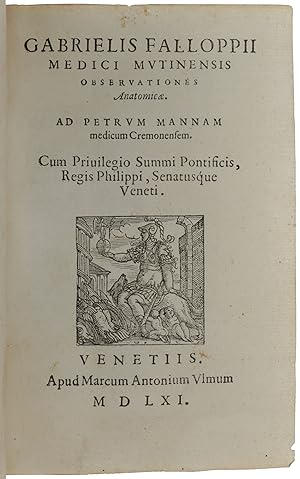
First edition. THE MOST IMPORTANT ITALIAN ANATOMICAL TEXT OF THE 16TH CENTURY . First edition, first issue, very rare, of the greatest Italian anatomical book of the sixteenth century, a detailed critical commentary on Vesalius' De humani corporis fabrica. This is a pristine copy in an untouched contemporary binding. "The large amount of new material [in the present work] included Falloppio's investigations of primary and secondary centers of ossification, the first clear description of primary dentition, numerous contributions to the study of the muscles (especially those of the head), and the famous account of the uterine ("Falloppian") tubes, which he correctly described as resembling small trumpets (tubae). He also gave to the placenta and vagina their present scientific names, provided a superior description of the auditory apparatus (including the first clear accounts of the chorda tympani and semicircular canals), and was the first to clearly distinguish the trochlear nerve of the eye. Vesalius responded positively to Falloppio's work with his posthumously published Examen on Falloppio (1564)" (Norman). "He was a careful dissector, a great observer, and an accurate recorder. He discovered and first described the chorda tympani and semicircular canals, correctly described the structure and course of the cerebral vessels, knew the circular folds of the small intestines. He enumerated all the nerves of the eye, and introduced a number of anatomical names. He is eponymously remembered by the Fallopian tube and the Fallopian aqueduct" (Garrison-Morton). ABPC/RBH record only five copies sold in the last 40 years, of which only the Norman copy was in an untouched contemporary binding (Christie's, March 18, 1998, $21,850). "Of the various works by and attributed to Falloppio only the Observations anatomicae (1561) was published during his lifetime and can be said with certainty to be fully authentic. It is not, however, a general and systematic textbook of anatomy but an unillustrated commentary or series of observations on the De humani corporis fabrica of Vesalius, in which Falloppio sought to correct errors committed by his illustrious predecessor and to present new material hitherto overlooked. His criticism, contrary to a characteristic of that age, is temperate and friendly, so that it is not uncommon to find the object of the criticism referred to as the "divine Vesalius," upon whose scientific foundations Falloppio, as a worthy successor, was willing to admit that he had based his own work. Since the Observationes anatomicae is not an all-inclusive study of anatomy, it never received the popular acclaim given, for example, to the De re anatomica (1559) of Colombo. It is, nevertheless, a work of greater originality. "Falloppio's investigations were the consequence of dissection not only of adult human bodies but also of fetuses, newborn infants, and children "up to the first seven months, and in several beyond" (fol. 17v). He was thus able to make a number of observations and contributions to knowledge of primary and secondary centers of ossification. His most notable contributions of this nature were his descriptions of the ossification of the occiput (fols. 21r ff.), of the sternum (fols. 5l r-52v), and of the primary centers of the innominate bone (fols. 59r-60r). In his studies of the teeth Falloppio provided for the first time a clear description of primary dentition, the follicle of the tooth bud, and the manner of growth and replacement of the primary by the secondary tooth, as well as the first denial of the belief that teeth and bones are derived from the same tissues (fols. 39r-42v). Falloppio's description of the auditory apparatus was superior to that of Vesalius and includes the first clear account of the round and oval windows, the cochlea, the semicircular canals, and the scala vestibuli and tympani (fols. 27r-30v). He also referred to the third ossicle of the ear, the stapes, actually already mentioned in print (Pedro Jimeno, 1549), but he declared that it had been first described orally in lectures by Giovanni Filippo Ingrassia during a visit to Rome in 1546 (fols. 25r-27r). "Not the least important of Falloppio's contributions were those dealing with the muscles, among which were his relatively detailed account of the subcutaneous muscles of the scalp and face (fols. 62r-v, 63u-64r, 66u-68r) and his first description of the arrangement of the extrinsic muscles of the ear (fols. 62v-63r). In his investigation of the muscles of the head and neck he discovered and described the external pterygoid muscle (fol. 72v), analyzed the functions of the muscles of mastication (fols. 71 -73r), described the tensor and levaror veli palati (fols. 76u-77r), and redescribed with greater clarity some of the intrinsic muscles of the larynx (fols. 77u-79r). His greatest contribution to the study of the muscles of the head, however, was his account of the arrangement and functions of the muscles of the orbit (fols. 64r-66u, 68r-71 u). For the first time, he described the levator palpebrae, even though this honor was later to be claimed by Giulio Cesare Aranzi (1587). He observed the nictitating membrane of mammals, first described by Aristotle and thereafter seemingly disregarded. He recognized the compound action of the oblique muscles, and he was the first to describe and provide the name for the trochlea of the superior oblique muscle. In addition to further, lesser contributions to the study of the muscles of the trunk, he added notably to knowledge of the intrinsic muscles of the hand and of their action (fols. 101v-108v), separated the adductor mass of the thigh into its three elements, and noted the quadratus femoris (fol. 101v), which had been previously overlooked. "In considering the vascular system, Falloppio denied the long-held belief that the walls of the vessels were composed of fibers which by their direction controlled the flow of blood (fol. 114v). Curiously enough, however, he den.
-

Observationes Anatomicae.
Verlag: Venetiis [Venice]: Apud Marcum Antonium Ulmum, 1562., 1562
Anbieter: Nigel Phillips ABA ILAB, Chilbolton, Vereinigtes Königreich
Verkäuferbewertung 5 von 5 Sternen
EUR 11.201,61
EUR 51,51 Versand
Versand von Vereinigtes Königreich nach USAAnzahl: 1 verfügbar
In den WarenkorbSmall 8vo, ff. (viii), 222. A few early MS marginalia. Light spotting and staining on the title and a tiny hole in the margin. Contemporary limp vellum, spine wrinkled and shrunk at the head, ties missing, several tears and small holes in the front endpapers. Generally a very clean copy in good original state, with the binding essentially undisturbed. FIRST EDITION, 1562 issue (see below). See G&M 378.2, 1208, and 1537 (1561 issue). The greatest Italian anatomical book of the sixteenth century. Rather than a complete study of the whole of anatomy, Falloppio, who was a pupil of Vesalius, designed this work as a critical commentary of his teacher?s De humani corporis fabrica, correcting some of its errors and adding additional observations and details. For this reason there was no need for illustrations. In fact it was a work of great originality, in which Falloppio reported very many new discoveries and observations. It was his only work published during his lifetime, and therefore the only one which can be said to be fully authentic. It is now very rarely offered for sale. Falloppio discovered and first described the chorda tympani, semicircular canals and the ?aqueduct of Falloppius?, correctly described the structure and course of the cerebral vessels, and knew the circular folds of the small intestines. He gave the first description of the ?circle of Willis?, enumerated all the nerves of the eye, and introduced a number of anatomical names, including the vagina and placenta, and is best remembered for his account of the tubes named after him. He also gave excellent descriptions of the ovaries, hymen, clitoris, and round ligaments, and proved the existence of the seminal vesicles. He included an important account of the kidneys, which may antedate that of Eustachius. For a full account of Falloppio?s discoveries, see the article by C.D. O'Malley in the DSB. Vesalius replied positively to Falloppio?s book with his Anatomicarum Gabrielis Falloppii observationum examen, 1564, published posthumously by his friends. This issue was printed from the same standing type as the first of 1561, and should therefore be properly called an issue, not a new edition. It has a ?I? added to the date on the title-page, some of the pages with tables are reset, some of the errata are corrected, and the foliation, although the same, is reset (e.g., f. 178 is misnumbered 278). The main body of the type is identical in every way. In addition, leaf (8), the errata leaf, is usually cancelled but if present exists in two states, one printed on both sides and one printed on the recto only. In this copy it is present and printed on both sides. The final leaf with the printer?s device and colophon dated 1561 was excised from all copies of this issue. See Lilly, Notable medical books, 39, and Norman Catalogue 757 (1561 issue). Politzer, History of otology, pp. 51?55.
-

Modena
Verlag: Books LLC, Reference Series Okt 2019, 2019
ISBN 10: 1156083044 ISBN 13: 9781156083048
Anbieter: buchversandmimpf2000, Emtmannsberg, BAYE, Deutschland
Verkäuferbewertung 5 von 5 Sternen
Taschenbuch. Zustand: Neu. Neuware -Source: Wikipedia. Pages: 70. Chapters: Buildings and structures in Modena, Modena F.C., People from Modena, Enzo Ferrari, Luciano Pavarotti, Mary of Modena, Luca Cadalora, Stefano Modena, Anna d'Este, Maria Fortunata d'Este, Francesco Guccini, Gabriele Amorth, Balsamic vinegar, Maria Beatrice d'Este, Duchess of Massa, Modena Cathedral, Maria Teresa Felicitas d'Este, Archduchess Maria Theresa of Austria-Este, Enrichetta d'Este, Maria Angela Caterina d'Este, Modena railway station, Battle of Zappolino, Rinaldo d'Este, Duke of Modena, Guido Mazzoni, Archduchess Maria Beatrix of Austria-Este, Francesco III d'Este, Duke of Modena, Collezione de dipinti antichi dell Banca Popolare dell'Emilia Romagna, Military Academy of Modena, Mirella Freni, Maria d'Este, Gabriele Falloppio, Franco Bonvicini, Davide Dionigi, Giacomo Castelvetro, Ercole III d'Este, Duke of Modena, Raffaele Scapinelli di Leguigno, Arrigo Levi, Isabella d'Este, Duchess of Parma, Guarino Guarini, Archduke Ferdinand Karl Viktor of Austria-Este, Alfonso IV d'Este, Duke of Modena, Mario Roatta, Archduke Maximilian of AustriäEste, Mauro Forghieri, Alessandro Tassoni, Francesco II d'Este, Duke of Modena, Orazio Vecchi, Giovanni Battista Bononcini, Giovanni Guerra, Teatro Comunale Modena, Daniele Audetto, War of the Bucket, Michelangelo Tamburini, Gianmatteo Mareggini, Galleria Estense, University of Modena and Reggio Emilia, Liliana Cavani, Tarquinia Molza, Maurizio Cheli, Massimo Barbolini, Cesare Aretusi, Valentina Bartolomasi, Nicola Fabrizi, Torre della Ghirlandina, Orto Botanico dell'Università di Modena e Reggio Emilia, Ducal Palace of Modena, Antonio Begarelli, Luigi Poletti, Stadio Alberto Braglia, Antonio Maria Bononcini, Pallavolo Modena, Peter Kolosimo, Biblioteca Estense, Vittorio Bellentani, Duilio Setti, Enrico Prampolini, Bartolomeo Schedoni, Valerio Colotti, Vittorio Cottafavi, Osteria Francescana, Pellegrino Aretusi, Filippo Messori, Antonio Joli, Arturo Carrari, Ludovico Lana, Antonio Consetti, Eugenio Centenaro Kerrigan, Giovanni Muzzioli, Francesco Capelli, Saint Margaret of Fontana, Bellerofonte Castaldi, Internazionali di Modena, Domenico Guardasoni, Francesco Stringa, Sigismondo Caula, Albareto, Adriana Serra Zanetti, Bernardino Cervi, Alessandro Aretusi, Tommaso Badia, Antonella Serra Zanetti, Amilcare Malagola, Domenico Carnovale, Giuseppe Dallamano, Ercole Setti, Laura Adani, Carlo Vigarani. Excerpt: Luciano Pavarotti, Cavaliere di Gran Croce OMRI (12 October 1935 ¿ 6 September 2007) was an Italian operatic tenor, who also crossed over into popular music, eventually becoming one of the most commercially successful tenors of all time. He made numerous recordings of complete operas and individual arias, and established himself as one of the finest tenors of the 20th century. He was one of 'The Three Tenors' and became well-known for his televised concerts and media appearances. Pavarotti was also noted for his charity work on behalf of refugees and the Red Cross, amongst others. Pavarotti began his professional career as a tenor in 1961 in Italy. That same year, he made his first international appearance in La traviata in Belgrade, Yugoslavia. He sang in opera houses in addition to Italy, in the Netherlands, Vienna, London, Ankara, Budapest and Barcelona. The young tenor earned valuable experience and recognition while touring Australia at the invitation of soprano Joan Sutherland in 1965. He made his United States debut in Miami soon after.Books on Demand GmbH, Überseering 33, 22297 Hamburg 70 pp. Englisch.
-

History of anatomy
Verlag: Books LLC, Reference Series Sep 2012, 2012
ISBN 10: 115536175X ISBN 13: 9781155361758
Anbieter: buchversandmimpf2000, Emtmannsberg, BAYE, Deutschland
Verkäuferbewertung 5 von 5 Sternen
Taschenbuch. Zustand: Neu. Neuware -Source: Wikipedia. Pages: 77. Chapters: Leonardo da Vinci, Marcello Malpighi, Galen, William Harvey, Andreas Vesalius, Gray's Anatomy, John Caius, Michael Servetus, Body snatching, Burke and Hare murders, Mondino de Liuzzi, Nomina Anatomica, Observationes Medicae, Nicolaes Tulp, Mécanisme de la physionomie humaine, Kaitai Shinsho, Alcmaeon of Croton, Philip Verheyen, Hieronymus Fabricius, Thomas Bartholin, Anatomy Act 1832, Antonio Scarpa, The Anatomy Lesson of Dr. Nicolaes Tulp, Anatomy murder, Jacopo Berengario da Carpi, Gabriele Falloppio, Realdo Colombo, William Hewson, History of anatomy in the 19th century, De humani corporis fabrica, Alexander Monro, Bartolomeo Eustachi, Gentile da Foligno, Govert Bidloo, Anatomical theatre, Charles Estienne, Jacques Dubois, Alessandra Giliani, Fasciculus Medicinae, Caspar Bartholin the Elder, Androtomy, Terry Collection, Warren Anatomical Museum, Zodiac Man. Excerpt: Leonardo di ser Piero da Vinci ( )) (April 15, 1452 ¿ May 2, 1519) was an Italian Renaissance polymath: painter, sculptor, architect, musician, scientist, mathematician, engineer, inventor, anatomist, geologist, cartographer, botanist and writer. Leonardo has often been described as the archetype of the Renaissance Man, a man of 'unquenchable curiosity' and 'feverishly inventive imagination'. He is widely considered to be one of the greatest painters of all time and perhaps the most diversely talented person ever to have lived. According to art historian Helen Gardner, the scope and depth of his interests were without precedent and 'his mind and personality seem to us superhuman, the man himself mysterious and remote'. Marco Rosci points out, however, that while there is much speculation about Leonardo, his vision of the world is essentially logical rather than mysterious, and that the empirical methods he employed were unusual for his time. Born out of wedlock to a notary, Piero da Vinci, and a peasant woman, Caterina, at Vinci in the region of Florence, Leonardo was educated in the studio of the renowned Florentine painter, Verrocchio. Much of his earlier working life was spent in the service of Ludovico il Moro in Milan. He later worked in Rome, Bologna and Venice and spent his last years in France, at the home awarded him by Francis I. Leonardo was and is renowned primarily as a painter. Among his works, the Mona Lisa is the most famous and most parodied portrait and The Last Supper the most reproduced religious painting of all time, with their fame approached only by Michelangelo's Creation of Adam. Leonardo's drawing of the Vitruvian Man is also regarded as a cultural icon, being reproduced on everything from the euro to text books to t-shirts. Perhaps fifteen of his paintings survive, the small number due to his constant, and frequently disastrous, experimentation with new techniques, and his chronic procrastination. Nevertheless, these few works, together wiBooks on Demand GmbH, Überseering 33, 22297 Hamburg 78 pp. Englisch.
-
SECRETI DIVERSI, ET MIRACOLOSI. RACOLTI DAL FALOPIA, ET APPROBATI DA ALTRI MEDICI DI GRAN SAMA. NOVAMENTE RISTAMPATI & RICORRETI A COMMUN BENEFICIO DI CIASCUNO. DISTINTI IN TRE LIBRI.
Erscheinungsdatum: 1650
Anbieter: Graham York Rare Books ABA ILAB, Honiton, Vereinigtes Königreich
Verbandsmitglied: ABA ILAB PBFA
Verkäuferbewertung 4 von 5 Sternen
EUR 589,56
EUR 18,32 Versand
Versand von Vereinigtes Königreich nach USAAnzahl: 1 verfügbar
In den Warenkorb1650, Venice, appresso li Milochi, pp [xxxii], 366, full contemporary vellum, engraved vignette title page, engraved bookplate of the Supreme Council with masonic devices. This important work, attributed to the anatomist Gabriello Falloppio (1523-1562), but possibly written by his contemporary, the physician Leonardo Fioravanti, was first published in 1563. Books of secrets such as this were very popular in medieval times, and this particularly features oils and medicines in the first part, wines and health drinks in the second, and alchemy and other curiosa in the third. Although a later edition, it is very scarce in either library holdings or commerce. Some browning and staining to text, covers with some marks, generally a good, complete copy of a scarce item.
-

Cancro al seno BRCA-linked: caratterizzazione e gestione
Sprache: Italienisch
Verlag: Edizioni Sapienza Jun 2023, 2023
ISBN 10: 6206136248 ISBN 13: 9786206136248
Anbieter: buchversandmimpf2000, Emtmannsberg, BAYE, Deutschland
Verkäuferbewertung 5 von 5 Sternen
Taschenbuch. Zustand: Neu. Neuware -Si stima che il 5-10% dei tumori al seno si sviluppi nel contesto di una predisposizione genetica legata alla trasmissione dei principali geni di suscettibilità. BRCA1/2 sono i geni maggiormente coinvolti nella forma ereditaria della malattia. L'obiettivo di questo libro è fornire un aggiornamento sul cancro al seno BRCA-correlato, sulla caratterizzazione molecolare di questi geni e sulla gestione medica delle persone a rischio. I soggetti portatori di una mutazione germinale in questi geni sono ad alto rischio di cancro al seno e alle ovaie e, in misura minore, alle tube di Falloppio, al pancreas e alla prostata. I geni BRCA sono caratterizzati da un ampio spettro mutazionale, che varia da Paese a Paese. L'identificazione dei portatori di mutazioni BRCA consente di offrire un trattamento personalizzato, il cui principale vantaggio è la riduzione della morbilità e della mortalità per cancro al seno. Questo libro sarà probabilmente di interesse per gli studenti di medicina, gli oncologi, i genetisti, i radioterapisti e i dottori in genetica.Books on Demand GmbH, Überseering 33, 22297 Hamburg 68 pp. Italienisch.
-
De curandis vulneribus sclopettorum, authore Leonardo Botallo Astense medico
Verlag: Venezia, Francesco Rampazetto, Venezia, 1564
Anbieter: Libreria Alberto Govi di F. Govi Sas, Modena, MO, Italien
Verkäuferbewertung 5 von 5 Sternen
Zustand: Buono (Good). GUNSHOT WOUNDS8vo (148x96 mm). 67, [1] leaves. Collation: A-H8 I4. Printer's device on the title page. Register and colophon on l. I4r. Woodcut historiated initials and woodcut illustrations of surgical instruments in text. 19th-century quarter vellum gilt, morocco lettering piece on spine. Ownership entry on the title page. Some foxing and staining, a few woodcuts slightly trimmed at edge, all in all a good copy.Second edition (first printed in Lyon by Guillaume Rouille in 1560). In the De curandis vulneribus sclopettorum, his first printed work and among the first ever devoted to gunshot wounds, the author brought together his vast experience as a traumatologist, describing the best techniques to be adopted in gunshot wounds and addressing the neurological impact of head injuries. The treatise combines previously published information with Botallo's own observations as a military surgeon, and supported Ambroise Pare's conclusion that gunshot wounds were not inherently poisonous and should receive mild rather than harsh treatment.Leonardo Botallo was born in Asti in 1530 into a noble family. He graduated in medicine from the University of Pavia, and also had the opportunity to attend the lectures given by G. Falloppio in the anatomical theatre at the University of Padua. Botallo began practising as a private physician in Asti and later became doctor for the French troops. This gave him the opportunity to refine his training, particularly in trauma care. In 1560, he was summoned to the court of Catherine de Medici, who appointed him archiatrician. In 1567, he worked for the queen's son, the Duke of Anjou (later Henry III), and in 1568, he served Charles IX. In 1570, he was with the Duke of Alençon. He was also physician to Elizabeth of Austria from 1571 to 1574, and to Henry I and Louise of Lorraine from 1575 to 1578. He also travelled to England and Belgium. His dedication and service to those princes earned him an honorary position as advisor, conferred by Henry III, as well as the title of ?abbé commendataire' of the abbeys of Digne and Notre-Dame de Chambre.Botallo gathered the fruits of his experience in various writings, some of which were published posthumously. After De curandis vulneribus sclopettorum, he published the following treatises: De foramine ovali dissertatio (Lyon, 1561), Luis venereae curandae ratio (Paris, 1563), De via sanguinis a dextero in sinistrum cordis ventriculum (Paris, 1564), De catharro eiusque causis symptomatibus, signis et curatione commentarium (Paris, 1564), De catharro eiusque causis symptomatibus,signis et curatione commentarium (Paris, 1564), De incidendae venae, cutis scarificandae et Hirudinum applicandarum modo (Lyon, 1565), Admonitio de fungo strangulatorio (Lyon, 1565), Observatio anatomica de monstruoso rene in cadavere nuper reperto (Lyon, 1565), Observatio alia de ossibus inventis inter utrumque cerebri ventriculum (Lyon, 1565), and De curatione per sanguinis missionem (Lyon, 1577)In August 1586 Botallo fell seriously ill, receiving care and comfort from his patroness, Catherine de' Medici before dying in late 1587. In 1660 came out in Lyon, edited by J. van Horne, the Opera omnia medica et chirurgica, which collects all his writings, even those that had remained unpublished until that date (cf. E. Taccari, Botallo, Leonardo, in: ?Dizionario Biografico degli Italiani?, vol. 13, Rome, 1971, s.v.).D.S.B, II, pp. 336-337; Hirsch, I, p. 643; Wellcome I, 998; Edit 16, CNCE7243. Book.
-
Prodromus suspensae di sputationi d. Henrici Fabri de Lichenibus praemissus, in quo de Mercurio subilmato potisimum agitur, Philosophici exercitii, & veritatis eliciendae gratia con scriptus A Bartholomaeo Hubnero Doctore Medico.
Verlag: ex Museo nostro, Erfurt, 1580
Anbieter: Librairie-Galerie Emmanuel Fradois, Paris, Frankreich
Verkäuferbewertung 5 von 5 Sternen
Erstausgabe
(170 x 140 mm) [4] ff., conservé dans une chemise cartonnée titrée au plat supérieur (travail du XIXe siècle) CAUSTICUM CAUSTICORUM. Édition originale, privée et unique, de ce virulent pamphlet de médecine portant sur les vertus curatives du mercure sublimé. Elle est illustrée au dos du dernier feuillet d'un bois gravé : portrait de Mercure au pétase ailé, au caducée et à la trompette ; à ses pieds sont assis une femme et deux enfants. Hubner compose ce traité en réponse à une dispute académique au sujet des lichens à laquelle aurait participé Henrich Faber, qu'il vilipende. Il s'élève tout particulièrement contre les propos tenus par Faber sur les propriétés du mercure sublimé, qu'il aurait qualifié (comme Gabriello Falloppio) de "causticum causticorum", "caustique des caustiques". Hubner défend l'usage médical de cette substance ? préparée selon certains préceptes ? en s'appuyant sur les travaux des médecins de la tradition galéniste. Né vers 1543 à Erfurt, Bartholomäus Hubner est fait docteur en médecine à Bâle en 1578. En plus d'un traité médical paru en 1589 sous le titre Capita de morbis incurabilibus, Hubner publie de nombreux almanachs et poèmes. Il meurt en 1597. Un seul exemplaire en bibliothèque : bibliothèque d'Erfurt.
-
In librum Hippocratis de Alimento Commentarius.
Verlag: Venetiis, ex Offic. Marci de Maria Salernitani, 1566,, Venezia, 1566
Anbieter: Libreria Antiquaria Pregliasco, Torino, TO, Italien
Verkäuferbewertung 5 von 5 Sternen
Zustand: molto buono. in-4 (216x160 mm), pp. 94, (2 bb.). Leg. coeva cart., titolo ms. al dorso. Impresa tipogr. al frontespizio, alcune iniziali silogr., testo in nitido car. rom. Prima ed unica edizione di questo interessante trattatello concernente la dietetica, ultimo lavoro del Fracanzani publicato in vita, frutto del ciclo di lezioni di medicina teorica tenute a Padova. «Dedicato al card. Alessandro Farnese, l'opuscolo presenta la traduzione latina del testo ippocratico corredato di un breve commento per ogni singola frase., il linguaggio fortemente tecnico e la stringatezza dello stile conferiscono all'opera un carattere di "prontuario" per medici eseprti, o per studenti già in possesso delle basilari nozioni di medicina ippocratica» (Diz. Biogr. Ital.vol. 49, p. 524-5). Il Francanzani (Vicenza 1506 - Padova 1567) fu illustre medico e professore nelle Università di Padova e Bologna, autore anche del "De morbo gallico fragmenta", pubblicato nel 1563 a Padova in appendice all'omonima opera di Gabriele Falloppio. Bellissimo esemplare a pieni margini, con barbe, freschissimo (salvo il quaderno B, uniformemente brunito). Non in Wellcome. Durling 1630. BING 846. BMC 275. Book.
-
De balneo thermali, Lixignano vocato, necnon de luto barboliorum medicato, in ducatu Parmensi, tractatus Hieronymi Zunthi, philosophi, ac medici Parmensis. In quo breviter docentur modi reales vtendi, & aquis, & luto thermali [.] Ad serenissimum Ranutium Farnesium, Parmae, Placentiae, &c. ducem IV
Verlag: Venezia, heir of Damiano Zenaro, Venezia, 1615
Anbieter: Libreria Alberto Govi di F. Govi Sas, Modena, MO, Italien
Verkäuferbewertung 5 von 5 Sternen
Zustand: Buono (Good). THE THERMAL BATHS OF LESIGNANO4to (201x144 mm). [16], 102, [2 blank] pp. Collation: *-**4 A-N4. Leaf N4 is a blank. Printer's device on title page. Woodcut initials and headpieces. Modern half vellum with lettering piece on spine. Some browning and foxing, but a good copy.Rare first edition of this early work on the healing waters of Lesignano near Parma and the local mud springs called ?barboj? from the mumbling caused by the emission of methane gas from the underground through small volcanoes; these geologic manifestations result in salty mud escaping to the surface and flowing into the small Barboj stream, a tributary of the Termina torrent. Zunti attributes the therapeutic efficacy of these thermal muds to their bituminous components. At the end (pp. 99-102) is included a previously unpublished short text by Gabriele Falloppio, entitles Responsio de obstructionibus ingentibus circa mesenterium, a materia varia factis . doctori Philippo Banzollae Parmensi [?] Gabrielis Falloppij nunc primum edita a Hieronymo Zunthio.Italian Union Catalogue, IT\ICCU\VEAE\007300; Krivatsky, 13283; Wellcome, I, 6824. Book.
-
Explicatio tabularum anatomicarum Bartholomaei Eustachii, anamotici summi. Auctor recognovit, castigavit, auxit, denuo edidit
Verlag: apud Joannem & Hermannum Verbeek, Leidae, 1761
Anbieter: Libreria Ex Libris ALAI-ILAB/LILA member, Roma, RM, Italien
Verkäuferbewertung 5 von 5 Sternen
Bella legatura coeva in piena pelle maculata con nervi, ricchi fregi e titolo oro su tassello dipinto al ds. (piccole mancanze alla cuffia superiore e minime tracce d usura). Tagli rossi. Trentadue carte bianche legate in fine del volume. Ottimo esemplare, assai fresco. Seconda edizione, aumentata dall A., di quest opera esplicativa delle tavole - realizzate tra il 1505 ed il 1574 - da Bartolomeo Eustachio, considerato insieme a Vesalio e Falloppio uno dei grandi fondatori dell anatomia moderna. Soltanto otto di queste tavole furono pubblicate da Eustachio negli Opuscula anatomica nel 1574; le altre rimasero in Vaticano e tornarono alla luce solo all inizio del XVIII Secolo. Blake, 139; Wellcome II, 26. Folio (cm. 41,2), 2 cc.nn., 295 pp. con 89 tavv. incise su rame f.t. Frontis. stampato in rosso e nero con graziosa vignetta disegnata ed incisa da J. Wandelaar.
-
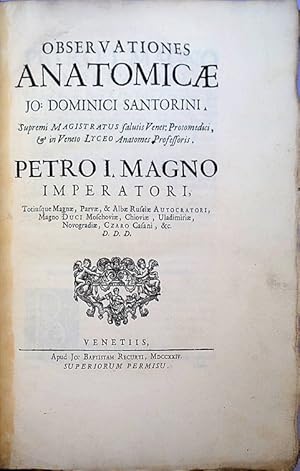
Observationes anatomicae
Verlag: apud Jo. Baptistam Recurti, Venice, 1724
Anbieter: Jeremy Norman's historyofscience, Novato, CA, USA
Verkäuferbewertung 5 von 5 Sternen
Erstausgabe Signiert
Heavily Annotated by an 18th-Century Medical Scholar Santorini, Giovanni Domenico (1681-1737). Observationes anatomicae. 4to. [12], 250 [i.e., 252]pp. 3 folding engraved plates, the second plate signed by the artist Marcus Galli and the engraver Carlo Orsolini (ca. 1710-ca. 1780). Venice: Giovanni Battista Recurti, 1724. 286 x 208 mm. (uncut). Original carta rustica boards, spine repaired, slight wear. Minor dampstain in upper margins of plates and last approx. 15 leaves, otherwise very good to fine. Extensive scholarly annotations in a legible and attractive 18th-century hand in the margins of several leaves; note on Santorini's death in the same hand on the front pastedown. First Edition. "Santorini was generally acknowledged as the outstanding anatomist of his time, carefully dissecting and delineating many difficult and complex gross features of the human body, such as facial muscles involved in emotional expression, accessory pancreatic ducts, and duodenal papillae. His name has been given to some of these structures, such as the arytenoid cartilages (1724), the risorius muscle, and the plexus pudendalis venosus . . . His most important work was Observationes anatomicae, a valuable exposition of details of human anatomy" (Dictionary of Scientific Biography). The four major anatomical discoveries for which Santorini is known eponymicallySantorini's cartilage (larynx), Santorini's vein, Santorini's duct (pancreas) and Santorini's caruncula (pancreas / bile duct)are described in this work. This copy of Santorini's Observationes anatomicae bears numerous marginal annotations and corrections in Latin by an anonymous but remarkably erudite 18th-century medical scholar. Many of the notes are so long and detailed that they appear to represent an ongoing writing projectpossibly in preparation for a future corrected edition, although no such edition was ever published (the text in the 1739 second edition of Santorini's work is unchanged from the first edition). The manuscript notes appear on 34 pages throughout the text; the most extensive notes are on pages 4-5, 63, 98-99, 108, 147, 148-149 and 160. The notes on pages 98-99 are of particular interest in that they comment on (and possibly dispute) Santorini's description of the laryngeal cartilages. Also remarkable are the notes on pp. 148-149, which comment on Santorini's description of pulmonary circulation. The notes cite the works of over a dozen medical writers, including Eustachius, Morgagni, Falloppio, Fabricius, Heister, Valverde, Vesalius, Columbo, Cesalpino, Diemerbroeck, Bartholin and Estienne. A few of the notes are dated 1738. The inscription on the inside front cover gives the date of Santorini's death as May 7, 1737 ("die Maij septima A.D. MDCCXXXVII") and states that he died of a periodic intermittent fever ("febre periodica intermittente"). Garrison-Morton 392. .
-

Quam salubria balnea sint: cum ad sanitatem tuendam, tum ad morbos curandos, dialogus adversus neotericos medicos.
Verlag: Rome A. Bladus de Asula 1535., 1535
Anbieter: Martayan Lan, New York, NY, USA
Verkäuferbewertung 4 von 5 Sternen
Erstausgabe
Hardcover. Zustand: Very Good. 1st Edition. Rare first edition of this influential balneological treatise by one of the founding fathers of hydrotherapy. A modern interpretation of Galen, Avicenna and Hippocrates, Brancaleoni s work promoted the healthful and hygienic effects of bathing a generation earlier than Falloppio, and well in advance of the 19th-century pan-European trend for spa cures associated with Vincenz Priessnitz (1799-1851) and Father Sebastian Kneipp.While the identity of the early annotator of this copy has not been confirmed, the primary hand appears identical to the notes appearing in another medical text handled by our firm: Ferdinando Balami s translation of Galen s De ossibus, also published in Rome by Blado in 1535, and bound in an analogous green vellum binding, which bears the ownership inscription of the physician Ottaviano Caligari. OCLC lists two copies of the 1535 edition: Harvard and the Wellcome (this edition not in the NUC). * Wellcome 1037; Durling 669, 670 (1536 eds.); BMC (1536 ed.); Bibliotheca Palatina F2421; not in Osler, Duveen, Waller. On De Balneis omnia see Durling 1101; Garrison & Morton 1986.
-

Gestione dell'infertilità inspiegabile
Sprache: Italienisch
Verlag: Edizioni Sapienza Apr 2021, 2021
ISBN 10: 6202768010 ISBN 13: 9786202768016
Anbieter: buchversandmimpf2000, Emtmannsberg, BAYE, Deutschland
Verkäuferbewertung 5 von 5 Sternen
Taschenbuch. Zustand: Neu. Neuware -L'infertilità inspiegabile è il fallimento del concepimento dopo tre anni di rapporti sessuali non protetti, mentre non può essere diagnosticata alcuna causa definita di infertilità dopo un lavoro completo. La terapia empirica per l'infertilità inspiegabile con la tecnologia della riproduzione assistita ha recentemente guadagnato popolarità. In questo studio abbiamo confrontato il valore della perfusione degli spermatozoi delle tube di Falloppio, l'inseminazione intrauterina standard e i rapporti sessuali a tempo dopo iperstimolazione ovarica controllata nel trattamento dell'infertilità inspiegabile. In conclusione, la perfusione degli spermatozoi delle tube di Falloppio è un metodo facile e ben tollerato, e potrebbe essere raccomandato per la gestione dell'infertilità inspiegabile.Books on Demand GmbH, Überseering 33, 22297 Hamburg 300 pp. Italienisch.
-

Embriogenesi umana
Sprache: Italienisch
Verlag: Edizioni Sapienza Jul 2023, 2023
ISBN 10: 6206213064 ISBN 13: 9786206213062
Anbieter: buchversandmimpf2000, Emtmannsberg, BAYE, Deutschland
Verkäuferbewertung 5 von 5 Sternen
Taschenbuch. Zustand: Neu. Neuware -L'embriogenesi umana corrisponde allo sviluppo dell'individuo dalla fecondazione all'ottava settimana. La fecondazione è l'incontro tra lo spermatozoo e l'ovocita II nel terzo esterno della tuba di Falloppio, la penetrazione dello spermatozoo nell'ovocita II e la fusione dei nuclei dello spermatozoo e dell'ovocita. Non appena avviene la fecondazione, l'individuo diventa uno zigote (uovo fecondato o ovulo fecondato) e inizia il suo sviluppo grazie a fattori genetici ed epigenetici. Durante la prima settimana di vita, lo zigote migra e si segmenta fino allo stadio di blastocisti. Nella seconda settimana hanno luogo l'annidamento, la decidualizzazione e gli eventi in coppia. La terza settimana vede la gastrulazione e la formazione degli embrioni. Dalla quarta all'ottava settimana, formazione definitiva degli annessi e delimitazione. L'ovulo fecondato può dividersi per dare due individui, che sono gemelli identici, o la poliovulazione, che dà luogo a gemelli fraterni. Durante questo periodo, l'individuo è chiamato embrione ed è molto vulnerabile ai fattori teratogeni.Books on Demand GmbH, Überseering 33, 22297 Hamburg 92 pp. Italienisch.
-
PARNASO MODENESE DAL SECOLO XV AL XVIII. Scelto e ordinato.
Verlag: Carlo Vincenzi e Andrea Rossi, Modena, 1866
Anbieter: studio bibliografico pera s.a.s., LUCCA, LU, Italien
Verkäuferbewertung 4 von 5 Sternen
Brossura. Zustand: discrete. Cm.26x18,5. Pg.(8), 332. Testo in bordura decorativa. Da rilegare. Dettagliata antologia lirica di autori modenesi: Giuseppe Baraldi, Giammaria Barbieri, Pietro Antonio Bernardoni, Lucia Bertana, Margherita Calori, Paolo Emilio Campi, Giuliano Cassiani, Lodovico Castelvetro, Luigi Cerretti, Cristoforo Codebò, Giovanni Falloppio, Santo Fattori, Ercole Forni, Giovanni Antonio Grassetti, Girolamo Graziani, Lodovico Lustrini, Francesco Medici, Francesco Maria Molza, Tarquinia Molza, Giovanni Moreali, Lodovico Antonio Muratori, Gandolfo Porrino, Marsilio Quistelli, Ercole e Giovanni Rangone, Bartolomeo Ricci, Pellegrino Rossi, Giuliano Sabbatini, Panfilo Sassi, Lodovico Scapinelli, Bartolomeo Schedoni, Girolamo Tagliazucchi, Alessandro Tassoni, Fulvio Testi, Francesco Torti, Filippo Valentini, Giovan Battista Vicini, Lodovico Antonio Vincenzi, Carlo Zuccoli 650 gr.
-
Gabr. Fallopii Wunderlicher Menschlichem Leben gewisser / und sehr nutzlicher Secreten / Drey Buecher. I. Von allerhand Olien / Cerotten / Unguenten / Pillulen / und Electuarien. II. Von allerhand Weinen / und gebrandten Wassern / zu underschiedlichen Gebrechen und Schwachheiten dienlich. III. Von etlichen sehr nutzlichen Secreten auß der Chymia. Allen Liebhabern der Kuensten / und Sorgfaeltigen Haußvaettern dienlich zu lesen / und nuetzlich zugebrauchen. Vom Authore selbst in Italiänischer Sprach publicirt / Jetzund aber Teutscher Nation zu gutem in unser Muttersprach ubersetzet
Sprache: Deutsch
Verlag: Wolfgang Hoffmann, Frankfurt am Main, 1641
Anbieter: avelibro OHG, Dinkelscherben, Deutschland
Verbandsmitglied: BOEV
Verkäuferbewertung 5 von 5 Sternen
16,5 x 9,5 cm. Zustand: Sehr gut. 474 Seiten, 15 Blatt, 2 Blatt Original Pergamenteinband der Zeit mit Rückenschildchen und zwei Schließbändern die aber fehlen. Innen sehr schönes und nahezu Fleckenfreies Exemplar, einige Registerseiten unten rechts mit einem Braunfleck im Rand. Am Schluß eingebunden 2 Seiten Handschriftliche Aufzeichnungen auds der Zeit. Gabriele (auch Gabrielle) Falloppio (auch Fallopio, Falloppia und Faloppio geschrieben; * 1523 (oder Ende 1522) in Modena; 9. Oktober 1562 in Padua[1]) war ein italienischer Anatom und Chirurg sowie Hochschullehrer vor allem in Padua. Auch bekannt ist er unter seinem latinisierten Namen Fallopius. Er gilt als Mitbegründer der modernen Anatomie und war einer der bedeutendsten Ärzte des 16. Jahrhunderts. Quelle: Wikipedia Auszug UG204 Sprache: Deutsch Gewicht in Gramm: 265.


![Bild des Verkäufers für Tractatus de compositione medicamentorum dilucidissimus; nunc primum ad candidatorum medicinae utilitatem summa opera, ac cura castigatus, & in lucem editus [.]. zum Verkauf von Versandantiquariat Wolfgang Friebes](https://pictures.abebooks.com/inventory/md/md30678971752.jpg)




![Bild des Verkäufers für De balneo thermali, Lixignano vocato, necnon de luto barboliorum medicato, in ducatu Parmensi, tractatus Hieronymi Zunthi, philosophi, ac medici Parmensis. In quo breviter docentur modi reales vtendi, & aquis, & luto thermali [.] Ad serenissimum Ranutium Farnesium, Parmae, Placentiae, &c. ducem IV zum Verkauf von Libreria Alberto Govi di F. Govi Sas](https://pictures.abebooks.com/inventory/md/md31457471645.jpg)