

Gesamtpreis (1 Artikel Artikel):
Versandziel:

9789400760875 - Iron Uptake in Bacteria with Emphasis on E. coli and Pseudomonas (SpringerBriefs in Biometals) (6 Ergebnisse)
Direkt zu den wichtigsten Suchergebnissen
Suchfilter
Produktart
- Alle Product Types
- Bücher (6)
- Magazine & Zeitschriften (Keine weiteren Ergebnisse entsprechen dieser Verfeinerung)
- Comics (Keine weiteren Ergebnisse entsprechen dieser Verfeinerung)
- Noten (Keine weiteren Ergebnisse entsprechen dieser Verfeinerung)
- Kunst, Grafik & Poster (Keine weiteren Ergebnisse entsprechen dieser Verfeinerung)
- Fotografien (Keine weiteren Ergebnisse entsprechen dieser Verfeinerung)
- Karten (Keine weiteren Ergebnisse entsprechen dieser Verfeinerung)
- Manuskripte & Papierantiquitäten (Keine weiteren Ergebnisse entsprechen dieser Verfeinerung)
Zustand Mehr dazu
- Neu (5)
- Wie Neu, Sehr Gut oder Gut Bis Sehr Gut (1)
- Gut oder Befriedigend (Keine weiteren Ergebnisse entsprechen dieser Verfeinerung)
- Ausreichend oder Schlecht (Keine weiteren Ergebnisse entsprechen dieser Verfeinerung)
- Wie beschrieben (Keine weiteren Ergebnisse entsprechen dieser Verfeinerung)
Einband
- alle Einbände
- Hardcover (Keine weiteren Ergebnisse entsprechen dieser Verfeinerung)
- Softcover (6)
Weitere Eigenschaften
- Erstausgabe (Keine weiteren Ergebnisse entsprechen dieser Verfeinerung)
- Signiert (Keine weiteren Ergebnisse entsprechen dieser Verfeinerung)
- Schutzumschlag (Keine weiteren Ergebnisse entsprechen dieser Verfeinerung)
- Angebotsfoto (3)
Sprache (1)
Preis
- Beliebiger Preis
- Weniger als EUR 20 (Keine weiteren Ergebnisse entsprechen dieser Verfeinerung)
- EUR 20 bis EUR 45
- Mehr als EUR 45
Gratisversand
- Kostenloser Versand nach USA (Keine weiteren Ergebnisse entsprechen dieser Verfeinerung)
Land des Verkäufers
Verkäuferbewertung
-

Iron Uptake in Bacteria with Emphasis on E. coli and Pseudomonas (SpringerBriefs in Biometals)
Buch 30 von 220: SpringerBriefs in Molecular ScienceAnbieter: Ria Christie Collections, Uxbridge, Vereinigtes Königreich
Verkäuferbewertung 5 von 5 Sternen

EUR 58,60
EUR 13,81 Versand
Versand von Vereinigtes Königreich nach USAAnzahl: Mehr als 20 verfügbar
In den WarenkorbZustand: New. In.
-
Iron Uptake in Bacteria With Emphasis on E. Coli and Pseudomonas
Buch 30 von 220: SpringerBriefs in Molecular ScienceAnbieter: Revaluation Books, Exeter, Vereinigtes Königreich
Verkäuferbewertung 5 von 5 Sternen
EUR 76,39
EUR 11,53 Versand
Versand von Vereinigtes Königreich nach USAAnzahl: 2 verfügbar
In den WarenkorbPaperback. Zustand: Brand New. 2013 edition. 100 pages. 9.00x6.00x0.25 inches. In Stock.
-

Iron Uptake in Bacteria with Emphasis on E. coli and Pseudomonas
Buch 30 von 220: SpringerBriefs in Molecular ScienceEUR 48,37
EUR 48,99 Versand
Versand von Deutschland nach USAAnzahl: Mehr als 20 verfügbar
In den WarenkorbZustand: New.
-
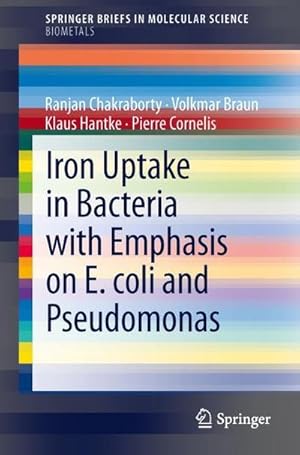
Iron Uptake in Bacteria with Emphasis on E. coli and Pseudomonas
Buch 30 von 220: SpringerBriefs in Molecular ScienceAnbieter: AHA-BUCH GmbH, Einbeck, Deutschland
Verkäuferbewertung 5 von 5 Sternen
Taschenbuch. Zustand: Neu. Druck auf Anfrage Neuware - Printed after ordering - Iron is essential for the growth of most bacteria because it serves as a cofactor for vital enzymes and for the components of the electron transport chain. Moreover, Iron plays an important role in bacterial pathogenicity; in fact, the iron transport systems in bacteria works as target for designing novel antibiotics. Because iron is not soluble under aerobic conditions, bacteria have had to find ways to overcome iron deficiency. One of them is producing an iron-chelating small organic molecule called siderophore. Indeed, most bacteria and fungi produce structurally and chemically diverse siderophores which are transported back to the cytoplasm using complex energy dependent transport systems. Escherichia coli and Pseudomonas were the first ones to be tested; however, nowadays iron transport systems have been investigated in many other bacteria. Iron Uptake in Bacteria with Emphasis on E. coli and Pseudomonas reviews the recent advancements in the field of iron transport systems in bacteria. Chapter 1 is dedicated to Dr. Dick van der Helm's contribution to the field of siderophore biology. It then describes and discusses the structural advances in the components and the mechanism of siderophore mediated iron transport systems in E.coli. Chapter 2 details the variety of iron transport and iron regulatory systems of both gram negative and gram positive bacteria. Finally, chapter 3 describes the iron transport systems of Pseudomonas. This book is aimed at researchers in the fields of iron metabolism in multiple organisms, and to those who are interested in studying iron transport systems of bacteria. It appeals also to scientists researching structure and function relationship of proteins.
-

Taschenbuch. Zustand: Neu. Iron Uptake in Bacteria with Emphasis on E. coli and Pseudomonas | Ranjan Chakraborty (u. a.) | Taschenbuch | xi | Englisch | 2013 | Springer | EAN 9789400760875 | Verantwortliche Person für die EU: Springer Verlag GmbH, Tiergartenstr. 17, 69121 Heidelberg, juergen[dot]hartmann[at]springer[dot]com | Anbieter: preigu.
-
Zustand: Sehr gut. Zustand: Sehr gut | Sprache: Englisch | Produktart: Bücher | Iron is essential for the growth of most bacteria because it serves as a cofactor for vital enzymes and for the components of the electron transport chain. Moreover, Iron plays an important role in bacterial pathogenicity; in fact, the iron transport systems in bacteria works as target for designing novel antibiotics. Because iron is not soluble under aerobic conditions, bacteria have had to find ways to overcome iron deficiency. One of them is producing an iron-chelating small organic molecule called siderophore. Indeed, most bacteria and fungi produce structurally and chemically diverse siderophores which are transported back to the cytoplasm using complex energy dependent transport systems. Escherichia coli and Pseudomonas were the first ones to be tested; however, nowadays iron transport systems have been investigated in many other bacteria. Iron Uptake in Bacteria with Emphasis on E. coli and Pseudomonas reviews the recent advancements in the field of iron transport systems in bacteria. Chapter 1 is dedicated to Dr. Dick van der Helm¿s contribution to the field of siderophore biology. It then describes and discusses the structural advances in the components and the mechanism of siderophore mediated iron transport systems in E.coli. Chapter 2 details the variety of iron transport and iron regulatory systems of both gram negative and gram positive bacteria. Finally, chapter 3 describes the iron transport systems of Pseudomonas. This book is aimed at researchers in the fields of iron metabolism in multiple organisms, and to those who are interested in studying iron transport systems of bacteria. It appeals also to scientists researching structure and function relationship of proteins.
