

Gesamtpreis (1 Artikel Artikel):
Versandziel:

9783540921509 - Differential Evolution: A Handbook for Global Permutation-Based Combinatorial Optimization (Studies in Computational Intelligence, 175, Band 175) (6 Ergebnisse)
Direkt zu den wichtigsten Suchergebnissen
Suchfilter
Produktart
- Alle Product Types
- Bücher (6)
- Magazine & Zeitschriften (Keine weiteren Ergebnisse entsprechen dieser Verfeinerung)
- Comics (Keine weiteren Ergebnisse entsprechen dieser Verfeinerung)
- Noten (Keine weiteren Ergebnisse entsprechen dieser Verfeinerung)
- Kunst, Grafik & Poster (Keine weiteren Ergebnisse entsprechen dieser Verfeinerung)
- Fotografien (Keine weiteren Ergebnisse entsprechen dieser Verfeinerung)
- Karten (Keine weiteren Ergebnisse entsprechen dieser Verfeinerung)
- Manuskripte & Papierantiquitäten (Keine weiteren Ergebnisse entsprechen dieser Verfeinerung)
Zustand Mehr dazu
- Neu (5)
- Wie Neu, Sehr Gut oder Gut Bis Sehr Gut (1)
- Gut oder Befriedigend (Keine weiteren Ergebnisse entsprechen dieser Verfeinerung)
- Ausreichend oder Schlecht (Keine weiteren Ergebnisse entsprechen dieser Verfeinerung)
- Wie beschrieben (Keine weiteren Ergebnisse entsprechen dieser Verfeinerung)
Einband
Weitere Eigenschaften
- Erstausgabe (Keine weiteren Ergebnisse entsprechen dieser Verfeinerung)
- Signiert (Keine weiteren Ergebnisse entsprechen dieser Verfeinerung)
- Schutzumschlag (Keine weiteren Ergebnisse entsprechen dieser Verfeinerung)
- Angebotsfoto (2)
Sprache (1)
Preis
- Beliebiger Preis
- Weniger als EUR 20 (Keine weiteren Ergebnisse entsprechen dieser Verfeinerung)
- EUR 20 bis EUR 45
- Mehr als EUR 45
Gratisversand
Land des Verkäufers
Verkäuferbewertung
-
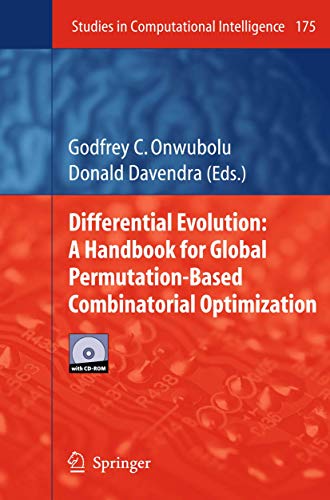
Differential Evolution: A Handbook For Global Permutation-based Combinatorial Optimization
Anbieter: Romtrade Corp., STERLING HEIGHTS, MI, USA
Verkäuferbewertung 5 von 5 Sternen

Zustand: New. This is a Brand-new US Edition. This Item may be shipped from US or any other country as we have multiple locations worldwide.
-
Differential Evolution: A Handbook for Global Permutation-Based Combinatorial Optimization (Studies in Computational Intelligence, 175)
Anbieter: Ria Christie Collections, Uxbridge, Vereinigtes Königreich
Verkäuferbewertung 5 von 5 Sternen
EUR 115,62
EUR 13,88 Versand
Versand von Vereinigtes Königreich nach USAAnzahl: Mehr als 20 verfügbar
In den WarenkorbZustand: New. In.
-
Zustand: Sehr gut. Zustand: Sehr gut | Sprache: Englisch | Produktart: Bücher | What is combinatorial optimization? Traditionally, a problem is considered to be c- binatorial if its set of feasible solutions is both ?nite and discrete, i. e. , enumerable. For example, the traveling salesman problem asks in what order a salesman should visit the cities in his territory if he wants to minimize his total mileage (see Sect. 2. 2. 2). The traveling salesman problem¿s feasible solutions - permutations of city labels - c- prise a ?nite, discrete set. By contrast, Differential Evolution was originally designed to optimize functions de?ned on real spaces. Unlike combinatorial problems, the set of feasible solutions for real parameter optimization is continuous. Although Differential Evolution operates internally with ?oating-point precision, it has been applied with success to many numerical optimization problems that have t- ditionally been classi?ed as combinatorial because their feasible sets are discrete. For example, the knapsack problem¿s goal is to pack objects of differing weight and value so that the knapsack¿s total weight is less than a given maximum and the value of the items inside is maximized (see Sect. 2. 2. 1). The set of feasible solutions - vectors whose components are nonnegative integers - is both numerical and discrete. To handle such problems while retaining full precision, Differential Evolution copies ?oating-point - lutions to a temporary vector that, prior to being evaluated, is truncated to the nearest feasible solution, e. g. , by rounding the temporary parameters to the nearest nonnegative integer.
-
Differential Evolution: A Handbook for Global Permutation-based Combinatorial Optimization
Anbieter: Revaluation Books, Exeter, Vereinigtes Königreich
Verkäuferbewertung 5 von 5 Sternen
EUR 154,49
EUR 11,59 Versand
Versand von Vereinigtes Königreich nach USAAnzahl: 2 verfügbar
In den WarenkorbHardcover. Zustand: Brand New. hardback/cd-rom edition. 211 pages. 9.50x6.50x0.50 inches. In Stock.
-

Differential Evolution
Sprache: Englisch
Verlag: Springer Berlin Heidelberg, 2009
ISBN 10: 3540921508 ISBN 13: 9783540921509
EUR 118,64
EUR 48,99 Versand
Versand von Deutschland nach USAAnzahl: Mehr als 20 verfügbar
In den WarenkorbBundle. Zustand: New. Presents a complete introduction to differential evolutionIncludes the continuous space DE formulation and the permutative-based combinatorial DE formulationWhat is combinatorial optimization? Traditionally, a problem is considered .
-

Differential Evolution: A Handbook for Global Permutation-Based Combinatorial Optimization : A Handbook for Global Permutation-Based Combinatorial Optimization
Sprache: Englisch
Verlag: Springer, Berlin, Springer, 2009
ISBN 10: 3540921508 ISBN 13: 9783540921509
Anbieter: AHA-BUCH GmbH, Einbeck, Deutschland
Verkäuferbewertung 5 von 5 Sternen
Buch. Zustand: Neu. Druck auf Anfrage Neuware - Printed after ordering - What is combinatorial optimization Traditionally, a problem is considered to be c- binatorial if its set of feasible solutions is both nite and discrete, i. e. , enumerable. For example, the traveling salesman problem asks in what order a salesman should visit the cities in his territory if he wants to minimize his total mileage (see Sect. 2. 2. 2). The traveling salesman problem's feasible solutions - permutations of city labels - c- prise a nite, discrete set. By contrast, Differential Evolution was originally designed to optimize functions de ned on real spaces. Unlike combinatorial problems, the set of feasible solutions for real parameter optimization is continuous. Although Differential Evolution operates internally with oating-point precision, it has been applied with success to many numerical optimization problems that have t- ditionally been classi ed as combinatorial because their feasible sets are discrete. For example, the knapsack problem's goal is to pack objects of differing weight and value so that the knapsack's total weight is less than a given maximum and the value of the items inside is maximized (see Sect. 2. 2. 1). The set of feasible solutions - vectors whose components are nonnegative integers - is both numerical and discrete. To handle such problems while retaining full precision, Differential Evolution copies oating-point - lutions to a temporary vector that, prior to being evaluated, is truncated to the nearest feasible solution, e. g. , by rounding the temporary parameters to the nearest nonnegative integer.
