

Gesamtpreis (1 Artikel Artikel):
Versandziel:

9783540304326 - Perspectives in Analysis: Essays in Honor of Lennart Carleson's 75th Birthday (Mathematical Physics Studies, 27, Band 27) (6 Ergebnisse)
Direkt zu den wichtigsten Suchergebnissen
Suchfilter
Produktart
- Alle Product Types
- Bücher (6)
- Magazine & Zeitschriften (Keine weiteren Ergebnisse entsprechen dieser Verfeinerung)
- Comics (Keine weiteren Ergebnisse entsprechen dieser Verfeinerung)
- Noten (Keine weiteren Ergebnisse entsprechen dieser Verfeinerung)
- Kunst, Grafik & Poster (Keine weiteren Ergebnisse entsprechen dieser Verfeinerung)
- Fotografien (Keine weiteren Ergebnisse entsprechen dieser Verfeinerung)
- Karten (Keine weiteren Ergebnisse entsprechen dieser Verfeinerung)
- Manuskripte & Papierantiquitäten (Keine weiteren Ergebnisse entsprechen dieser Verfeinerung)
Zustand Mehr dazu
- Neu (3)
- Wie Neu, Sehr Gut oder Gut Bis Sehr Gut (2)
- Gut oder Befriedigend (1)
- Ausreichend oder Schlecht (Keine weiteren Ergebnisse entsprechen dieser Verfeinerung)
- Wie beschrieben (Keine weiteren Ergebnisse entsprechen dieser Verfeinerung)
Einband
- alle Einbände
- Hardcover (6)
- Softcover (Keine weiteren Ergebnisse entsprechen dieser Verfeinerung)
Weitere Eigenschaften
- Erstausgabe (Keine weiteren Ergebnisse entsprechen dieser Verfeinerung)
- Signiert (Keine weiteren Ergebnisse entsprechen dieser Verfeinerung)
- Schutzumschlag (Keine weiteren Ergebnisse entsprechen dieser Verfeinerung)
- Angebotsfoto (4)
Sprache (1)
Gratisversand
- Kostenloser Versand nach USA (Keine weiteren Ergebnisse entsprechen dieser Verfeinerung)
Land des Verkäufers
Verkäuferbewertung
-
Perspectives in Analysis. Essays in Honor of Lennart Carleson's 75th Birthday. [Mathematical Physics Studies, Vol. 27].
Buch 2 von 24: Mathematical Physics StudiesAnbieter: Antiquariat Thomas Haker GmbH & Co. KG, Berlin, Deutschland
Verbandsmitglied: GIAQ
Verkäuferbewertung 5 von 5 Sternen
 Sonderangebot
EUR 7,04
EUR 20,00 Versand
Versand von Deutschland nach USAAnzahl: 1 verfügbar
In den WarenkorbHardcover/Pappeinband. Zustand: Sehr gut. 392 p. Very good. Shrink wrapped. / Sehr guter Zustand. In Folie verschweißt. Sprache: Englisch Gewicht in Gramm: 904.
-

Perspectives in Analysis: Essays in Honor of Lennart Carleson's 75th Birthday (Mathematical Physics Studies, 27)
Buch 2 von 24: Mathematical Physics StudiesAnbieter: Ria Christie Collections, Uxbridge, Vereinigtes Königreich
Verkäuferbewertung 5 von 5 Sternen
EUR 60,62
EUR 13,88 Versand
Versand von Vereinigtes Königreich nach USAAnzahl: Mehr als 20 verfügbar
In den WarenkorbZustand: New. In.
-
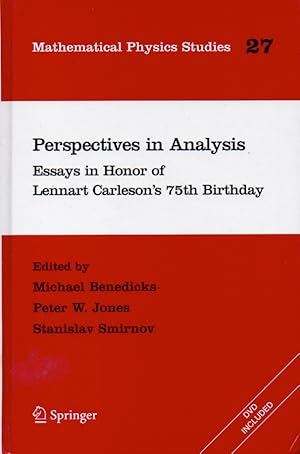
Perspectives in Analysis _ Essays in Honor of Lennart Carleson's 75th Birthday
Buch 2 von 24: Mathematical Physics StudiesSprache: Englisch
Verlag: Springer Publishing Company, Berlin, 2005
ISBN 10: 3540304320 ISBN 13: 9783540304326
Anbieter: San Francisco Book Company, Paris, Frankreich
Verkäuferbewertung 4 von 5 Sternen

Hardcover. Zustand: Very good. Hardcover Octavo no dust jacket. red and white papered boards, 376 pp.
-

Perspectives in Analysis, w. DVD
Buch 2 von 24: Mathematical Physics StudiesSprache: Englisch
Verlag: Springer Berlin Heidelberg, 2006
ISBN 10: 3540304320 ISBN 13: 9783540304326
EUR 64,08
EUR 48,99 Versand
Versand von Deutschland nach USAAnzahl: Mehr als 20 verfügbar
In den WarenkorbZustand: New. Among the authors there are winners of the Max-Planck Medal and the Fields Medal. All are really outstanding world-class experts in mathematical analysis and mathematical physicsAmong the authors there are winners of the Max-Planck Medal and the Fiel.
-

Perspectives in Analysis, w. DVD : Essays in Honor of Lennart Carleson's 75th Birthday
Buch 2 von 24: Mathematical Physics StudiesSprache: Englisch
Verlag: Springer, Berlin, Springer, 2006
ISBN 10: 3540304320 ISBN 13: 9783540304326
Anbieter: AHA-BUCH GmbH, Einbeck, Deutschland
Verkäuferbewertung 5 von 5 Sternen
Buch. Zustand: Neu. Druck auf Anfrage Neuware - Printed after ordering - The Conference 'Perspectives in Analysis' was held during May 26-28, 2003 at the Royal Institute of Technology in Stockholm, Sweden. The purpose of the conference was to consider the future of analysis along with its relations to other areas of mathematics and physics, and to celebrate the seventy- fth birthday of Lennart Carleson. The scienti c theme was one with which the name of Lennart Carleson has been associated for over fty years. His modus operandi has long been to carry out a twofold approach to the selection of research problems. First one should look for promising new areas of ana- sis, especially those having close contact with physically oriented problems of geometric character. The second step is to select a core set of problems that require new techniques for their resolutions. After making a central contri- tion, Lennart would usually move on to a new area, though he might return to the topic of his previous work if new techniques were developed that could break old mathematical log jams. Lennart's operating approach is based on fundamental realities of modern mathematics as well as his own inner c- victions. Here we rst refer to an empirical fact of mathematical research: All topics have a nite half-life, with fteen years being an upper bound for most areas. After that time it is usually a good idea to move on to so- thing new.
-
Zustand: Sehr gut. Zustand: Sehr gut | Seiten: 396 | Sprache: Englisch | Produktart: Bücher | The Conference ¿Perspectives in Analysis¿ was held during May 26¿28, 2003 at the Royal Institute of Technology in Stockholm, Sweden. The purpose of the conference was to consider the future of analysis along with its relations to other areas of mathematics and physics, and to celebrate the seventy-?fth birthday of Lennart Carleson. The scienti?c theme was one with which the name of Lennart Carleson has been associated for over ?fty years. His modus operandi has long been to carry out a twofold approach to the selection of research problems. First one should look for promising new areas of ana- sis, especially those having close contact with physically oriented problems of geometric character. The second step is to select a core set of problems that require new techniques for their resolutions. After making a central contri- tion, Lennart would usually move on to a new area, though he might return to the topic of his previous work if new techniques were developed that could break old mathematical log jams. Lennart¿s operating approach is based on fundamental realities of modern mathematics as well as his own inner c- victions. Here we ?rst refer to an empirical fact of mathematical research: All topics have a ?nite half-life, with ?fteen years being an upper bound for most areas. After that time it is usually a good idea to move on to so- thing new.
![Bild des Verkäufers für Perspectives in Analysis. Essays in Honor of Lennart Carleson's 75th Birthday. [Mathematical Physics Studies, Vol. 27]. zum Verkauf von Antiquariat Thomas Haker GmbH & Co. KG](https://pictures.abebooks.com/inventory/md/md31010630837.jpg)

