

Gesamtpreis (1 Artikel Artikel):
Versandziel:

9781493943548 - Statistical Methods for Astronomical Data Analysis (Springer Series in Astrostatistics, Band 3) von Chattopadhyay, Asis Kumar (5 Ergebnisse)
Direkt zu den wichtigsten Suchergebnissen
Suchfilter
Produktart
- Alle Product Types
- Bücher (5)
- Magazine & Zeitschriften (Keine weiteren Ergebnisse entsprechen dieser Verfeinerung)
- Comics (Keine weiteren Ergebnisse entsprechen dieser Verfeinerung)
- Noten (Keine weiteren Ergebnisse entsprechen dieser Verfeinerung)
- Kunst, Grafik & Poster (Keine weiteren Ergebnisse entsprechen dieser Verfeinerung)
- Fotografien (Keine weiteren Ergebnisse entsprechen dieser Verfeinerung)
- Karten (Keine weiteren Ergebnisse entsprechen dieser Verfeinerung)
- Manuskripte & Papierantiquitäten (Keine weiteren Ergebnisse entsprechen dieser Verfeinerung)
Zustand Mehr dazu
- Neu (5)
- Wie Neu, Sehr Gut oder Gut Bis Sehr Gut (Keine weiteren Ergebnisse entsprechen dieser Verfeinerung)
- Gut oder Befriedigend (Keine weiteren Ergebnisse entsprechen dieser Verfeinerung)
- Ausreichend oder Schlecht (Keine weiteren Ergebnisse entsprechen dieser Verfeinerung)
- Wie beschrieben (Keine weiteren Ergebnisse entsprechen dieser Verfeinerung)
Einband
- alle Einbände
- Hardcover (Keine weiteren Ergebnisse entsprechen dieser Verfeinerung)
- Softcover (5)
Weitere Eigenschaften
- Erstausgabe (Keine weiteren Ergebnisse entsprechen dieser Verfeinerung)
- Signiert (Keine weiteren Ergebnisse entsprechen dieser Verfeinerung)
- Schutzumschlag (Keine weiteren Ergebnisse entsprechen dieser Verfeinerung)
- Angebotsfoto (4)
Sprache (1)
Preis
- Beliebiger Preis
- Weniger als EUR 20 (Keine weiteren Ergebnisse entsprechen dieser Verfeinerung)
- EUR 20 bis EUR 45 (Keine weiteren Ergebnisse entsprechen dieser Verfeinerung)
- Mehr als EUR 45
Gratisversand
- Kostenloser Versand nach USA (Keine weiteren Ergebnisse entsprechen dieser Verfeinerung)
Land des Verkäufers
Verkäuferbewertung
-

EUR 101,04
EUR 48,99 Versand
Versand von Deutschland nach USAAnzahl: Mehr als 20 verfügbar
In den WarenkorbZustand: New.
-

Taschenbuch. Zustand: Neu. Statistical Methods for Astronomical Data Analysis | Asis Kumar Chattopadhyay (u. a.) | Taschenbuch | Springer Series in Astrostatistics | xiii | Englisch | 2017 | Springer | EAN 9781493943548 | Verantwortliche Person für die EU: Springer Verlag GmbH, Tiergartenstr. 17, 69121 Heidelberg, juergen[dot]hartmann[at]springer[dot]com | Anbieter: preigu.
-

Statistical Methods for Astronomical Data Analysis
Buch 3 von 4: Springer Series in AstrostatisticsSprache: Englisch
Verlag: Springer New York, Springer US Apr 2017, 2017
ISBN 10: 1493943545 ISBN 13: 9781493943548
Anbieter: buchversandmimpf2000, Emtmannsberg, BAYE, Deutschland
Verkäuferbewertung 5 von 5 Sternen

Taschenbuch. Zustand: Neu. Neuware -This book introduces ¿Astrostatistics¿ as a subject in its own right with rewarding examples, including work by the authors with galaxy and Gamma Ray Burst data to engage the reader. This includes a comprehensive blending of Astrophysics and Statistics. The first chapter¿s coverage of preliminary concepts and terminologies for astronomical phenomenon will appeal to both Statistics and Astrophysics readers as helpful context. Statistics concepts covered in the book provide a methodological framework. A unique feature is the inclusion of different possible sources of astronomical data, as well as software packages for converting the raw data into appropriate forms for data analysis. Readers can then use the appropriate statistical packages for their particular data analysis needs. The ideas of statistical inference discussed in the book help readers determine how to apply statistical tests. The authors cover different applications of statistical techniques already developed or specifically introduced for astronomical problems, including regression techniques, along with their usefulness for data set problems related to size and dimension. Analysis of missing data is an important part of the book because of its significance for work with astronomical data. Both existing and new techniques related to dimension reduction and clustering are illustrated through examples. There is detailed coverage of applications useful for classification, discrimination, data mining and time series analysis. Later chapters explain simulation techniques useful for the development of physical models where it is difficult or impossible to collect data. Finally, coverage of the many R programs for techniques discussed makes this book a fantastic practical reference. Readers may apply what they learn directly to their data sets in addition to the data sets included by the authors.Springer Verlag GmbH, Tiergartenstr. 17, 69121 Heidelberg 364 pp. Englisch.
-
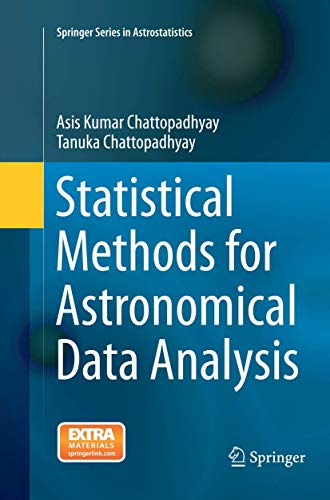
Statistical Methods for Astronomical Data Analysis (Springer Series in Astrostatistics)
Buch 3 von 4: Springer Series in AstrostatisticsAnbieter: Revaluation Books, Exeter, Vereinigtes Königreich
Verkäuferbewertung 5 von 5 Sternen
EUR 173,75
EUR 14,34 Versand
Versand von Vereinigtes Königreich nach USAAnzahl: 1 verfügbar
In den WarenkorbPaperback. Zustand: Brand New. reprint edition. 362 pages. 9.25x6.10x0.86 inches. In Stock.
-

Statistical Methods for Astronomical Data Analysis
Buch 3 von 4: Springer Series in AstrostatisticsSprache: Englisch
Verlag: Springer New York, Springer US, 2017
ISBN 10: 1493943545 ISBN 13: 9781493943548
Anbieter: AHA-BUCH GmbH, Einbeck, Deutschland
Verkäuferbewertung 5 von 5 Sternen
Taschenbuch. Zustand: Neu. Druck auf Anfrage Neuware - Printed after ordering - This book introduces 'Astrostatistics' as a subject in its own right with rewarding examples, including work by the authors with galaxy and Gamma Ray Burst data to engage the reader. This includes a comprehensive blending of Astrophysics and Statistics. The first chapter's coverage of preliminary concepts and terminologies for astronomical phenomenon will appeal to both Statistics and Astrophysics readers as helpful context. Statistics concepts covered in the book provide a methodological framework. A unique feature is the inclusion of different possible sources of astronomical data, as well as software packages for converting the raw data into appropriate forms for data analysis. Readers can then use the appropriate statistical packages for their particular data analysis needs. The ideas of statistical inference discussed in the book help readers determine how to apply statistical tests. The authors cover different applications of statistical techniques already developed or specifically introduced for astronomical problems, including regression techniques, along with their usefulness for data set problems related to size and dimension. Analysis of missing data is an important part of the book because of its significance for work with astronomical data. Both existing and new techniques related to dimension reduction and clustering are illustrated through examples. There is detailed coverage of applications useful for classification, discrimination, data mining and time series analysis. Later chapters explain simulation techniques useful for the development of physical models where it is difficult or impossible to collect data. Finally, coverage of the many R programs for techniques discussed makes this book a fantastic practical reference. Readers may apply what they learn directly to their data sets in addition to the data sets included by the authors.

