
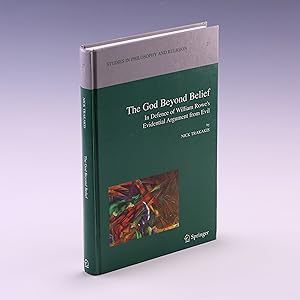
9781402051449 - the god beyond belief: in defence of william rowe's evidential argument from evil (studies in philosophy and religion, 27, band 27) von trakakis, nick (3 Ergebnisse)
 Weitere Bilder
- Hardcover
Anbieter: Salish Sea Books, Bellingham, WA, USASalish Sea Books
Verkäufer/-in kontaktierenVerkäufer/-in mit 5 SternenZustand: Gebraucht - Befriedigend
EUR 112,51
EUR 4,36 VersandVersand innerhalb von USAAnzahl: 1 verfügbar
Zustand: Good. Good+; Hardcover; Covers are still glossy, but with a few scratches to the back cover; Unblemished textblock edges; The endpapers and all text pages are clean and unmarked; The binding is excellent with a straight spine; This book will be stored and delivered in a sturdy cardboard box with foam padding; Medium For…mat (8.5" - 9.75" tall); Dark green and gray covers with title in white lettering; 2006, Springer-Verlag Publishing; 376 pages; "The God Beyond Belief: In Defence of William Rowe's Evidential Argument from Evil (Studies in Philosophy and Religion)," by Nick Trakakis.

- Hardcover
Anbieter: Ria Christie Collections, Uxbridge, Vereinigtes KönigreichRia Christie Collections
Verkäufer/-in kontaktierenVerkäufer/-in mit 5 SternenZustand: Neu
EUR 165,72
EUR 13,98 VersandVersand von Vereinigtes Königreich nach USAAnzahl: Mehr als 20 verfügbar
Zustand: New. In.

- Hardcover
Anbieter: AHA-BUCH GmbH, Einbeck, DeutschlandAHA-BUCH GmbH
Verkäufer/-in kontaktierenVerkäufer/-in mit 5 SternenZustand: Neu
EUR 168,73
EUR 64,19 VersandVersand von Deutschland nach USAAnzahl: 2 verfügbar
Buch. Zustand: Neu. Druck auf Anfrage Neuware - Printed after ordering - For quite some time I have corresponded with Nick Trakakis, a very t- ented young philosopher at Monash University in Australia. He was c- pleting a manuscript on the problem of evil. Although we've never met, I've come to greatly admire his philosophical a…bility, even, or I hope particularly, when he notes weaknesses, if not outright mistakes, in my own writings on this topic. His knowledge of the relevant literature is nothing short of extraordinary. I am deeply impressed by the clarity and quality of his wr- ing, his measured judgments, as well as his philosophical ability. In this volume Trakakis begins with my 1979 paper, 'The Problem of Evil and Some Varieties of Atheism,' sets forth the evidential argument from evil, and considers the large body of literature developed in response to that argument. He examines and evaluates with great care the objections raised by Wykstra, Howard-Snyder, Durston,Alston, and others, along with my responses to those forceful objections. Noting the importance of the assumption that if there are God-justifying goods for horrendous human and animal suffering then it is likely that humans would have some awareness of what those justifying goods might be, Trakakis carefully evaluates the lit- ature bearing on this crucial issue, including, of course, the significance of what is commonly known as the problem of divine hiddenness, and the line of response proposed by the sceptical theists - philosophers who are theists but sceptical of arguments against theism.


