

Gesamtpreis (1 Artikel Artikel):
Versandziel:

9780898382556 - Integrated Natural Language Dialogue: A Computational Model (The Springer International Series in Engineering and Computer Science, 41, Band 41) von Frederking, Rob... (6 Ergebnisse)
Direkt zu den wichtigsten Suchergebnissen
Suchfilter
Produktart
- Alle Product Types
- Bücher (6)
- Magazine & Zeitschriften (Keine weiteren Ergebnisse entsprechen dieser Verfeinerung)
- Comics (Keine weiteren Ergebnisse entsprechen dieser Verfeinerung)
- Noten (Keine weiteren Ergebnisse entsprechen dieser Verfeinerung)
- Kunst, Grafik & Poster (Keine weiteren Ergebnisse entsprechen dieser Verfeinerung)
- Fotografien (Keine weiteren Ergebnisse entsprechen dieser Verfeinerung)
- Karten (Keine weiteren Ergebnisse entsprechen dieser Verfeinerung)
- Manuskripte & Papierantiquitäten (Keine weiteren Ergebnisse entsprechen dieser Verfeinerung)
Zustand Mehr dazu
- Neu (4)
- Wie Neu, Sehr Gut oder Gut Bis Sehr Gut (1)
- Gut oder Befriedigend (1)
- Ausreichend oder Schlecht (Keine weiteren Ergebnisse entsprechen dieser Verfeinerung)
- Wie beschrieben (Keine weiteren Ergebnisse entsprechen dieser Verfeinerung)
Einband
- alle Einbände
- Hardcover (6)
- Softcover (Keine weiteren Ergebnisse entsprechen dieser Verfeinerung)
Weitere Eigenschaften
- Erstausgabe (Keine weiteren Ergebnisse entsprechen dieser Verfeinerung)
- Signiert (Keine weiteren Ergebnisse entsprechen dieser Verfeinerung)
- Schutzumschlag (Keine weiteren Ergebnisse entsprechen dieser Verfeinerung)
- Angebotsfoto (3)
Sprache (1)
Gratisversand
- Kostenloser Versand nach USA (Keine weiteren Ergebnisse entsprechen dieser Verfeinerung)
Land des Verkäufers
Verkäuferbewertung
-

Integrated Natural Language Dialogue: A Computational Model
Sprache: Englisch
Verlag: Kluwer Academic Publishers, 1987
ISBN 10: 0898382556 ISBN 13: 9780898382556
Hardcover. Zustand: Très bon. Ancien livre de bibliothèque. Edition 1987. Ammareal reverse jusqu'à 15% du prix net de cet article à des organisations caritatives. ENGLISH DESCRIPTION Book Condition: Used, Very good. Former library book. Edition 1987. Ammareal gives back up to 15% of this item's net price to charity organizations.
-
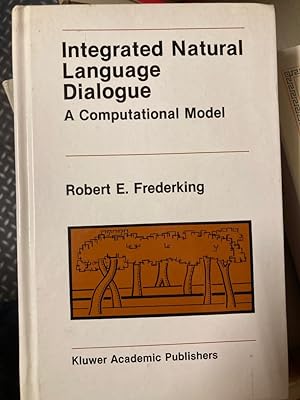
Integrated Natural Language Dialogue: A Computational Model.
Anbieter: Plurabelle Books Ltd, Cambridge, Vereinigtes Königreich
Verbandsmitglied: GIAQ
Verkäuferbewertung 5 von 5 Sternen

EUR 16,70
EUR 9,26 Versand
Versand von Vereinigtes Königreich nach USAAnzahl: 1 verfügbar
In den WarenkorbHardcover. Zustand: Very Good. xvii 178p hardback, index and bibliography, clean unmarked pages, a clean and fresh copy Language: English.
-
Integrated Natural Language Dialogue: A Computational Model (The Springer International Series in Engineering and Computer Science, 41)
Anbieter: Ria Christie Collections, Uxbridge, Vereinigtes Königreich
Verkäuferbewertung 5 von 5 Sternen
EUR 164,39
EUR 13,87 Versand
Versand von Vereinigtes Königreich nach USAAnzahl: Mehr als 20 verfügbar
In den WarenkorbZustand: New. In.
-

EUR 180,46
EUR 48,99 Versand
Versand von Deutschland nach USAAnzahl: Mehr als 20 verfügbar
In den WarenkorbGebunden. Zustand: New. Natural language dialogue is a continuous, unified phenomenon. Speakers use their conversational context to simplify individual utterances through a number of linguistic devices, including ellipsis and definite references. Yet most computational systems for.
-
Integrated Natural Language Dialogue
Sprache: Englisch
Verlag: Kluwer Academic Publishers, 1987
ISBN 10: 0898382556 ISBN 13: 9780898382556
Anbieter: Kennys Bookstore, Olney, MD, USA
Verkäuferbewertung 5 von 5 Sternen
Zustand: New. Series: The Springer International Series in Engineering and Computer Science. Num Pages: 180 pages, biography. BIC Classification: UYQL. Category: (P) Professional & Vocational; (UP) Postgraduate, Research & Scholarly. Dimension: 234 x 156 x 12. Weight in Grams: 1030. . 1987. Hardback. . . . . Books ship from the US and Ireland.
-

Integrated Natural Language Dialogue : A Computational Model
Anbieter: AHA-BUCH GmbH, Einbeck, Deutschland
Verkäuferbewertung 5 von 5 Sternen
Buch. Zustand: Neu. Neuware - Natural language dialogue is a continuous, unified phenomenon. Speakers use their conversational context to simplify individual utterances through a number of linguistic devices, including ellipsis and definite references. Yet most computational systems for using natural language treat individual utterances as separate entities, and have distinctly separate processes for handling ellipsis, definite references, and other dialogue phenomena. This book, a slightly revised version of the Ph. D. dissertation that I completed in December 1986, describes a different approach. It presents a computational system, Psli3, that uses the uniform framework of a production system architecture to carry out natural language understanding and generation in a well-integrated way. This is demonstrated primarily through intersentential ellipsis resolution, in addition to examples of definite reference resolution and interactive error correction. The system's conversational context arises naturally as the result of the persistence of the internal representations of previous utterances in working memory. Natural language input is interpreted within this framework using a modification of the syntactic technique of chart parsing, extended to include semantics, and adapted to the production system architecture. This technique, called semantic chart parsing, provides a graceful way of handling ambiguity within this architecture, and allows separate knowledge sources to interact smoothly across different utterances in a highly integrated fashion. xvi Integrated Natural Language Dialogue The design of this system demonstrates how flexible and natural user interactions can be carried out using a system with a naturally flexible control structure.
