

Gesamtpreis (1 Artikel Artikel):
Versandziel:

9780865981065 - Risks of Unintentional Nuclear War von Frei, Daniel (2 Ergebnisse)
Direkt zu den wichtigsten Suchergebnissen
Suchfilter
Produktart
- Alle Product Types
- Bücher (2)
- Magazine & Zeitschriften (Keine weiteren Ergebnisse entsprechen dieser Verfeinerung)
- Comics (Keine weiteren Ergebnisse entsprechen dieser Verfeinerung)
- Noten (Keine weiteren Ergebnisse entsprechen dieser Verfeinerung)
- Kunst, Grafik & Poster (Keine weiteren Ergebnisse entsprechen dieser Verfeinerung)
- Fotografien (Keine weiteren Ergebnisse entsprechen dieser Verfeinerung)
- Karten (Keine weiteren Ergebnisse entsprechen dieser Verfeinerung)
- Manuskripte & Papierantiquitäten (Keine weiteren Ergebnisse entsprechen dieser Verfeinerung)
Zustand Mehr dazu
- Neu (Keine weiteren Ergebnisse entsprechen dieser Verfeinerung)
- Wie Neu, Sehr Gut oder Gut Bis Sehr Gut (Keine weiteren Ergebnisse entsprechen dieser Verfeinerung)
- Gut oder Befriedigend (2)
- Ausreichend oder Schlecht (Keine weiteren Ergebnisse entsprechen dieser Verfeinerung)
- Wie beschrieben (Keine weiteren Ergebnisse entsprechen dieser Verfeinerung)
Einband
Weitere Eigenschaften
- Erstausgabe (1)
- Signiert (Keine weiteren Ergebnisse entsprechen dieser Verfeinerung)
- Schutzumschlag (Keine weiteren Ergebnisse entsprechen dieser Verfeinerung)
- Angebotsfoto (Keine weiteren Ergebnisse entsprechen dieser Verfeinerung)
Sprache (1)
Preis
- Beliebiger Preis
- Weniger als EUR 20
- EUR 20 bis EUR 40
- Mehr als EUR 40 (Keine weiteren Ergebnisse entsprechen dieser Verfeinerung)
Gratisversand
- Kostenloser Versand nach USA (Keine weiteren Ergebnisse entsprechen dieser Verfeinerung)
Land des Verkäufers
Verkäuferbewertung
-
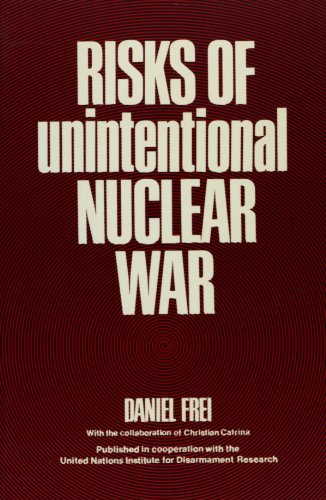
Risks of Unintentional Nuclear War
Anbieter: Orbiting Books, Hereford, Vereinigtes Königreich
Verkäuferbewertung 5 von 5 Sternen

EUR 17,90
EUR 13,72 Versand
Versand von Vereinigtes Königreich nach USAAnzahl: 1 verfügbar
In den Warenkorbhardcover. Zustand: Very Good. Appears unread, may have minor damage from transit/storage. Next day dispatch from the UK (Mon-Fri). Please contact us with any queries.
-
Risks of Unintentional Nuclear War
Sprache: Englisch
Verlag: Allanheld, Osmun Publishers, Croom Helm--London, 1983
ISBN 10: 086598106X ISBN 13: 9780865981065
Anbieter: Ground Zero Books, Ltd., Silver Spring, MD, USA
Verkäuferbewertung 4 von 5 Sternen

Erstausgabe
Trade paperback. Zustand: Very good. First Printing [Stated]. xxxi, [1], 255, [1] pages. Glossary. Illustrations. Bibliography. Cover has slight wear and soiling. Pencil erasure residue on half title. Published in cooperation with the United Nations Institute for Disarmament Research. This study sets out to analyze one of the most disquieting and controversial aspects of the current arms race. The risk of unintentional nuclear war is being assessed differently according to the which in which this phenomena is conceived. The threat of unintentional nuclear wear, and of an inadvertent nuclear global holocaust arising therefrom, has been felt from the very beginning of the modern strategic system. Nuclear warfare (sometimes atomic warfare or thermonuclear warfare) is a military conflict or political strategy in which nuclear weaponry is used to inflict damage on the enemy. Nuclear weapons are weapons of mass destruction; in contrast to conventional warfare, nuclear warfare can produce destruction in a much shorter timeframe and can have a long-lasting radiological warfare dimension. A major nuclear exchange would have long-term effects, primarily from the fallout released, and could also lead to a "nuclear winter" that could last for decades, centuries, or even millennia after the initial attack. Some activists had claimed in the 1980s that with this potential nuclear winter side-effect of a nuclear war, almost every human on Earth could starve to death. However analysts, who dismiss the nuclear winter hypothesis, calculate that with nuclear weapon stockpiles at Cold War highs, in a surprise countervalue global nuclear war, billions of casualties would have resulted in the nuclear holocaust with billions of more rural people, nevertheless surviving. So far, two nuclear weapons have been used in the course of warfare, both by the United States near the end of World War II. On August 6, 1945, a uranium gun-type device (code name "Little Boy") was detonated over the Japanese city of Hiroshima. Three days later, on August 9, a plutonium implosion-type device (code name "Fat Man") was detonated over the Japanese city of Nagasaki. These two bombings resulted in the deaths of approximately 120,000 people. After World War II, nuclear weapons were also developed by the Soviet Union (1949), the United Kingdom (1952), France (1960), and the People's Republic of China (1964), which contributed to the state of conflict and extreme tension that became known as the Cold War. In 1974, India, and in 1998, Pakistan, two countries that were openly hostile toward each other, developed nuclear weapons. Israel (1960s) and North Korea (2006) are also thought to have developed stocks of nuclear weapons, though it is not known how many. The Israeli government has never admitted to having nuclear weapons, although it is known to have constructed the reactor and reprocessing plant necessary for building nuclear weapons. South Africa also manufactured several complete nuclear weapons in the 1980s, but subsequently became the first country to voluntarily destroy their domestically made weapons stocks and abandon further production (1990s). Nuclear weapons have been detonated on over 2,000 occasions for testing purposes and demonstrations. After the collapse of the Soviet Union in 1991 and the resultant end of the Cold War, the threat of a major nuclear war between the two nuclear superpowers was generally thought to have declined. Since then, concern over nuclear weapons has shifted to the prevention of localized nuclear conflicts resulting from nuclear proliferation, and the threat of nuclear terrorism.

