

Gesamtpreis (1 Artikel Artikel):
Versandziel:

9780804789677 - Incest Avoidance and the Incest Taboos: Two Aspects of Human Nature von Wolf, Arthur P. (7 Ergebnisse)
Direkt zu den wichtigsten Suchergebnissen
Suchfilter
Produktart
- Alle Product Types
- Bücher (7)
- Magazine & Zeitschriften (Keine weiteren Ergebnisse entsprechen dieser Verfeinerung)
- Comics (Keine weiteren Ergebnisse entsprechen dieser Verfeinerung)
- Noten (Keine weiteren Ergebnisse entsprechen dieser Verfeinerung)
- Kunst, Grafik & Poster (Keine weiteren Ergebnisse entsprechen dieser Verfeinerung)
- Fotografien (Keine weiteren Ergebnisse entsprechen dieser Verfeinerung)
- Karten (Keine weiteren Ergebnisse entsprechen dieser Verfeinerung)
- Manuskripte & Papierantiquitäten (Keine weiteren Ergebnisse entsprechen dieser Verfeinerung)
Zustand Mehr dazu
- Neu (5)
- Wie Neu, Sehr Gut oder Gut Bis Sehr Gut (Keine weiteren Ergebnisse entsprechen dieser Verfeinerung)
- Gut oder Befriedigend (1)
- Ausreichend oder Schlecht (Keine weiteren Ergebnisse entsprechen dieser Verfeinerung)
- Wie beschrieben (1)
Einband
- alle Einbände
- Hardcover (Keine weiteren Ergebnisse entsprechen dieser Verfeinerung)
- Softcover (7)
Weitere Eigenschaften
- Erstausgabe (Keine weiteren Ergebnisse entsprechen dieser Verfeinerung)
- Signiert (Keine weiteren Ergebnisse entsprechen dieser Verfeinerung)
- Schutzumschlag (Keine weiteren Ergebnisse entsprechen dieser Verfeinerung)
- Angebotsfoto (2)
Sprache (1)
Preis
- Beliebiger Preis
- Weniger als EUR 20
- EUR 20 bis EUR 40
- Mehr als EUR 40 (Keine weiteren Ergebnisse entsprechen dieser Verfeinerung)
Gratisversand
- Kostenloser Versand nach USA (Keine weiteren Ergebnisse entsprechen dieser Verfeinerung)
Land des Verkäufers
Verkäuferbewertung
-
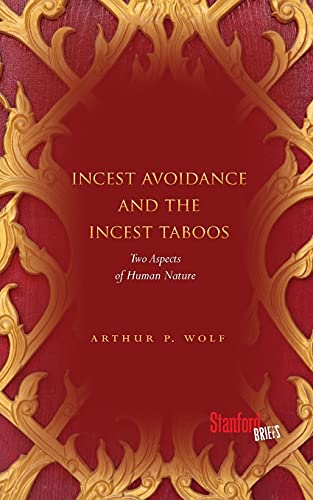
Incest Avoidance and the Incest Taboos: Two Aspect
Sprache: Englisch
Verlag: Stanford University Press, 2014
ISBN 10: 0804789673 ISBN 13: 9780804789677
Anbieter: N. Fagin Books, Chicago, IL, USA
Verkäuferbewertung 4 von 5 Sternen

2014. Anthropological theory and method. Stanford Briefs/Standford University Press. Very good - bear fine paperback 177p.
-
Incest Avoidance and the Incest Taboos: Two Aspects of Human Nature
Sprache: Englisch
Verlag: Stanford University Press, 2014
ISBN 10: 0804789673 ISBN 13: 9780804789677
Anbieter: WorldofBooks, Goring-By-Sea, WS, Vereinigtes Königreich
Verkäuferbewertung 5 von 5 Sternen

EUR 7,09
EUR 6,42 Versand
Versand von Vereinigtes Königreich nach USAAnzahl: 1 verfügbar
In den WarenkorbPaperback. Zustand: Very Good. The book has been read, but is in excellent condition. Pages are intact and not marred by notes or highlighting. The spine remains undamaged.
-
Incest Avoidance and the Incest Taboos
Sprache: Englisch
Verlag: Stanford University Press, 2014
ISBN 10: 0804789673 ISBN 13: 9780804789677
Anbieter: Majestic Books, Hounslow, Vereinigtes Königreich
Verkäuferbewertung 4 von 5 Sternen
EUR 17,31
EUR 7,45 Versand
Versand von Vereinigtes Königreich nach USAAnzahl: 3 verfügbar
In den WarenkorbZustand: New. pp. 188.
-
Incest Avoidance and the Incest Taboos: Two Aspects of Human Nature
Sprache: Englisch
Verlag: Stanford University Press, 2014
ISBN 10: 0804789673 ISBN 13: 9780804789677
Anbieter: Kennys Bookstore, Olney, MD, USA
Verkäuferbewertung 4 von 5 Sternen
Zustand: New. Num Pages: 188 pages. BIC Classification: JHBT. Category: (G) General (US: Trade). Dimension: 5182 x 3226 x 14. Weight in Grams: 218. . 2014. Paperback. . . . . Books ship from the US and Ireland.
-
Incest Avoidance and the Incest Taboos Two Aspects of Human Nature
Anbieter: Revaluation Books, Exeter, Vereinigtes Königreich
Verkäuferbewertung 5 von 5 Sternen
EUR 21,73
EUR 11,47 Versand
Versand von Vereinigtes Königreich nach USAAnzahl: 2 verfügbar
In den WarenkorbPaperback. Zustand: Brand New. 1st edition. 187 pages. 8.00x5.00x0.50 inches. In Stock.
-

EUR 20,47
EUR 48,99 Versand
Versand von Deutschland nach USAAnzahl: Mehr als 20 verfügbar
In den WarenkorbKartoniert / Broschiert. Zustand: New. Über den AutorrnrnArthur P. Wolf is the David and Lucile Packard Professor of Human Biology at Stanford University, and author or editor of numerous books and articles, including Sexual Attraction and Childhood Association: A Chinese Bri.
-

Incest Avoidance and the Incest Taboos : Two Aspects of Human Nature
Sprache: Englisch
Verlag: Stanford University Press Apr 2014, 2014
ISBN 10: 0804789673 ISBN 13: 9780804789677
Anbieter: AHA-BUCH GmbH, Einbeck, Deutschland
Verkäuferbewertung 5 von 5 Sternen
Taschenbuch. Zustand: Neu. Neuware - Why do most people never have sex with close relatives And why do they disapprove of other people doing so Incest Avoidance and Incest Taboos investigates our human inclination to avoid incest and the powerful taboo against incest found in all societies. Both subjects stir strong feelings and vigorous arguments within and beyond academic circles. With great clarity, Wolf lays out the modern assumptions about both, concluding that all previous approaches lack precision and balance on insecure evidence. Researchers he calls 'constitutionalists' explain human incest avoidance by biologically-based natural aversion, but fail to explain incest taboos as cultural universals. By contrast, 'conventionalists' ignore the evolutionary roots of avoidance and assume that incest avoidant behavior is guided solely by cultural taboos. Both theories are incomplete.

