

Gesamtpreis (1 Artikel Artikel):
Versandziel:

9780804751155 - A Return to Aesthetics: Autonomy, Indifference, and Postmodernism von Loesberg, Jonathan (5 Ergebnisse)
Direkt zu den wichtigsten Suchergebnissen
Suchfilter
Produktart
- Alle Product Types
- Bücher (5)
- Magazine & Zeitschriften (Keine weiteren Ergebnisse entsprechen dieser Verfeinerung)
- Comics (Keine weiteren Ergebnisse entsprechen dieser Verfeinerung)
- Noten (Keine weiteren Ergebnisse entsprechen dieser Verfeinerung)
- Kunst, Grafik & Poster (Keine weiteren Ergebnisse entsprechen dieser Verfeinerung)
- Fotografien (Keine weiteren Ergebnisse entsprechen dieser Verfeinerung)
- Karten (Keine weiteren Ergebnisse entsprechen dieser Verfeinerung)
- Manuskripte & Papierantiquitäten (Keine weiteren Ergebnisse entsprechen dieser Verfeinerung)
Zustand Mehr dazu
- Neu (5)
- Wie Neu, Sehr Gut oder Gut Bis Sehr Gut (Keine weiteren Ergebnisse entsprechen dieser Verfeinerung)
- Gut oder Befriedigend (Keine weiteren Ergebnisse entsprechen dieser Verfeinerung)
- Ausreichend oder Schlecht (Keine weiteren Ergebnisse entsprechen dieser Verfeinerung)
- Wie beschrieben (Keine weiteren Ergebnisse entsprechen dieser Verfeinerung)
Einband
- alle Einbände
- Hardcover (5)
- Softcover (Keine weiteren Ergebnisse entsprechen dieser Verfeinerung)
Weitere Eigenschaften
- Erstausgabe (Keine weiteren Ergebnisse entsprechen dieser Verfeinerung)
- Signiert (Keine weiteren Ergebnisse entsprechen dieser Verfeinerung)
- Schutzumschlag (Keine weiteren Ergebnisse entsprechen dieser Verfeinerung)
- Angebotsfoto (2)
Sprache (1)
Preis
- Beliebiger Preis
- Weniger als EUR 20 (Keine weiteren Ergebnisse entsprechen dieser Verfeinerung)
- EUR 20 bis EUR 45 (Keine weiteren Ergebnisse entsprechen dieser Verfeinerung)
- Mehr als EUR 45
Gratisversand
- Kostenloser Versand nach USA (Keine weiteren Ergebnisse entsprechen dieser Verfeinerung)
Land des Verkäufers
Verkäuferbewertung
-

A Return to Aesthetics
Sprache: Englisch
Verlag: MK - Stanford University Press, 2005
ISBN 10: 0804751153 ISBN 13: 9780804751155
Anbieter: PBShop.store UK, Fairford, GLOS, Vereinigtes Königreich
Verkäuferbewertung 5 von 5 Sternen

EUR 138,72
EUR 5,81 Versand
Versand von Vereinigtes Königreich nach USAAnzahl: 1 verfügbar
In den WarenkorbHRD. Zustand: New. New Book. Shipped from UK. Established seller since 2000.
-
A Return to Aesthetics: Autonomy, Indifference, and Postmodernism
Sprache: Englisch
Verlag: Stanford University Press, 2005
ISBN 10: 0804751153 ISBN 13: 9780804751155
Anbieter: Kennys Bookstore, Olney, MD, USA
Verkäuferbewertung 5 von 5 Sternen
Zustand: New. A Return to Aesthetics confronts postmodernism's rejection of aesthetics by showing that this critique rests on central concepts of classical aesthetic theory, namely autonomous form, disinterest, and symbolic discourse. Num Pages: 304 pages, Illustrations. BIC Classification: HPN. Category: (P) Professional & Vocational; (UP) Postgraduate, Research & Scholarly; (UU) Undergraduate. Dimension: 5817 x 3887 x 22. Weight in Grams: 517. . 2005. Hardback. . . . . Books ship from the US and Ireland.
-
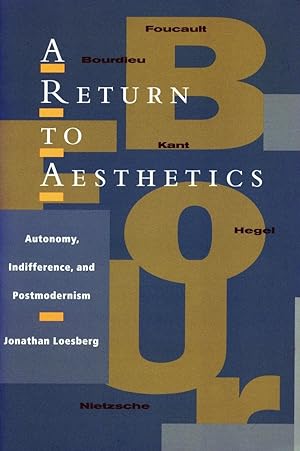
Loesberg, J: A Return to Aesthetics
Sprache: Englisch
Verlag: Stanford University Press, 2005
ISBN 10: 0804751153 ISBN 13: 9780804751155
EUR 143,99
EUR 48,99 Versand
Versand von Deutschland nach USAAnzahl: Mehr als 20 verfügbar
In den WarenkorbGebunden. Zustand: New. A Return to Aesthetics confronts postmodernism s rejection of aesthetics by showing that this critique rests on central concepts of classical aesthetic theory, namely autonomous form, disinterest, and symbolic discourse.Über den Autor.
-
A Return to Aesthetics Autonomy, Indifference, and Postmodernism
Anbieter: Revaluation Books, Exeter, Vereinigtes Königreich
Verkäuferbewertung 5 von 5 Sternen
EUR 190,05
EUR 14,47 Versand
Versand von Vereinigtes Königreich nach USAAnzahl: 2 verfügbar
In den WarenkorbHardcover. Zustand: Brand New. 1st edition. 289 pages. 9.00x6.00x0.75 inches. In Stock.
-

A Return to Aesthetics : Autonomy, Indifference, and Postmodernism
Sprache: Englisch
Verlag: Stanford University Press Jul 2005, 2005
ISBN 10: 0804751153 ISBN 13: 9780804751155
Anbieter: AHA-BUCH GmbH, Einbeck, Deutschland
Verkäuferbewertung 5 von 5 Sternen
Buch. Zustand: Neu. Neuware - A Return to Aesthetics confronts postmodernism's rejection of aesthetics by showing that this critique rests on central concepts of classical aesthetic theory, namely autonomous form, disinterest, and symbolic discourse. The author argues for the value of these concepts by recovering them through a historical reinterpretation of their meaning prior to their distortion by twentieth-century formalism. Loesberg then applies these concepts to a discussion of two of the most significant critics of the ideology of Enlightenment, Foucault and Bourdieu. He argues that understanding the role of aesthetics in the postmodern critique of Enlightenment will get us out of the intellectual impasse wherein numbingly repeated attacks upon postmodernism as self-contradictory match numbingly repeated defenses. Construing postmodern critiques as examples of aesthetic reseeing gives us a new understanding of the postmodern critique of the Enlightenment.
